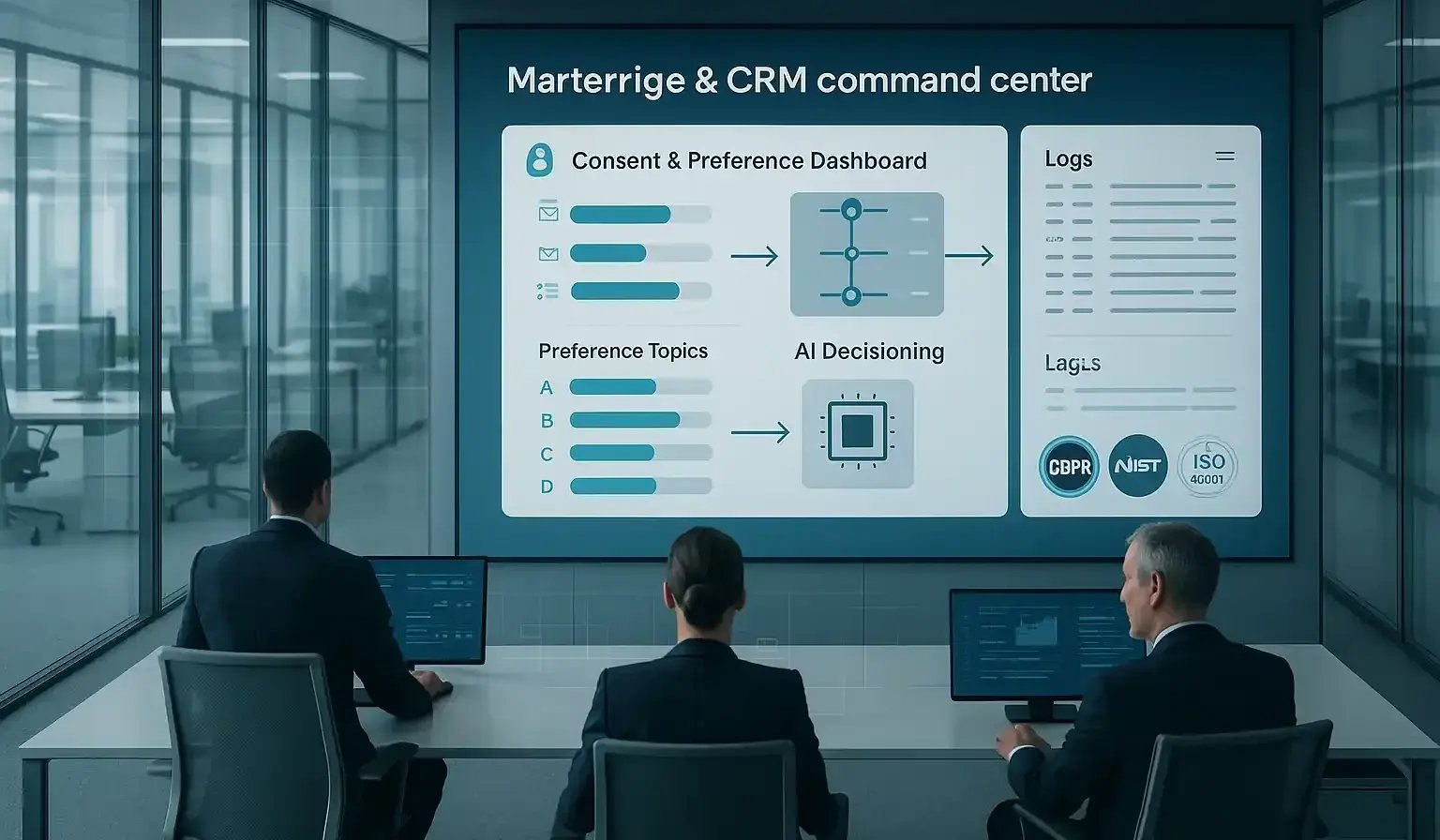
Design CRM actions that are timely, compliant, and provably valuable.
Why consent-first decisioning beats clever prompts
Speed without consent is a liability—and a missed performance opportunity. Many teams try to personalize CRM outreach by layering prompts on top of messy data and hoping tone alone carries the day. The result is inconsistent timing, compliance risk, and buyer fatigue. Consent‑aware decisioning flips the script: you design actions around moments that change outcomes (onboarding milestones, service recovery, renewal windows) and enforce permission, minimization, and explainability by default.
Start with the journey, not the channel. Enumerate decision nodes where a timely action plausibly moves a KPI—time‑to‑value, first‑contact resolution, renewal rate, expansion. For each node, define the minimal context bundle needed (e.g., plan tier, last interaction, usage trend break), the lawful basis, frequency caps, and human‑in‑the‑loop thresholds.
Treat consent and preference as runtime controls evaluated at activation, not buried in a form from months ago. Independent research shows leaders who activate real‑time decisions on unified profiles outperform on revenue and loyalty; see Adobe & Forrester.
Microsoft’s guidance underscores that cloud‑native pipelines and privacy‑by‑design are prerequisites for scale, not an afterthought; see Microsoft. Compliance frameworks provide the grammar of trust: the NIST AI RMF for lifecycle risk and GDPR Article 6 for lawful basis.
When customers can see and control how their data is used—and when teams can explain why an action fired—response rates rise and complaint risk falls.
Data, policy, and minimal-context decision services
Turn principles into an architecture your CRM can operate. Separate systems of record (CRM, product, billing, support) from a consent‑aware profile layer that exposes only what a decision needs. Stream events (login, feature milestones, support ticket updates, contract changes) with schemas, lineage, and freshness SLAs.
Tag data with purpose, residency, and retention so policy checks are automatable. Above this, run a decision service that evaluates consent and eligibility, chooses an action (message, task, escalation), and writes an immutable decision log. Resist “ML everywhere.”
Rules plus guardrails handle many nodes—renewal reminders at day 90, service recovery on negative CSAT, onboarding nudges when a milestone stalls—while selective models add value for complex surfaces (propensity to act, uplift for expensive interventions, eligibility).
Retrieval boundaries enforce minimization; allow/deny lists confine actions to approved scopes. Observability makes this safe to scale: trace from event to action and monitor golden signals (latency, error, saturation, throughput) alongside business KPIs; see Splunk.
For deployment, adopt progressive delivery patterns—feature flags, blue/green and canary releases—to test changes under live traffic without surprises; a clear primer is HashiCorp.
Operating model, metrics, and trust by design
Operate consent‑aware decisioning like a product with finance and risk at the table. Define outcome metrics and counterfactuals per node (incremental revenue, cost‑to‑serve reduction, NRR lift, NPS change) and pre‑set payback targets.
Favor randomized control where feasible; otherwise, use quasi‑experiments (matched cohorts, difference‑in‑differences) with stop‑loss thresholds and instant rollback. Publish weekly experiment readouts and monthly value realization reviews that reconcile lift with costs (integration, inference, governance).
Make trust visible: preference centers that work, clear explanations of why a message was sent, and easy opt‑outs. Align operations to the NIST AI RMF Playbook and consider running under an auditable AI management system such as ISO/IEC 42001; see a practical overview at ISMS.online.
For MapleSage’s ICPs—SaaS, insurance, and retail—good first wins include: day‑3 claim status transparency to cut inbound calls, onboarding milestone nudges to accelerate time‑to‑value, and renewal window experiences that pair benefits checks with account‑specific guidance. With consent‑aware data, a rules‑first decision layer, and an experiment‑first culture, CRM stops broadcasting and starts helping—on time, in bounds, and provably valuable.