A pragmatic blueprint to add AI agents safely with uptime and ROI.
Where agents fit in enterprise architectures
Enterprises don’t fail at AI because the idea is weak; they fail because the integration is. Most organizations already run a patchwork of CRMs, ERPs, policy or billing cores, data warehouses, and messaging platforms—plus pockets of RPA and scripts.
The question is not “Can we add AI agents?” but “Where do they add judgment without destabilizing what works?” The sweet spot is decision nodes that strain rule‑only automation: triaging ambiguous requests, summarizing documents and notes into structured signals, choosing among actions when policy and context matter, and assembling context packs for humans in the loop. Keep deterministic RPA where variance is low (form fills, reconciliations, lookups) and place agents where perception and selective reasoning raise throughput or quality.
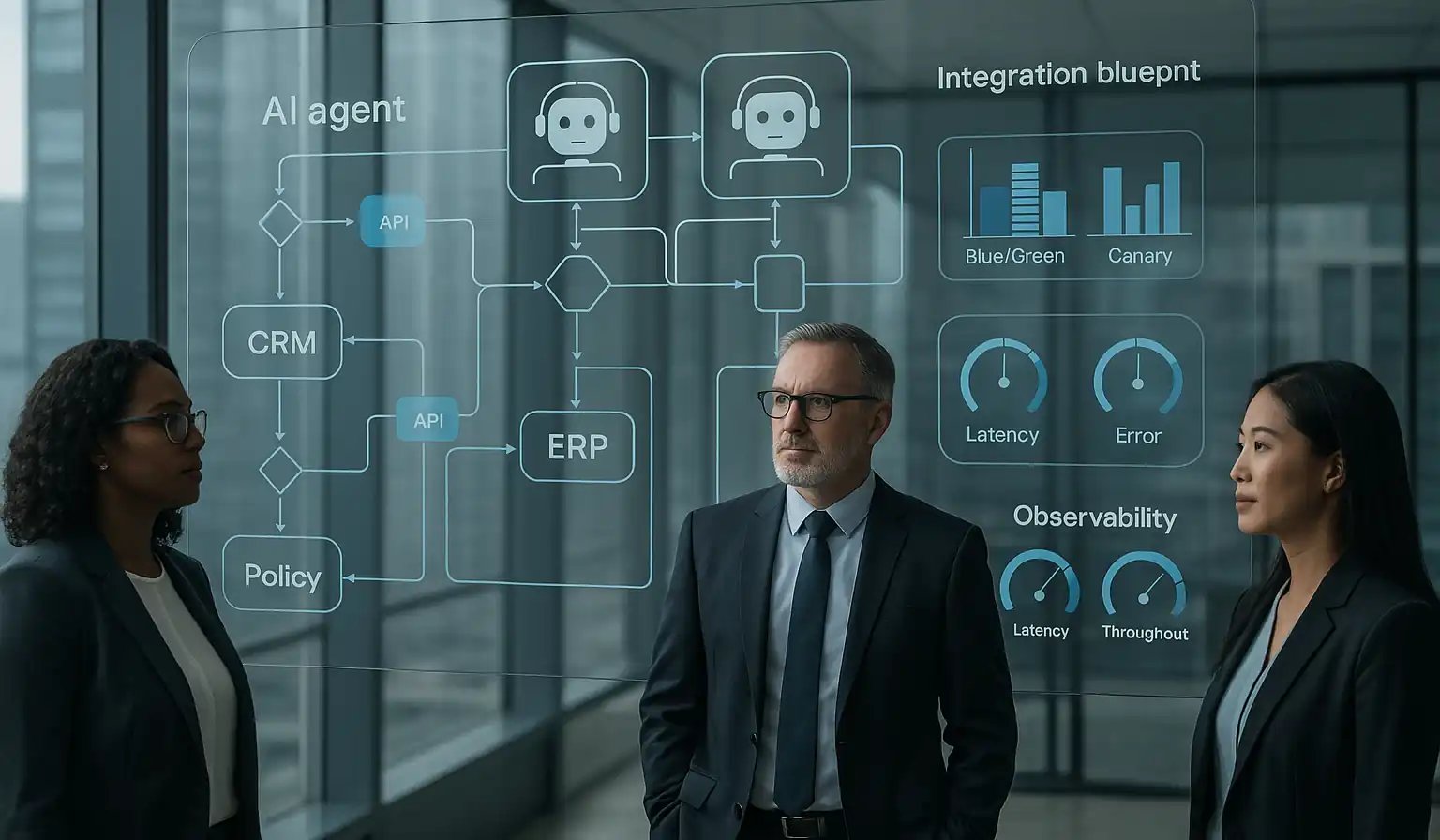
Architecturally, treat an agent like a microservice with versioned APIs, scoped credentials, and clear responsibilities: perceive (retrieve and interpret minimal context), decide (apply rules + selective models), act (execute an allowed next step), and log (immutable decision trail).
Decouple agents from brittle point‑to‑point wiring using an orchestration layer that mediates authentication, retrieval boundaries, idempotency, retries, and circuit breakers. This isolates change, enables shadow mode, and lets you scale traffic gradually. Start with a portfolio view: inventory candidate workflows, segment by variance and risk, and define what “good” looks like (cycle time, accuracy, cost‑to‑serve, NPS/NRR).
Then align stakeholders on a staircase roadmap: shadow → supervised → narrow autonomy within guardrails. Throughout, insist on consent‑aware retrieval (only the fields needed for the decision), explainable actions, and human override where stakes are high (pricing, renewals, adjudication). Done well, agents become force multipliers for Ops, CS, and revenue teams—without compromising trust or uptime.
Safety rails: deployment, observability, governance
Uptime and trust hinge on three safety rails: deployment discipline, observability, and governance. First, treat any new behavior—scoring logic, prompt, tool use—as a deployable artifact with a rollback plan. Progressive delivery patterns reduce blast radius: blue/green, canary, and feature flags allow safe validation under live traffic; see HashiCorp and Harness for approachable primers.
Second, “if you can’t see it, you can’t scale it.” Instrument the full path from trigger to action with distributed tracing, structured logs, and golden signals—latency, error, saturation, and throughput—paired with business KPIs so product, ops, and finance share one scoreboard; a leader‑friendly overview is Splunk.
Track cost, too (e.g., token spend, approval rate, human overrides). Third, governance must accelerate—not block—delivery. Map lifecycle controls to the NIST AI RMF, enforce least‑privilege access and allow/deny lists for systems, fields, and actions, and implement retrieval boundaries so agents fetch only minimal context.
Keep immutable decision logs that capture inputs, retrieved evidence, policies applied, and outcomes; these logs power audits, root‑cause analysis, and optimization.
Finally, embed privacy by design: consent and purpose checks at activation, PII minimization, and region‑aware data residency. This combination—progressive delivery, deep telemetry, policy‑driven access—lets you move fast without breaking fundamentals.
A phased rollout and ROI measurement playbook
A repeatable rollout converts promise into proof. Phase 1 (Shadow): agents read and recommend but do not act. Benchmark recommendations against current outcomes to calibrate accuracy, latency, and cost; publish weekly readouts. Phase 2 (Supervised): enable a narrow set of low‑risk actions behind feature flags for small canary cohorts with stop‑loss thresholds and instant rollback.
Measure business SLAs: cycle‑time reduction, error rate deltas, CSAT/NRR lift. Phase 3 (Narrow Autonomy): expand to repetitive, mid‑value actions with clear policies and human‑in‑the‑loop for exceptions. Throughout, run controlled experiments where feasible; otherwise use quasi‑experimental designs (matched cohorts, difference‑in‑differences) to attribute lift at the journey node (e.g., “day‑3 claim status update,” “onboarding blocker cleared”).
Maintain a CFO‑ready value dashboard that reconciles incremental lift with costs (integration, inference, oversight). Socialize an operating model: a cross‑functional council (business owner, data/ML, security, legal) approves new decision nodes and risk tiers; model cards and release notes document changes.
For MapleSage’s ICPs—insurance, SaaS, and retail—good first targets include claims transparency and routing, churn‑risk outreach with context packs, and inventory‑aware service recovery. With a portfolio lens, progressive delivery, and auditable decisions, enterprises integrate agents that compound value—without risking uptime or compliance.