A field guide to cut underwriting time by half with ACORD and explainable AI.
Standardize intake and ACORD to unlock reliable data
Underwriting teams are drowning in documents while brokers want faster answers. The path forward is not to replace underwriters, but to give them a workbench that standardizes intake, extracts facts reliably, and surfaces the right context at the right moment.
Start by eliminating variability at the front door. Use ACORD‑aligned forms in portals and broker submissions to capture consistent data, and validate at the edge to reduce back‑and‑forth (e.g., address normalization, required fields by line, date sanity checks). Route submissions automatically by product and complexity, and show a single pane of glass that links submissions, attachments, third‑party data, and prior policy history.
Standards are a force multiplier. ACORD data models minimize bespoke mappings and make it easier to push clean data into policy admin and rating engines. With consistent data, you can layer analytics and AI services that actually help: classification to triage documents, entity extraction to pre‑fill key fields, and summarization to condense long loss runs into digestible signals.
Evidence matters. Each suggestion must come with a breadcrumb trail—what page and paragraph drove the extraction or risk flag—so underwriters can accept corrections quickly and build trust in the system. EY’s research highlights that productivity gains depend as much on workflow design and change management as on model accuracy; see EY on Generative AI.
Finally, design the experience for speed. Keyboard‑first editing, inline redlines, and one‑click broker requests reduce cognitive load. Role‑based queues ensure the right expertise sees the right risks, and specialty checklists (Marine cargo manifests, D&O litigation summaries, Renewable Energy engineering docs) keep quality consistent. When the workbench respects underwriters’ time and judgment, adoption follows—and turnaround time falls dramatically.
Build explainable AI assists with human-in-the-loop control
Augment underwriters with explainable assistance rather than black‑box autopilot. Start by building a canonical submission schema anchored to ACORD data elements. Ingest broker emails, portal uploads, and third‑party data into object storage; index everything so documents, pages, and tables are addressable by ID. Run models to classify document types, extract key fields (insured name, addresses, limits, COPE, prior losses), and summarize loss runs and engineering reports.
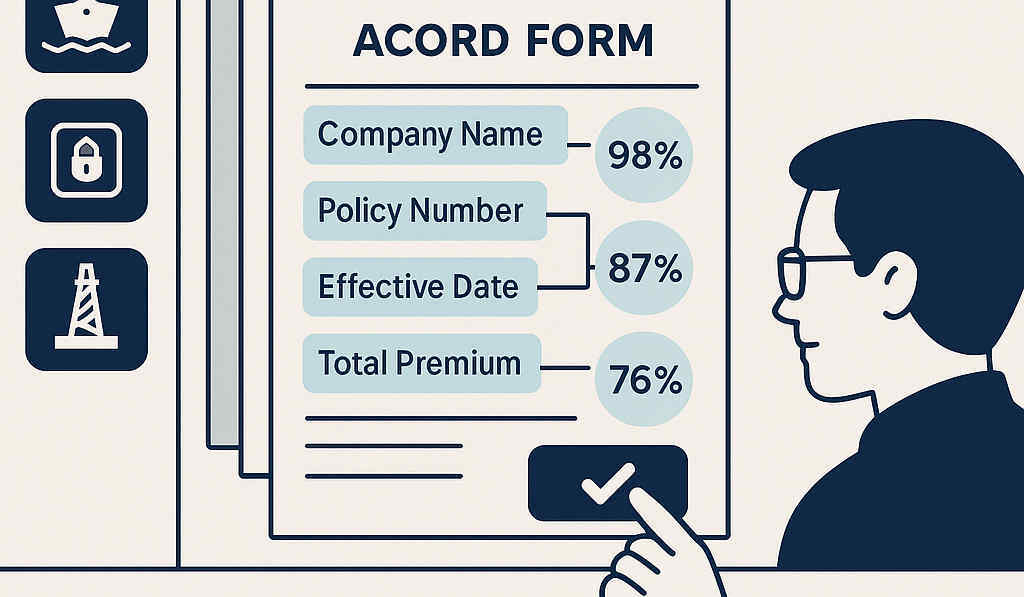
For every extraction or risk signal, attach evidence—page snippets, table cells, or highlighted text—and a confidence score. Underwriters should be able to accept, correct, or request clarification in one click. ACORD standards reduce mapping churn and speed partner onboarding; learn more at ACORD. Embed human‑in‑the‑loop gates at decision boundaries. New business for complex risks, high‑sum insured, or ambiguous extractions should route to senior queues automatically.
Use explainable models—tree ensembles with SHAP values or monotonic GAMs—so reviewers see why a signal fired. Persist a trace ID from ingestion through decision to support audit and post‑mortems.
EY’s analysis of AI in insurance underscores the value of explainability and workflow change over pure model accuracy; see EY on Generative AI and the broader 2024 outlook: EY 2024 Outlook. Integration makes or breaks the workbench.
Push cleansed data back into PAS and rating engines; expose APIs and webhooks so brokers can check status and submit missing docs without email loops. Instrument the flow: submission completeness rates, manual edits per field, time‑to‑decision by line, and quote‑to‑bind ratio deltas.
Maintain role‑based access controls, field‑level audit logs, and retention schedules aligned with regulation. With evidence‑backed assistance and tight feedback loops, you create a workbench that respects underwriters’ time and earns adoption—a prerequisite for real ROI.
Operational rollout, metrics, and specialty line playbooks
Operationalize with a phased rollout and measurable goals.
Phase 1 (30–45 days): digitize intake for one line (e.g., Marine cargo) and turn on ACORD extraction with evidence links. Measure baseline turnaround time and manual data entry minutes per submission.
Phase 2 (45–90 days): add decision support—loss trend summaries, appetite checks, and exception routing to senior queues; integrate with rating and PAS write‑backs; enable broker status webhooks.
Phase 3 (90–150 days): pilot limited auto‑decisions for low‑risk renewals under strict thresholds with clear override paths and monthly governance reviews.
Track outcomes that matter: median time‑to‑decision, quote‑to‑bind lift, corrections per field (dropping over time), and underwriter capacity reclaimed. Publish transparency statements describing where AI assists and how overrides work; regulators increasingly expect explainability and auditability.
For data model durability, align to ACORD data standards: ACORD Data Standards. Specialty playbooks help adoption: for Marine, templates for cargo manifests and bills of lading; for Cyber, external posture checks and incident history summaries; for Renewable Energy, engineering reports and maintenance logs. With the right scaffolding, “ACORD to decision” becomes hours, not days—without compromising human judgment or compliance.