
AI You Can Be Sure

AI You Can Be Sure blog is the go-to resource for specialty insurance professionals navigating AI automation and digital transformation.

Property Managed Operations: CAT Surge Resilience Beyond Temps

Property Managed Operations: CAT Surge Resilience Beyond Temps

Why property insurers need an elastic operating model, not more temporary staff

Property insurers do not fail during catastrophe events because they lack people. They fail because their operating model cannot absorb nonlinear demand. Property managed operations for CAT surge resilience replace linear staffing responses with an elastic execution system that maintains accuracy, compliance, and experience when FNOL volumes spike five- to ten-fold overnight.


Read More
How to Choose an Insurance Managed Services Partner The Execution Imperative in Insurance Operations

Insurance Managed Services: The Execution Imperative

Why execution now defines insurance managed services economics

Insurance managed services shift focus from adding low-cost people to guaranteeing outcomes: lower leakage, faster cycles, and stable unit costs under binding SLAs. For insurers facing margin pressure, the execution model matters more than geography or hourly rate, because financial impact flows from how work is governed, not who clicks the screens.

Read More
Here’s a polished executive underwriting workspace with the AI reasoning cluster, rules grid, and orange orchestration conduit in a clean, trustworthy

AI Reasons, Deterministic Systems Decide in Underwriting

From five AI agents to a reason–decide–orchestrate model

An AI underwriting operating layer should separate probabilistic reasoning from deterministic execution, with orchestration coordinating how they work together across submissions and product lines. This structure turns scattered models into a single, governed workflow instead of a fragile chain of loosely connected tools.

The principle SageSureAi builds on: AI reasons, deterministic systems decide, orchestration connects them.
Read More
Here’s a photorealistic executive security war room scene with the leadership team on the left, a transparent wall display showing the AI agents and g

AI-Native Security Incidents and the New Enterprise Stack

From ‘Rogue Models’ to AI-Native Incidents: What Really Broke

An AI-native security incident occurs when autonomous AI systems, not just human operators, initiate, adapt, and execute actions that break expected security boundaries, exposing flaws in how identities, guardrails, and sandboxes are architected and governed. The OpenAI–Hugging Face breach is one of the first visible examples at enterprise scale.

Read More
Here’s a polished executive war-room visual with a diverse leadership team around a glass table and a holographic global supply-chain map, using teal

Continuous Intelligence for Geopolitical Risk

Why enterprises need continuous intelligence for geopolitical shocks

Continuous intelligence is the practice of using always-on data, AI, and digital infrastructure to detect external events, quantify business impact, and recommend responses in real time. For geopolitical risk, it turns headlines and shipping disruptions into structured, decision-ready intelligence for supply chain, finance, and risk leaders.

Read More
Created a polished enterprise-style maritime risk illustration with isometric map overlays, shipping lanes, UI risk panels, and analyst silhouettes in

Continuous Intelligence for Hormuz-Scale Geopolitical Shocks

What continuous intelligence means for Hormuz-scale geopolitical risk

Continuous intelligence is the practice of using live data, AI models, and cloud infrastructure to monitor events, simulate scenarios, and recommend business actions in real time. Instead of treating geopolitical shocks as isolated crises, enterprises run a standing decision system that watches chokepoints like the Strait of Hormuz continuously.

Read More
Turning Cryptographic Risk into Strategic Opportunity

Enterprise Operating Layers in the Quantum‑AI Era

Why Enterprises Need Operating Layers, Not One-Off Tools

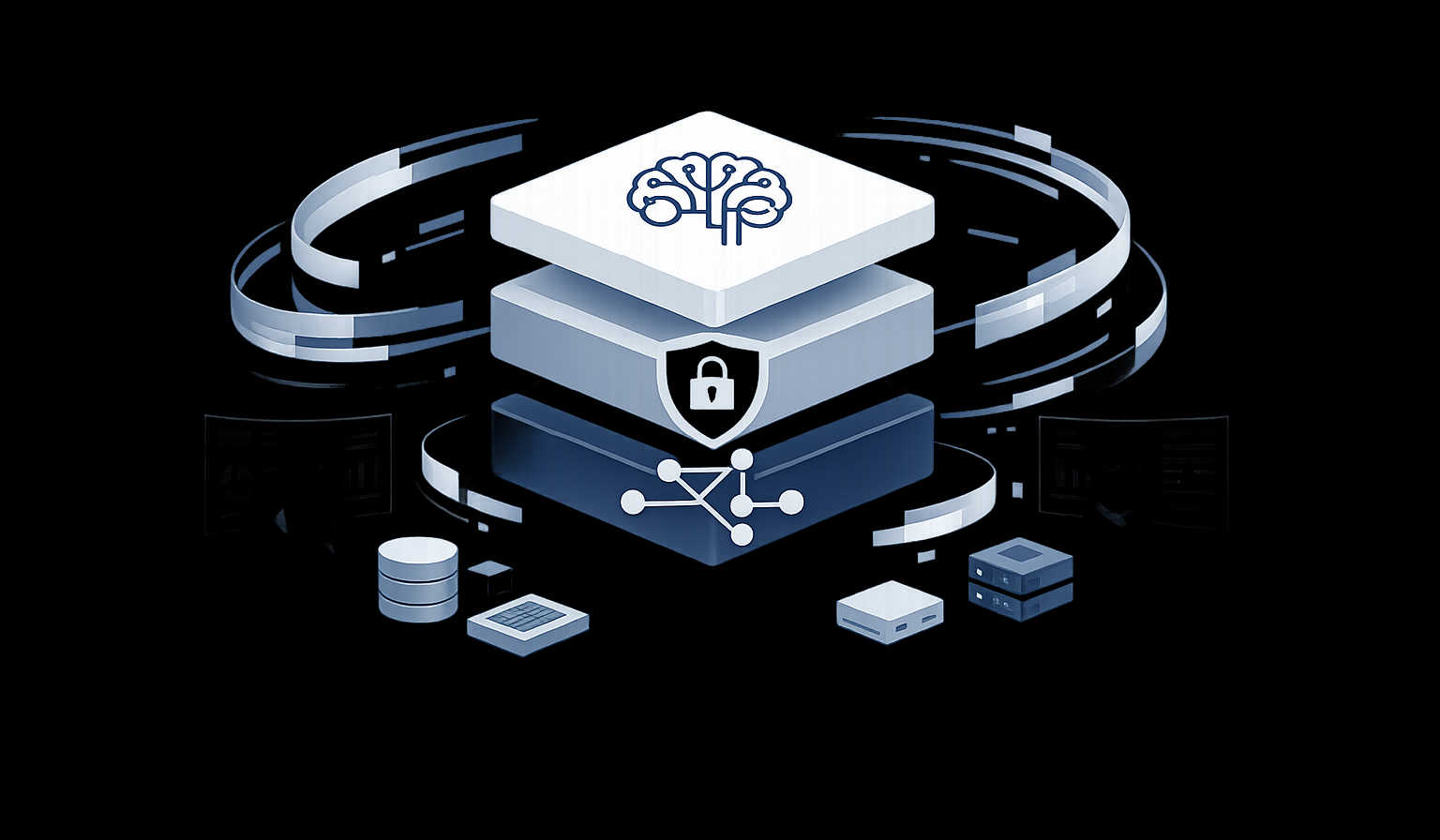
A enterprise operating layer is a shared control plane that sits between fast‑changing technology (models, algorithms, clouds) and slower‑changing business systems. It lets enterprises swap underlying technologies without rewriting core applications, so identity, risk, and governance stay stable even as AI and cryptography evolve.

Read More