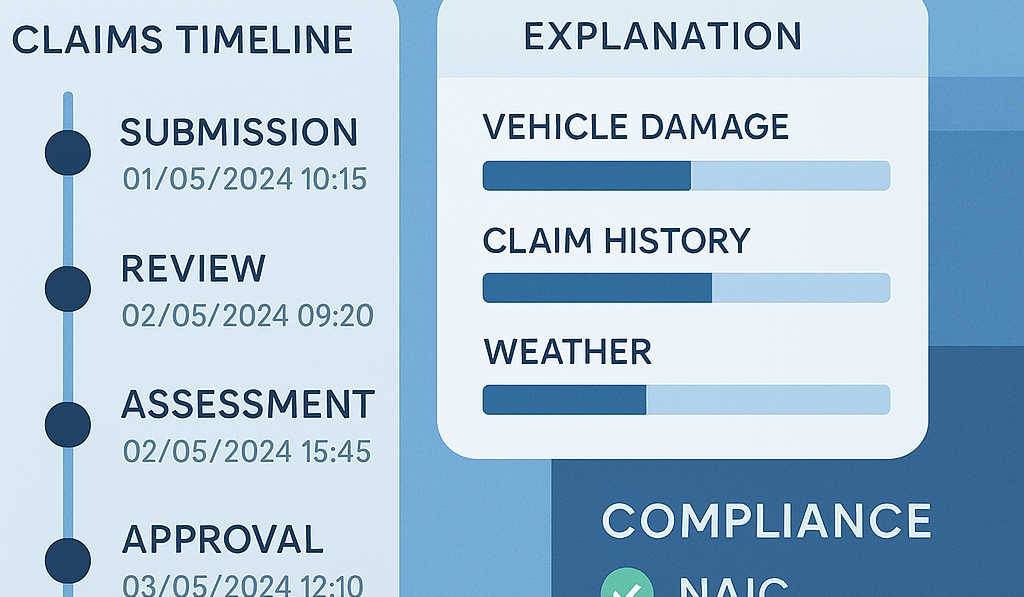
A pragmatic guide to make AI decisions in insurance explainable and auditable.
Start with an audit backbone you can trust
Insurers don’t just need AI that works; they need AI they can explain. Regulators, auditors, brokers, and customers increasingly ask not only “what decision was made?” but “why and how?” Building explainability into claims and underwriting from the start is the safest path to scale. It reduces false positives, shortens reviews, and accelerates approvals from compliance—while protecting policyholders and your brand. \n\nStart with an audit backbone.
Treat every significant state change as an event—FNOL received, claim triaged, coverage verified, payment initiated—and persist it with immutable payloads tied to trace IDs. Store decision inputs and outputs next to those events, including model version, features used, and the explanation artifacts shown to reviewers. This makes post‑hoc forensics and regulator reviews straightforward. Event trails also unlock customer‑facing transparency—real‑time status and clear rationales—without re‑plumbing your core systems.
For a primer on event‑driven patterns common in modern insurance platforms, see this integration overview: Guidewire: Outbound Integrations. \n\nChoose techniques that balance accuracy and clarity. For fraud triage and document intelligence, favor ensemble tree methods with SHAP explanations, or generalized additive models with monotonic constraints for sensitive features. These provide faithful local explanations and reduce the risk of hidden proxies for protected characteristics. Calibrate scores so thresholds map to expected precision (e.g., “alerts above 0.82 average 65% precision”), which helps SIU leaders staff and set SLAs.
For document extraction, retain page/snippet‑level evidence so reviewers can confirm facts in seconds rather than minutes. \n\nPut humans in the loop—by design. Define escalation rules where ambiguity or value is high, require dual‑control on adverse actions, and capture override reasons to improve models and guardrails. Explainability is not a report; it’s an interaction model that empowers people to do the right thing quickly and consistently.
Design explainability: evidence, transparency, human oversight
Designing for explainability starts with evidence. Every automated suggestion—document extraction, triage score, fraud risk—should carry breadcrumbs that a reviewer can trace: page and paragraph identifiers, highlighted spans, or table cell coordinates. Pair these with local explanations that show which features moved a score up or down (e.g., SHAP values for tree ensembles, monotone partial dependencies for GAMs).
When a human overrides, capture the reason and attach counter‑evidence. This builds a dataset that improves the system and, crucially, demonstrates to regulators that humans remain in control. \n\nMake explanations useful, not just available. Investigators and adjusters need context: peer group comparisons, historical claim patterns, and known network relationships (e.g., provider appears in prior suspicious claims).
Summaries should be plain language, free of jargon (“additional documentation requested because the invoice total deviates 3.1 standard deviations from similar repairs”). Explainability that shortens review time drives adoption; explainability that adds noise will be ignored. \n\nExpose transparency to customers where appropriate.
When an automated step routes a claim or requests extra documents, communicate why in clear language and provide an appeal path. For EU contexts, anticipate AI Act obligations for high‑risk systems: explainable outputs, documentation, and human oversight. For a practical lens on governance expectations, review EIOPA’s guidance: EIOPA Principles. Pair this with GDPR guidance on automated decision‑making and profiling from EU regulators via the EDPB: EDPB Guidelines.
Operational guardrails: MRM, privacy, audit trails
Operationalize governance with discipline borrowed from banking’s Model Risk Management (MRM) and adapted to insurance. Maintain a live model inventory with purpose, owners, training data provenance, and validation results. Require independent validation for material models; document intended use, known limitations, and monitoring plans.
Log every inference with a trace ID, input snapshot, output score, and explanation artifact shown to reviewers. Build controls around data: field‑level encryption for PII, consent capture, retention aligned with regulation, and region‑aware processing. \n\nAlign with cross‑market expectations. In the U.S., NAIC’s AI principles emphasize fairness, accountability, and transparency; several states now publish bulletins on insurer AI. Start with the NAIC principles: NAIC AI Principles.
In the EU, the AI Act will classify many insurance AI uses as high‑risk with explicit governance duties; EIOPA’s prior principles remain a practical reference: EIOPA Principles. For U.S. federal guidance shaping good practice, consult NIST’s AI Risk Management Framework: NIST AI RMF. \n\nMeasure and improve. Track precision and exoneration time on flagged cases, reviewer time saved per automated suggestion, override rates by signal, and customer dispute rates. When drift or precision drops, throttle automation and retrain with recent exonerations.
Publish monthly governance reports—what changed, what’s monitored, and where models are approved for use. Transparency is a product feature; when done well, it becomes a competitive advantage that accelerates approval from compliance and confidence from customers. \n\nFinally, ensure your vendors meet your bar. Demand evidence‑linked extractions, portable explanations, event‑log compatibility, and exportable audit artifacts. If they can’t show where a score came from and how a human can safely override it, it doesn’t belong in regulated insurance operations.