

#InsuranceInnovation
#OperationalExcellence
De-risk your managed services transition
AI You Can Be Sure
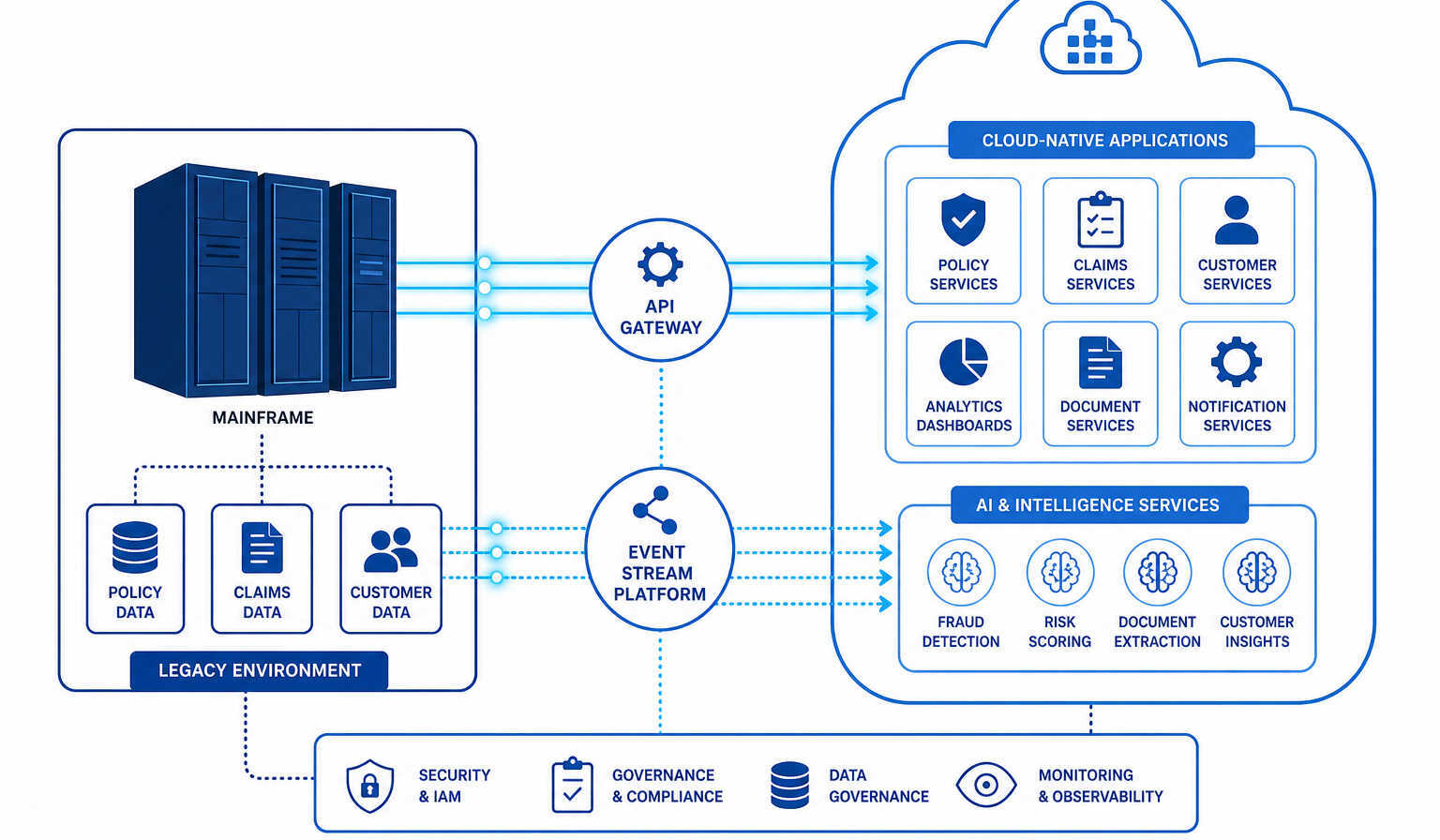

How insurers can modernize legacy cores with API-first integration, events, and data platforms without rip-and-replace risk.
Legacy core systems are the gravitational center of most insurers’ technology stacks—and often their biggest barrier to AI and digital transformation. Policy admin, billing, and claims platforms built for batch processing and green-screen workflows still run reliably, but they were not designed for API-first integration, real-time event streams, or AI-assisted claims and underwriting. At the same time, the industry has a long history of painful core replacements that overrun, under-deliver, or compromise stability. Insurance leaders are therefore searching for a middle path: a way to modernize legacy cores without the pain of a big-bang rip-and-replace, while still unlocking cloud, data, and AI capabilities.
For SageSure’s ICPs—CTOs, heads of architecture, digital transformation leaders, and operations executives—the stakes are both strategic and operational. Claims teams want event-driven automation and digital FNOL; underwriting wants workbenches and document intelligence; CX and marketing want real-time data to personalize experiences; compliance and risk want stronger audit trails and resilience.
Market research and case studies show that success comes from API-first, event-driven modernization rather than from trying to replace everything at once. EPAM’s “Digital Modernization in the Insurance Industry” survey of 200 European insurance executives found that 45% cite legacy technology as the biggest barrier to adopting digital tools and new ways of working, but that firms pairing core modernization with data and integration investments are far more confident in their ability to meet growth and efficiency goals (Digital Modernization in the Insurance Industry).
BriteCore’s 2025 P&C core systems report similarly highlights that carriers are shifting toward cloud-hosted cores, open APIs, and analytics platforms as they seek to balance stability with innovation (2025 P&C Core Systems Report). Together, these findings underscore that the real differentiator is not simply “cloud” or “core replacement,” but how well insurers design their integration, event, and data layers.
This article lays out an API-first modernization blueprint tailored for regulated insurers who cannot afford downtime. It argues that the path to AI-ready claims, underwriting, and CX runs through three capabilities: domain APIs that safely expose legacy cores, event streams that broadcast policy and claims changes in real time, and governed data platforms that turn this flow into trustworthy fuel for analytics and AI. By treating these capabilities as products—with roadmaps, KPIs, and governance—insurance leaders can modernize step by step, delivering value to business stakeholders while reducing operational and regulatory risk.
Designing integration and data patterns that actually work for regulated insurers means accepting three realities.
First, legacy cores are not going away quickly. Policy admin, billing, and claims systems—often on IBM i or mainframes—will remain the system of record for years, even as you layer on new digital and AI capabilities.
Second, point-to-point integrations, one-off ETL jobs, and brittle vendor interfaces are already constraining change and risking outages.
Third, regulators and boards expect modernization to improve resilience, auditability, and control—not just speed.
A pragmatic API-first blueprint for insurance blends domain APIs, event-driven patterns, and governed data products. The API layer sits between consumers (portals, broker platforms, mobile apps, AI services, partner ecosystems) and the core systems. Instead of letting every project connect directly to claims or policy databases, you define coarse-grained services such as createFNOL, getPolicy, issueEndorsement, and postPayment. Real-world case studies illustrate the payoff.
OpenLegacy’s work with a global insurer shows how wrapping IBM i (AS/400) policy and claims applications with microservice-based APIs cut payment times from days to minutes and reduced staff effort, unlocking real-time digital quotes and claims payments without touching the core ledger (Insurance API Integration Case Study).
A similar initiative at Ayalon Insurance used APIs to expose an AS/400 core and enable DevOps practices, shortening time-to-market for new products and channels (Insurance Digital Transformation Case Study). Alongside APIs, event streams carry the lifeblood of the business.
Modern reference architectures from cloud providers show how emitting domain events such as policy.bound, fnol.received, claim.triaged, payment.initiated, and renewal.offered into a central bus decouples services and powers real-time analytics and automation. An AWS guide on building an event-driven claims application walks through how Amazon EventBridge can route claim lifecycle events to enrichment, fraud, and payment services without hardwiring everything to the core system (Building a Modern, Event-Driven Application for Insurance Claims Processing).
For SageSure’s ICPs, this pattern is what allows claims copilots, underwriting workbenches, and CX portals to stay in sync with legacy cores in near real time. The third pillar is a governed data platform built around explicit, ACORD-aware data products. Instead of dumping core data into an unstructured lake, leading insurers define contracts for key entities—Policy, Claim, Party, Coverage, Billing—and build curated data sets for analytics and AI. EPAM’s “Digital Modernization in the Insurance Industry” survey of 200
European executives finds that firms combining core modernization with integrated data and analytics investments are significantly more confident about meeting growth and efficiency goals (Digital Modernization in the Insurance Industry). BriteCore’s 2025 P&C core systems report similarly highlights that carriers prioritizing integration and analytics alongside cloud-hosted cores are better positioned to deploy AI at scale (2025 P&C Core Systems Report). For modernization leaders, the message is clear: APIs and events unlock access; curated, governed data products make that access usable and safe for AI and analytics.
Running API-first legacy modernization as an AI-ready product, rather than a one-off IT project, changes how insurers structure teams, metrics, and risk management. For SageSure’s ICPs—CTOs, digital transformation leaders, and operations executives—the goal is to show that each step of modernization delivers tangible value in claims, underwriting, and CX while strengthening resilience and compliance. Measurement is the first lever.
Leaders should track time-to-integrate a new partner or channel, cycle times for key journeys (for example, SME quote-and-bind, specialty FNOL-to-first-contact, simple property claims), percentage of interactions executed via APIs and events versus batch/manual workflows, and the impact of new capabilities on NPS, retention, and straight-through processing.
Case studies of API-led modernization demonstrate what is possible. Symfa’s CPP modernization project for a large insurer highlights how API-led connectivity and a low-code front end enabled a complex commercial package product to go live in two months despite a skeletal starting point and numerous dependencies (How We Apply API-Led Connectivity for CPP Modernization).
Camunda’s work with The Norfolk & Dedham Group shows how replacing an outdated workflow platform with modern process orchestration improved claims processing visibility, compliance, and customer experience while de-risking a legacy stack that was no longer supported (Transforming Legacy Workflows at The Norfolk & Dedham Group Insurance). Governance then ensures modernization reduces, rather than increases, operational and regulatory risk. APIs should be cataloged with clear ownership, versioning, and security baselines—mutual TLS, OAuth2 scopes, rate limiting, and PII masking at the gateway. Events need schema registries and backward-compatibility policies so downstream consumers are not broken by change.
Data products should have stewards who own quality SLAs and ensure that AI models pulling from shared datasets comply with privacy regulations such as GDPR and regional insurance data rules. Regulatory expectations on operational resilience and outsourcing mean that cloud-hosted services and integration platforms must be brought within existing risk frameworks, with defined RTO/RPO targets, vendor oversight, and incident playbooks.
Finally, modernization must be framed in business language. Boards care less about API densities and more about outcomes: faster new-product launches, improved claims and underwriting KPIs, and the ability to deploy AI safely. Deloitte’s insurance industry outlook notes that carriers investing in digital foundations—APIs, cloud, data platforms—are better positioned to industrialize AI at scale and navigate macroeconomic and climate volatility (Deloitte Insurance Industry Outlook).
For SageSure’s ICPs, that is the heart of the story: an API-first, event-driven, data-governed architecture does not just modernize IT; it creates the safe, explainable foundation on which AI claims automation, underwriting workbenches, and digital CX can thrive. Practical CTAs for readers include commissioning an API and integration baseline assessment, piloting event-driven claims or FNOL journeys on top of legacy cores, and defining an enterprise-wide data product catalog for policy and claims. With those building blocks in place, insurers can unlock AI “you can be sure of” without betting the franchise on a single, risky core replacement.