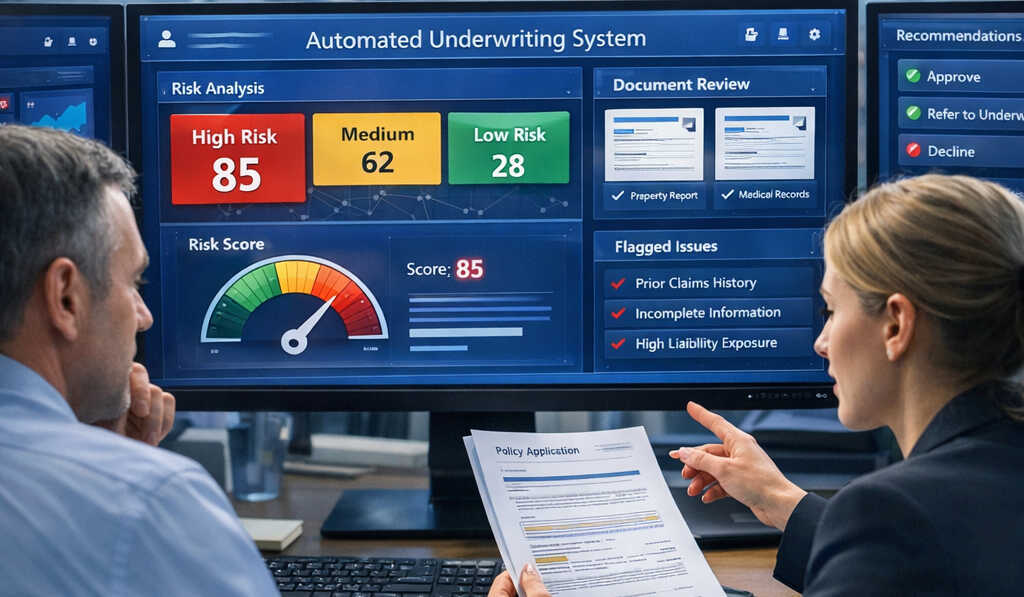
How insurers can design automated underwriting systems that boost speed and accuracy while staying explainable, compliant, and profitable.
Why automated underwriting must move from black box to explainable copilot
For many insurers, \"automated underwriting system\" used to mean a black box that spat out yes/no decisions and left actuaries and regulators nervous. Today, the conversation is different. Underwriting leaders want systems that can genuinely accelerate decisions and sharpen risk selection—but only if they remain explainable, auditable, and firmly under human control.
Market and academic evidence suggests the upside is real. Search-intent data shows sustained interest around automated underwriting software and systems, with terms like “automated underwriting system” and “automated underwriting software” drawing hundreds of monthly searches at manageable difficulty levels.
A 2024 Management Science article, “Rise of the Machines: The Impact of Automated Underwriting,” examines large-scale rollout of automated underwriting and finds that automation speeds up approvals and expands credit access, while also shifting risk profiles in ways that demand robust monitoring (Rise of the Machines: The Impact of Automated Underwriting).
In parallel, vendor case studies in insurance and banking show that well-governed automated underwriting can cut turnaround times from days to minutes for straightforward cases while improving consistency and reducing manual rework. For SageSure’s ICPs—chief underwriters, underwriting COOs, and insurance CTOs—these trends translate into a concrete brief: design automated underwriting systems that deliver speed and consistency without creating new regulatory or reputational risks. That means combining rules engines and AI models in a hybrid architecture, building explainability into every recommendation, and structuring human oversight so that underwriters remain the final arbiter on complex or sensitive risks.
This article provides a blueprint for that design. First, it outlines why legacy, opaque automation is no longer acceptable and what a modern automated underwriting system must deliver across speed, accuracy, and trust. Second, it explores how to architect AI-assisted underwriting with clear separation of concerns between rules, models, and humans, backed by APIs and event streams. Third, it shows how to measure ROI and govern these systems using frameworks aligned with NIST’s AI RMF and NAIC model bulletins, so that investment cases hold up under board and regulator scrutiny.
Designing automated underwriting systems that keep humans in the loop
Once leaders accept that underwriting must move faster, the harder question is how to design automated systems that underwriters, regulators, and brokers can trust. For SageSure’s ICP—VPs of Underwriting, Chief Underwriters, and CTOs—the goal is not to eliminate humans; it is to re-balance work so that scarce underwriting talent spends more time on judgment and less on clerical tasks, while still delivering measurable lifts in speed and portfolio quality.
Design starts with a clear division of labour between rules, models, and people. Traditional rules engines excel at encoding deterministic underwriting guidelines: eligibility checks, appetite filters, basic pricing logic. They are transparent, auditable, and relatively easy to update. AI models—often gradient boosting or deep-learning approaches—excel at scoring risk based on patterns in historical data that humans cannot see.
A 2024 Finantrix analysis comparing life insurance underwriting rules engines with AI models reports that AI processes applications 5–6x faster than rules engines and improves accuracy by 4–6 percentage points, but at the cost of higher operational complexity and explainability requirements (Comparing Life Insurance Underwriting Rules Engines vs. AI Models). For P&C and specialty carriers, a hybrid pattern is emerging: use rules to enforce regulatory and product constraints, and use AI to prioritise work, enrich risk views, and suggest pricing bands—always under human oversight.
Architecture matters just as much as algorithms. An automated underwriting system that is tightly coupled to a single legacy PAS will be hard to evolve and govern. Instead, modern designs expose underwriting services via APIs—submitApplication, getRiskScore, issueDecision—and capture every step as an event. Policy admin and CRM platforms call these services; underwriting workbenches surface their outputs. This decoupled pattern is what enables SageSure-style capabilities like explainable risk scoring, document triage, and cross-portfolio appetite views across multiple lines and geographies. Critically, user experience must make AI assistance feel like a copilot, not a black box. Underwriters should see the factors driving each recommendation—key rating variables, document signals, comparable historical cases—alongside confidence scores and suggested actions.
Where data is thin or noisy, the system should say so explicitly, nudging underwriters to seek more information instead of pretending to be certain. Interfaces must also make override paths obvious: underwriters need a one-click way to change an AI-recommended decision with a short rationale captured for future analysis. That is what turns model governance from a theoretical framework into a daily practice embedded in the underwriting desk.
Govern and measure automated underwriting as a trust-first product
Automated underwriting systems only become strategic assets when they are measured and governed like products, not treated as one-off IT deployments. For leaders in underwriting and risk, this means linking system performance to tangible business outcomes and ensuring that AI components meet emerging regulatory expectations on transparency, fairness, and control.
On the measurement side, begin with three families of KPIs. Speed metrics include time from submission receipt to quote and to bind, broken down by segment, channel, and automation path (manual, assisted, straight-through). Accuracy and portfolio quality metrics cover loss ratios by cohort, hit ratios, and post-bind rework (endorsements or cancellations shortly after policy inception) for risks processed through automated flows versus traditional ones. Talent metrics look at underwriter time allocation, caseload, and satisfaction: how much time is actually being returned to judgment and broker engagement.
External research helps calibrate expectations. A 2024 Management Science article, “Rise of the Machines: The Impact of Automated Underwriting,” analyses large-scale adoption of automated underwriting in financial services and finds that automation materially speeds decisions and expands access, but also changes risk profiles in ways that require careful monitoring (Rise of the Machines: The Impact of Automated Underwriting). A 2025 paper on measuring ROI of AI investments in underwriting and fraud detection proposes a structured framework that links AI-driven TAT reductions and fraud savings directly to combined ratio improvements, while mapping implementations against NIST’s AI Risk Management Framework and NAIC AI model bulletins (Measuring ROI of AI Investments in Insurance Underwriting and Fraud Detection). For SageSure’s audience, these sources support a narrative where automated underwriting systems are not just faster, but also managed against explicit ROI and risk targets. Governance then turns those targets into guardrails.
Insurers should maintain a model registry that records each model’s purpose, training data, validation results, monitoring thresholds, and approved usage contexts. High-risk models—those that materially influence pricing, declinations, or coverage limits—should be subject to independent validation and periodic fairness reviews across geographies, industries, and protected classes. Human-in-the-loop controls must be explicit: which decisions can be made automatically, which require underwriter approval, and which must escalate to senior review.
Event-level logging underpins explainability. Every automated decision should emit an event capturing model version, key features, context, and human outcome (accepted, modified, overridden), along with the rationale. When a regulator, auditor, or broker asks why a borderline cyber risk was declined or repriced, teams should be able to reconstruct the decision from this history. That same data powers continuous improvement, revealing where models underperform, which rules are overly conservative, and where underwriters consistently override recommendations. When automated underwriting is run this way—as a trust-first product with clear KPIs and governance—it becomes easier to make the investment case.
Leaders can show how the system shortened turnaround for brokers, improved portfolio shape, and freed underwriters to focus on complex, high-value risks, all while staying aligned with AI risk frameworks like NIST and NAIC. That is the path to “AI you can be sure of” in underwriting: faster, smarter decisions that remain accountable and explainable.