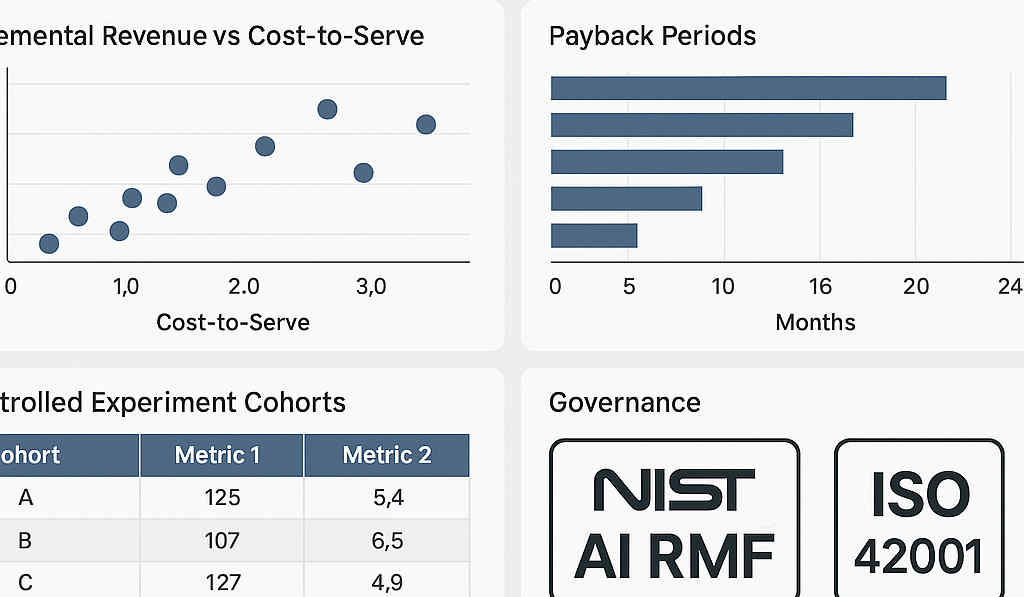
A CFO/CIO-ready template for quarterly AI value, reliability, and risk reporting.
Define value: moments, costs, and counterfactuals
Boards don’t buy AI—they buy outcomes and credible guardrails. Start by defining where timeliness and context change results—onboarding blockers cleared, claim-status transparency that prevents calls and complaints, renewal windows that protect net revenue retention, fraud flags that reroute cases, and sales coverage that prevents deal slippage.
For each moment, write a one-page brief with the outcome KPI, the smallest helpful action, allowable data and lawful basis, a risk tier (which dictates testing depth and human oversight), and a release plan (shadow → supervised → narrow autonomy). Map costs explicitly: data (ingestion, storage, egress), compute (inference, training), channels (messaging, human time), and oversight (QA, governance). Benefits are incremental revenue, lower cost-to-serve, or risk reduction—measured against a counterfactual. This framing prevents vanity metrics from hijacking strategy.
Accuracy and AUC don’t pay the bills unless they change a decision that moves the P&L. For costly interventions, prefer uplift/treatment-effect modeling to target “persuadables” instead of blanketing high-propensity segments. Validate that your “real time” is fast enough to matter by publishing freshness SLAs for critical topics and enforcing them at the pipeline edge.
Finally, pair business KPIs with reliability SLOs (latency, availability, error budgets) so directors can see value and risk in one view. The NIST AI RMF Playbook offers a shared risk vocabulary that helps executives and operators align on acceptable trade-offs and required controls.
Measure with experiments, calibrated models, and SLOs
Evidence beats promise. Favor randomized controlled tests for customer-facing changes; where infeasible, use quasi-experiments (matched cohorts, difference-in-differences) with pre-registered stop-loss thresholds and instant rollback.
Attribute lift at the journey-node level—“day-3 claim status update,” “onboarding blocker cleared,” “renewal prep at day 90”—to avoid channel-based misattribution. When capacity is constrained, optimize decision curves for the top deciles you can actually serve, and calibrate probabilities so thresholds reflect economics, not leaderboards. Instrument observability from event to action so leaders can correlate system health with business outcomes.
Trace requests end-to-end and monitor golden signals—latency, error, saturation, throughput—next to KPIs like cycle time, NRR, cost-to-serve, win rate, and CSAT/NPS. A leader-friendly rationale for why observability pays is summarized here: Splunk. Deploy changes safely. Treat prompts, rules, models, and frequency caps as deployable artifacts with rollback. Use feature flags and blue/green or canary releases to validate under live traffic before broad rollout; see HashiCorp for an approachable primer.
Governance signals: risk posture leaders can trust
Boards need to see that growth and governance scale together. Report three categories of signals every quarter.
1) Value: incremental revenue, cost-to-serve reduction, payback periods, and NRR/retention deltas attributed to specific journey nodes.
2) Reliability: SLO attainment (latency, availability, freshness, error budgets), incident counts with mean time to detect/resolve, and cost telemetry (inference spend, human-in-the-loop hours).
3) Risk posture: coverage against recognized frameworks and control adoption. Anchor your language to the NIST AI RMF so directors can map risks and controls consistently across use cases. Include a short appendix of material model and policy changes shipped behind feature flags, their measured lift, and any override/complaint rates.
Make trust visible to customers and auditors. Maintain immutable decision logs that capture inputs, retrieved evidence, policies applied, rationale, and outcomes; publish a customer-facing explanation standard (“why you received this”) and provide preference centers that actually work. These aren’t just compliance niceties—they reduce complaint risk and improve response. With value, reliability, and risk signals on one page, leadership can scale what works, fix what wobbles, and retire what doesn’t—turning AI from a promise into a program the board can defend.