How to scale claims during CAT surges with event-driven ops and control.
Why CAT surges demand event-driven claims operations
Catastrophe seasons are longer, claim volumes surge unpredictably, and customers expect real‑time status. The carriers that outperform during CAT events share a pattern: they move from brittle, batchy handoffs to event‑driven flow with explainable automation and clear human override paths. That shift turns chaos into throughput—simple claims glide through, complex ones get expert attention fast, and every decision is traceable.
Start at the edge where delays begin: first notice and submission. Replace email chains and call-center scripts with guided digital FNOL that adapts to loss type and policy context. Validate basics (policy number format, location, date sanity checks) as the user types; pre‑fill from policy data; and capture quality evidence with mobile photo/video guidance. Standards reduce mapping friction with partners—align intake fields to ACORD elements so downstream systems speak the same language; reference: ACORD Data Standards. The objective is “collect once, use everywhere”: triage, coverage checks, fraud scoring, vendor assignment, and customer communications all draw from the same clean inputs.
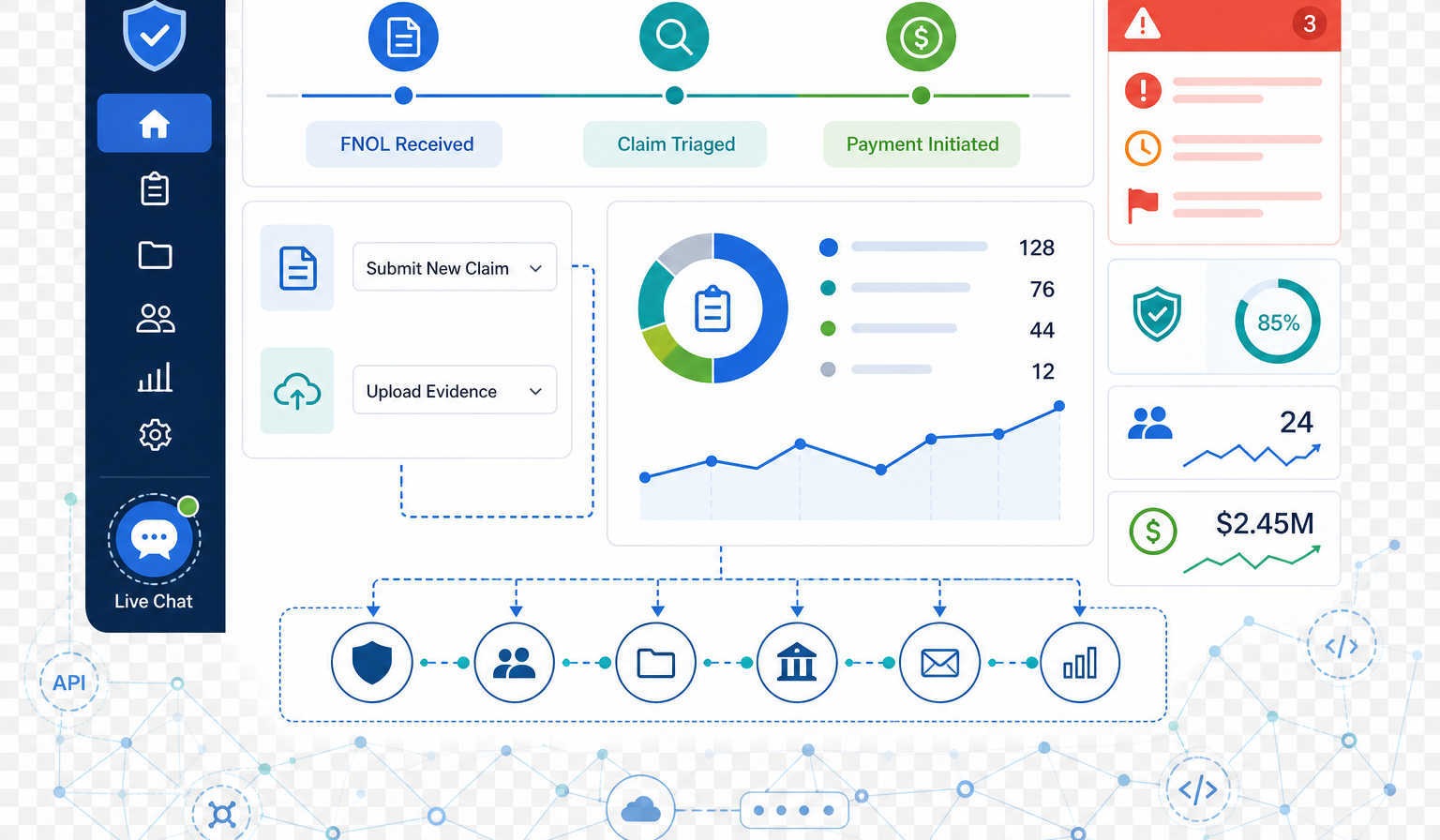
From intake, shift from point‑to‑point integrations to an event backbone. Each milestone—fnol.received, claim.triaged, coverage.verified, repair.assignment.created, payment.initiated—emits an immutable event that specialized services subscribe to. This decoupling lets you scale the specific steps under pressure (triage, communications) without overloading your claims core. It also builds an audit spine so regulators and customers can see what happened, when, and why. Industry outlooks emphasize staged modernization and platform patterns over risky rip‑and‑replace; for macro validation, review a current perspective on insurer priorities: Deloitte Insurance Outlook.
Trust comes from evidence‑linked assistance, not opaque automation. Use layout‑aware extraction so every pre‑filled field carries a breadcrumb back to the exact page or table cell in a document. When a triage score routes a claim, expose the features and evidence behind it and let reviewers override with reasons—logged next to the event that triggered the action. Persist model versions and inputs/outputs so you can reconstruct any decision quickly. This is both good operations and good governance; U.S. regulators, through NAIC, emphasize fairness, transparency, and accountability as AI use expands in insurance. See the principles here: NAIC AI Principles.
Finally, make transparency a first‑class feature for customers and brokers. Render the same events to an external portal as a simple timeline with proactive notifications—“inspection scheduled,” “estimate approved,” “payment initiated.” J.D. Power’s research links digital claims experiences to higher satisfaction, even when external factors (like repair capacity) slow progress; study highlights are here: J.D. Power Digital Claims. In surge conditions, clarity lowers call volume and preserves adjuster focus—speed with control, not speed versus control.
Design surge mode: APIs, events, queues, and partner orchestration
Surge mode is an operating posture, not a hero shift. The design goal is simple: keep simple work flowing straight through, surface exceptions early, and preserve auditability even when volumes spike. The architecture that enables this blends synchronous APIs with an event backbone and explicit queues so each unit of work moves independently. APIs handle the moments that must be immediate and consistent—create FNOL, upload evidence, query policy status—behind a secure gateway that enforces identity, consent, rate limits, and schema versioning. Events broadcast lifecycle facts—fnol.received, claim.triaged, coverage.verified, repair.assignment.created, payment.initiated—that downstream services subscribe to without tight coupling. Major platforms in insurance endorse this pattern because it simplifies outbound integrations and keeps the core stable under load; see how application events decouple long‑running tasks here: Guidewire App Events overview and complementary guidance on outbound integrations: Guidewire: Outbound Integrations.
Queues make surge explicit. Separate ingress (FNOL) from triage, coverage verification, fraud scoring, repair assignment, and payments. Each queue owns its SLA, capacity, and backlog transparency. A triage service scores severity and fraud risk, emitting claim.triaged and routing cases to the right handler, while low‑severity, clean claims pass eligibility checks for straight‑through processing (STP) with clear human overrides. Partner orchestration becomes a specialized subscriber: repair networks, surveyors, or forensics providers are assigned by geography and capacity as events arrive, then publish their own events (inspection.scheduled, report.received). This design prevents the claims core from becoming a chokepoint and makes surge handling a repeatable playbook rather than an all‑hands scramble.
Governance must scale with speed. Propagate a trace ID from the first API call through every event so “what happened when, and why?” is answerable in minutes. Persist inputs/outputs for any AI‑assisted step (document extraction, fraud triage) with model versions and explanation artifacts so reviewers can override with reasons—an expectation emphasized by regulators; for principles shaping insurer AI, see NAIC AI Principles. When surge mode relaxes noncritical validations (e.g., deferring a secondary document for low‑severity claims), log the policy and the window in which it applied. Observability completes the picture: per‑queue latency, age of oldest item, and SLA breach alerts help leaders direct capacity where it matters most.
Run surge-ready claims with governance and clear SLAs
Surge‑ready operations become real when you install metrics, playbooks, and roles that teams trust. Set shared north‑star goals tied to customer value: FNOL‑to‑triage in minutes for eligible segments; percentage of proactive notifications sent; 75th/95th percentile cycle times by line of business; and deflection of “where’s my claim?” calls. Customer research consistently shows that digital status and clear expectations raise satisfaction even when repairs take longer; see benchmarks in the J.D. Power digital claims studies: J.D. Power Digital Claims. Pair these with operational KPIs—STP rate for defined eligibility, mean time to partner assignment, and exception ratio after automation—so you can tune thresholds under pressure.
Then codify the surge playbook in three phases:
• Readiness (steady state). Maintain a vetted partner panel with capacity signals, event consumers with idempotent handlers and dead‑letter queues, and a transparency statement that explains what is automated vs. human‑reviewed. Drill quarterly with brokers and partners using simulated event streams so everyone practices the handoffs before CAT season.
• Activation (T‑0 to T+24 hours). Enable surge mode policy toggles: scale extraction and triage services horizontally, relax noncritical validations for low‑severity claims, and raise SLA for non‑urgent tasks. Publish proactive status across channels and expose a broker/policyholder portal so stakeholders see the same facts; patterns for rendering lifecycle events to external users are documented by platform vendors, for example: Guidewire Lifecycle Events.
• Stabilization (T+24 to T+14 days). Expand STP eligibility where precision is high, route ambiguity to senior queues, and publish weekly governance reports: model drift, override reasons, and any temporary policy changes. Tie outcomes to renewal‑linked KPIs with your CMO: faster status and clear decisions correlate with retention; for property claims satisfaction context, see J.D. Power Property Claims.
Finally, invest in people. Train adjusters on evidence‑linked review so AI assists speed decisions rather than add debate; celebrate “time saved” stories to build confidence. With events as the nervous system and governance as muscle memory, surge mode becomes a capability—not a crisis tactic.