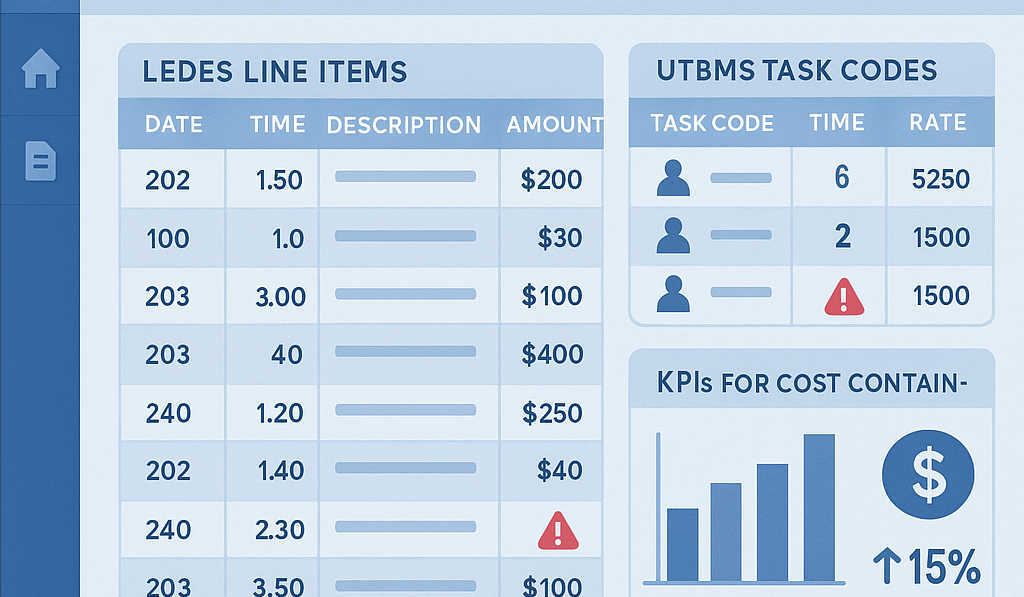
Cut cyber defense costs with LEDES-aware invoice review and governance.
Why cyber claims need automated, LEDES-aware invoice controls
In cyber claims, time is leverage—and defense spend can escalate quickly. The first 72 hours set the tone for containment and strategy, but weeks later the bill arrives with dozens of timekeepers, vague narratives, and task-code anomalies. Manual review can’t keep pace, leading to leakage, disputes, and strained counsel relationships. The fix is not penny‑wise denials; it is predictable, explainable controls that align counsel with objectives and reduce friction. Automated legal invoice review—grounded in LEDES/UTBMS standards and your panel billing guidelines—turns a painful back‑office grind into a fast, defensible process that protects indemnity and LAE without slowing the claim. Start by anchoring on what good looks like. Strong outside counsel billing guidelines set expectations on staffing, task coding, travel, research, and block billing—and give reviewers a defensible yardstick. A concise industry perspective on why billing guidelines matter for insurers is here: Billing Guidelines Matter. For a concrete example of panel counsel e‑billing practices tied to LEDES, see an insurer’s public guidance and enrollment details: Hartford e‑Billing and the companion billing rules: Hartford Billing Guidelines. On the standard itself, LEDES and UTBMS codes are the lingua franca for structured legal billing; an accessible overview is here: LEDES & UTBMS Guide. Cyber context matters. Market updates highlight rising notification activity and changing incident patterns, which can drive intense early motion practice and forensics coordination—spend you must control without blunting response. See a recent overview of cyber claims and market dynamics: Marsh Cyber Market Update. With clear guidelines and LEDES‑aware automation, you can focus counsel on outcomes, not paperwork—and resolve audits fast because every adjustment cites a rule and a code, not a hunch.
Design the review stack: intake, LEDES/UTBMS, explainable flags
Build a review stack that ingests any invoice, enforces standards, and explains adjustments in plain language. 1) Intake and normalization. Accept LEDES 1998B/2000 and PDF invoices. For PDFs, run layout‑aware extraction to capture timekeeper, date, hours, rate, UTBMS task/activity/expense codes, and narrative—keeping a link to the exact line and page. Validate vendor identity, matter link, and panel status at the edge. 2) Policy‑as‑code for guidelines. Translate your billing guidelines into machine‑readable rules: no block billing above N minutes; research caps by matter phase; staffing ratios (partner/associate/paralegal); travel limits; duplicate detection across matters; and prior approval checks for experts. Rules should point to the exact clause in your guidelines, not just raise a generic flag. For real‑world anchors, review public guideline examples: Panel Billing Guidelines. 3) LEDES/UTBMS fluency. Use a code catalog so reviewers see allowed/expected code patterns by phase and matter type (ransomware response vs. BEC). Normalize common miscoded entries and surface anomalies. For a quick primer on codes and why they matter in insurance defense, see: LEDES & UTBMS Primer. 4) Explainable flags and side‑by‑side context. Show each adjustment with a reason, the violated rule, and comparisons to peer matter medians (e.g., hours for initial containment) so counsel can self‑correct. Provide a one‑click appeal path with evidence attachments. 5) Events, not email. Publish invoice.received, audit.completed, adjustment.disputed, and adjustment.resolved events so finance, claims, and counsel share a single source of truth. This reduces “where is it?” email loops and creates a clean audit trail for regulators and internal reviews. 6) Tie to outcomes. Connect invoice audits to claim phases and settlement strategy. For cyber, align with 72‑hour response playbooks so billing reflects urgency (containment) and de‑emphasizes low‑value tasks early. With LEDES‑aware automation, you can enforce the strategy you intended at intake—faster, and with less friction.
Run the program: KPIs, panels, governance, and 90-day plan
Run legal spend like a program with shared KPIs, panel collaboration, and governance. KPIs that matter: audited dollars as a share of total; sustained vs. reversed adjustments; time‑to‑audit and time‑to‑pay; narrative vagueness rate; partner/associate mix; and variance from peer medians by phase. For cyber specifically, track cost per incident type (ransomware, BEC, exfiltration), hours to initial containment guidance, and the share of invoices received in LEDES vs. PDF. A 90‑day plan that pays for itself: • Days 1–30: Stand up LEDES intake and PDF extraction with line‑level evidence links. Codify top 10 billing rules (block billing, staffing ratios, travel limits, prior approvals) and validate against one panel firm. Baseline KPIs. • Days 31–60: Expand to UTBMS‑aware anomaly detection and peer medians; add events (invoice.received, audit.completed, adjustment.disputed/resolved) and a one‑click appeal flow. Publish weekly dashboards to counsel. Onboard two more firms. • Days 61–90: Tie audits to claim phases and cyber playbooks; introduce vendor scorecards; and measure time‑to‑audit and time‑to‑pay reductions. Target a 5–10% net reduction in defense spend with improved satisfaction (fewer back‑and‑forth appeals, faster payments). Governance and trust: maintain a rules inventory mapping each automated adjustment to a guideline clause; persist inputs/outputs with trace IDs; and align data retention, consent, and access controls to your privacy policies. Make transparency a feature—publish a plain‑language summary of your billing standards to panel counsel and stick to them. For broader market context on why guidelines matter and how e‑billing supports consistency, see Wolters Kluwer: Billing Guidelines and an insurer’s LEDES process at Hartford e‑Billing. When spend controls are predictable and fair, you protect the claim, move faster, and keep panel relationships strong.