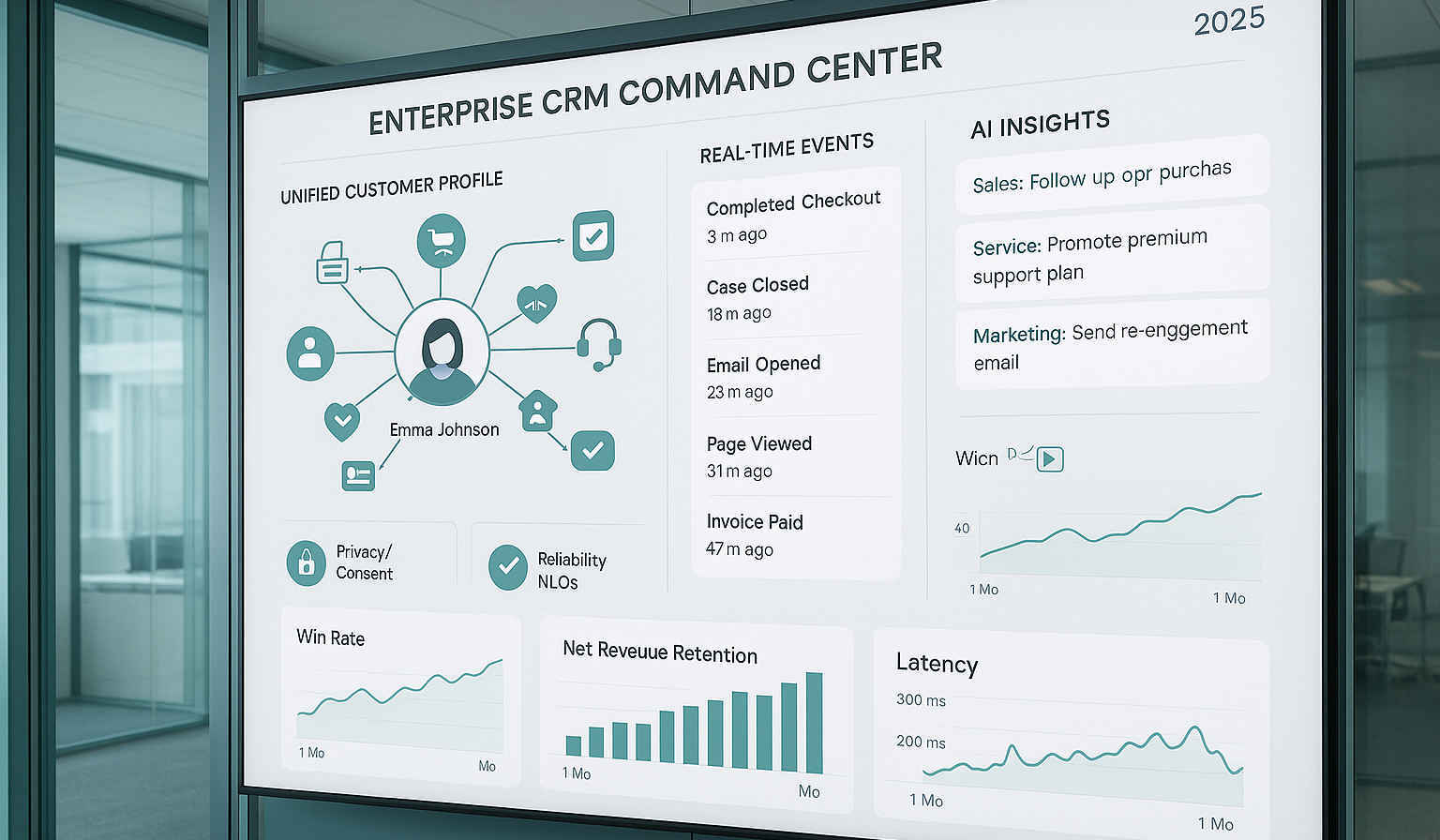
What’s changed in CRM: real-time, consent-aware decisioning that moves revenue and retention.
From databases to decisions: what modern CRM must do
CRM used to be a system of record: a place to store contacts, activities, and deals. In 2025, that’s table stakes. What differentiates leaders is turning CRM data into timely, explainable actions that move revenue and retention—without breaking trust. That means a CRM that does three things well:
1) unifies identity so the system knows who is who across sales, service, marketing, product, and finance;
2) activates signals in real time so hours, not weeks, separate an issue from a response; and
3) enforces consent, minimization, and reliability by design so actions are defensible to customers, auditors, and boards.
Static dashboards don’t shorten cycles. Decisions do. Bain’s tech outlook notes sales remains a frontier for productivity gains when AI frees more time for selling and removes low‑value toil (Bain). McKinsey shows that gen AI moves the needle when embedded in workflows for prioritization, coaching, and content quality—not as a sidecar (McKinsey).
For Customer Success, timely nudges during onboarding and service recovery protect Net Revenue Retention far more than monthly “health” emails; Gainsight’s playbooks and trends underscore onboarding as a primary lever for retention (Gainsight). The new baseline for CRM is consent‑aware, real‑time decisioning.
Outreach respects permissions at activation, not just collection; retrieval boundaries ensure only minimal context is fetched; and AI agents act as microservices for moments: assembling opportunity context packs, recommending next‑best actions, and triggering service escalations.
Reliability is not an afterthought: changes roll out behind feature flags with blue/green or canary releases; failures are observable and reversible. This is how CRM stops being a database and becomes a system of decisions.
The architecture: profiles, events, decisioning, and reliability
Under the hood, modern CRM looks less like a monolith and more like a platform with clear seams:
- Profiles and identity: Stitch people, accounts, and relationships deterministically first, then probabilistically.
Tag fields with lineage, residency, and retention so downstream policy checks can be automated. Treat consent and preferences as runtime controls—evaluated each time an action fires. Adobe & Forrester’s analysis links this foundation to superior revenue and loyalty in personalization programs (Adobe & Forrester).
- Events and freshness SLAs: Emit domain events (meeting booked, stage changed, ticket escalated, usage cliff detected) into a governed stream with schemas and freshness targets. Cloud providers offer reference designs for streaming analytics and online features (Google Cloud); vendor‑neutral primers are helpful for non‑SRE leaders (Confluent).
- Decisioning as a service: Use rules with guardrails for common moments (renewal windows, onboarding milestones, service recovery), and add models selectively where the surface is complex (lead/account scoring, uplift for expensive outreach, churn risk).
Each decision should:
1) request a minimal context bundle,
2) evaluate consent and lawful basis (e.g., GDPR Article 6),
3) choose an action (notify, route, escalate, create task), and
4) write an immutable decision log (inputs, rationale, outcome).
This separation preserves explainability and accelerates iteration. - Reliability and safety: Treat behavior changes—prompts, models, policies—as deployable artifacts with rollback.
Use feature flags and blue/green or canary releases (HashiCorp), and instrument observability from event to action with golden signals (latency, error, saturation, throughput) next to business KPIs leaders trust; see Splunk. This platform pattern makes
CRM changes safer and faster, and it aligns with emerging governance: the NIST AI RMF Playbook provides lifecycle controls; ISO/IEC 42001 offers an auditable management system (overview: ISMS.online).
Operate for outcomes: experiments, KPIs, and governance
Outcomes—not features—justify investment. Run CRM like a product with value hypotheses, guardrails, and evidence. - Choose journey nodes where timeliness changes outcomes: discovery to proposal, executive sponsor engagement, service recovery, renewal prep.
For each, define the smallest helpful action, allowable data and lawful basis, risk tier (which dictates testing depth and human oversight), and KPIs with counterfactuals. - Prove impact with experiments.
Favor randomized control; otherwise, use quasi‑experiments (matched cohorts, difference‑in‑differences) with pre‑set stop‑loss thresholds and instant rollback. Attribute at the node: “AI context pack cut discovery‑to‑proposal by 2.3 days,” “top‑decile account scoring raised win rate by 3 points,” “day‑3 status update reduced inbound calls X% and raised CSAT Y.” - Pair business KPIs with SLOs.
Track stage conversion, days‑to‑close, forecast accuracy, NRR/retention, and cost‑to‑serve alongside golden signals (latency, error, saturation, throughput). Publish weekly experiment readouts and monthly value reviews. - Keep humans in command for high‑stakes moves (pricing, terms, escalations). Maintain immutable decision logs and model cards so audits become evidence assembly, not archaeology.
Practical next steps: - Stand up a consent‑aware profile and event stream for your top three moments. - Implement a decision service with retrieval boundaries and logs; start with rules, add models where lift is real. - Ship behind flags, measure lift and latency, and scale only when guardrails hold. With a platform for real‑time, consent‑aware decisions, CRM evolves from a database into the engine of your revenue and retention flywheel—timely, explainable, and trusted.