Why Enterprises Need Operating Layers, Not One-Off Tools
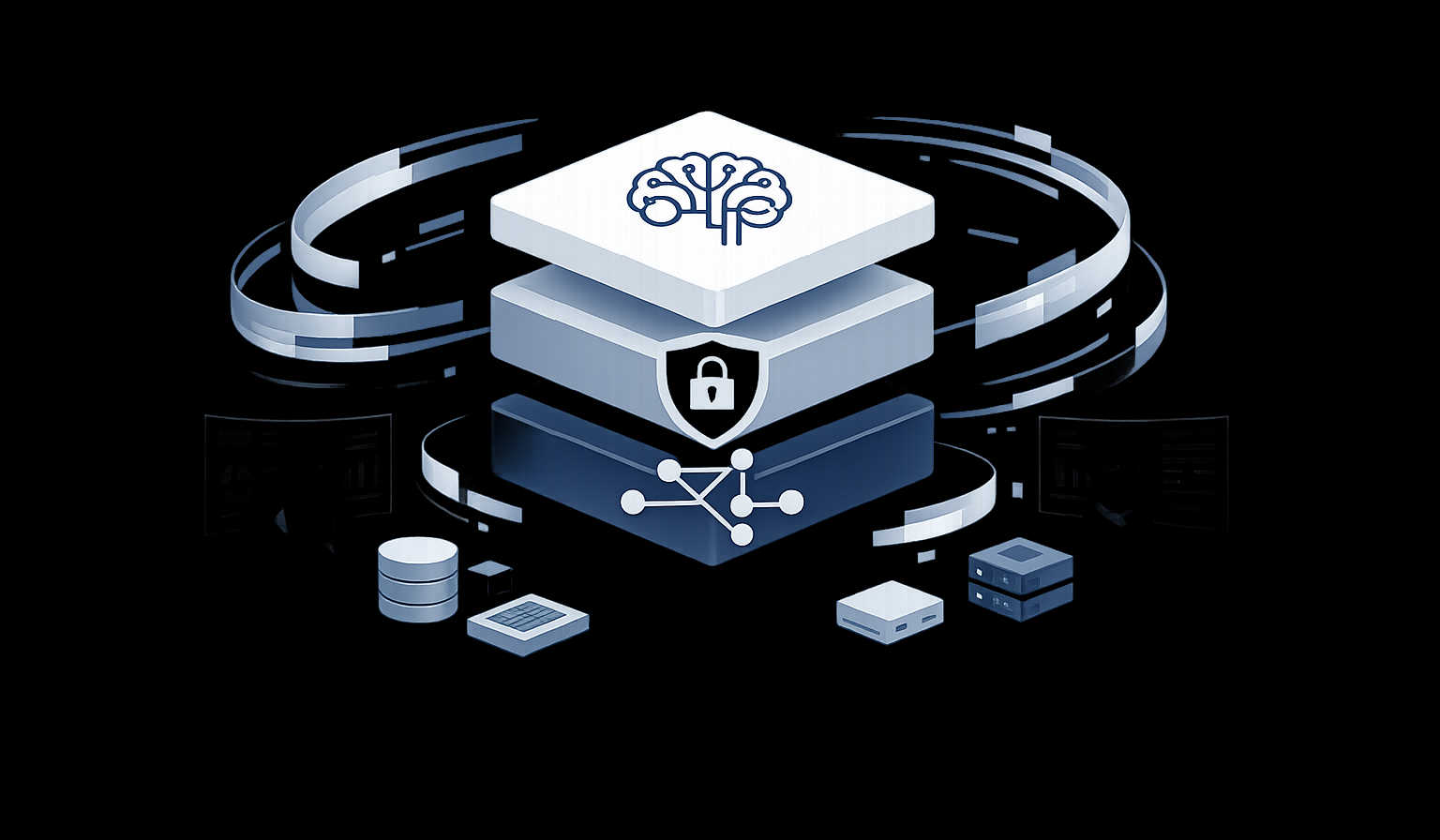
A enterprise operating layer is a shared control plane that sits between fast‑changing technology (models, algorithms, clouds) and slower‑changing business systems. It lets enterprises swap underlying technologies without rewriting core applications, so identity, risk, and governance stay stable even as AI and cryptography evolve.
Most enterprises feel the same tension today: AI models, cryptographic standards, and cloud services are moving faster than their core systems can adapt. A carrier might adopt GPT this year, face a new quantum‑safe mandate next year, and replatform billing or claims the year after. Without an abstraction layer, every shift becomes a disruptive migration project.
Operating layers solve a specific pain point: architectural fragility. Instead of embedding model choices, cipher suites, or vendor SDKs directly into policy admin, claims, or broker portals, enterprises centralize control into operating layers that expose stable APIs. This is how organizations can respond to Bloomberg‑style quantum headlines without rewriting hundreds of services every time a standard changes.
The pattern repeats across domains. Intelligence, cryptography, decisions, and knowledge all behave like moving parts. Business capabilities—quoting, binding, FNOL, claims adjudication, reconciliations—must not. The rest of this article translates that philosophy into four concrete operating layers and a practical strategy.
The Intelligence Operating Layer: Managing Models, Not Bets
An Intelligence Operating Layer routes work across models (Claude, GPT, GLM, DeepSeek, and future systems) instead of hard‑wiring a single provider into every application. It standardizes prompt formats, context enrichment, guardrails, and evaluation so product teams can change models without changing their applications.
In practice, this layer exposes a small set of stable APIs: "summarize claim evidence," "propose triage decision," "extract entities from broker submission." Underneath, it can select a low‑cost model for routine work, a stronger model for complex reasoning, or an internal model where data residency requires it. When a new model arrives, the enterprise tests it centrally, then updates routing policies.
The business impact is tangible. One global insurer documented a 40% reduction in time‑to‑adopt new models by centralizing orchestration and evaluation in an AI control plane, rather than embedding vendor SDKs into every workflow. More importantly, risk teams gain a single place to apply governance: PII filtering, red‑team tests, and human approval rules for high‑impact actions.
Instead of asking, "Is GPT better than Claude this quarter?", leaders ask a different question: "Does our Intelligence Operating Layer make it safe to change models without disrupting underwriting, claims, or customer experience?" That is a far more durable strategic posture.
The Cryptographic Operating Layer: From Quantum Hype to Trust
A Cryptographic Operating Layer abstracts keys, certificates, algorithms, and policies away from business applications. It manages the transition from RSA and ECDSA to post‑quantum standards such as ML‑KEM and ML‑DSA, while keeping identity, APIs, and documents continuously trustworthy.
Quantum headlines often focus on whether a future computer will “hack Bitcoin.” Enterprises face a different question: if cryptographically relevant quantum machines appear near the end of this decade, which parts of identity, PKI, and digital signatures become vulnerable first? For insurers, that includes broker authentication, claims evidence, policy documents, reinsurance treaties, and long‑lived customer records.
Regulators already treat this as a migration problem, not a research curiosity. NIST has finalized core post‑quantum standards, and guidance such as U.S. NSM‑10 and EU directives encourages migration by the early‑to‑mid‑2030s. At the same time, CA/Browser Forum rules are compressing public TLS lifetimes down to 47 days, forcing automation of certificate lifecycle management.
A Cryptographic Operating Layer treats all of this as centrally managed policy. Applications call "sign," "verify," or "open mTLS channel" through stable interfaces. The layer chooses algorithms, negotiates hybrid key exchanges, rotates certificates automatically, and maintains a real‑time cryptographic bill of materials. When a standard changes—or a quantum‑safe primitive is weakened—the enterprise updates the operating layer, not every system.
Decision Operating Layer: Turning AI Outputs into Underwriting Action
A Decision Operating Layer sits between AI recommendations and business actions. It combines models, human judgment, and regulatory rules into a governed decision process for underwriting, pricing, and claims. The goal is not more predictions; it is safer, faster decisions that auditors and regulators can trust.
In many carriers today, decision logic is scattered across rating engines, spreadsheets, adjuster notes, and custom scripts. Introducing AI into that landscape can amplify fragmentation: one model in FNOL, another in SIU, a third embedded in broker portals. When each system decides differently, governance becomes nearly impossible.
The Decision Operating Layer centralizes three elements: decision policies, evidence requirements, and human approval points. For example, it can define that claims under a certain threshold may be straight‑through processed if an AI model, rules engine, and fraud score all agree; everything else routes to an adjuster with an explainer attached. A large specialty carrier using this pattern reported a double‑digit improvement in straight‑through processing while preserving audit trails granular enough for regulators.
By separating recommendations from execution, enterprises avoid tying their underwriting posture to any single model release. They can swap out or retrain components while keeping the surrounding controls, approvals, and documentation stable.
Knowledge Operating Layer: Enterprise Memory Beyond Context Windows
A Knowledge Operating Layer manages institutional memory: policies, architecture decisions, design history, business rules, and case‑specific evidence. It connects heterogeneous sources—data warehouses, document stores, ticketing systems, and model transcripts—into a governed, queryable knowledge fabric.
LLMs with million‑token context windows tempt teams to believe that bigger prompts are the same as enterprise memory. In reality, enterprises need something different: durable, curated knowledge that remains consistent across channels and survives vendor changes. That includes how a product was filed, why a rating factor was approved, and which exceptions were granted for a key account.
This layer provides standardized ways to capture, version, and retrieve that knowledge: schema for policies and rules; connectors that push decisions and rationales back into the record; and governance that decides which content can safely feed AI workflows. One financial institution, for instance, reduced time‑to‑answer complex policy questions by more than 60% after implementing a knowledge layer that grounded AI assistants on approved sources only.
By treating knowledge as infrastructure rather than as temporary prompt stuffing, enterprises gain a consistent foundation for both humans and AI agents. When models change, the operating layer still anchors decisions in the same governed, inspectable memory.
Designing a Cohesive Enterprise Operating Layer Strategy
Designing Enterprise Operating Layers is less about buying a single platform and more about adopting a coherent architectural philosophy: technology will continue to change quickly; the enterprise should not have to.
A practical strategy starts with mapping volatility. Where are models, algorithms, or vendors most likely to change over the next five to ten years? For most regulated organizations, the answer is clear: AI models, cryptography standards, cloud services, and external data providers. Those domains are strong candidates for operating layers.
From there, leaders define shared control planes—intelligence, cryptographic, decision, knowledge, and eventually governance layers—that expose stable APIs to business systems. Each layer owns discovery, policy, orchestration, and auditability for its domain. Over time, these layers form an architectural stack that lets PAS, FNOL, claims, ERP, payments, and CRM evolve more slowly than the technology underneath.
The strategic advantage is not having the “best model” or the “strongest algorithm” in any given year. It is having an operating architecture where intelligence, trust, and governance can evolve together—without constant disruption to the business.