A pragmatic guide to evolve from RPA to AI agents—safely, measurably, and without downtime.
Where RPA excels and where agents add judgment
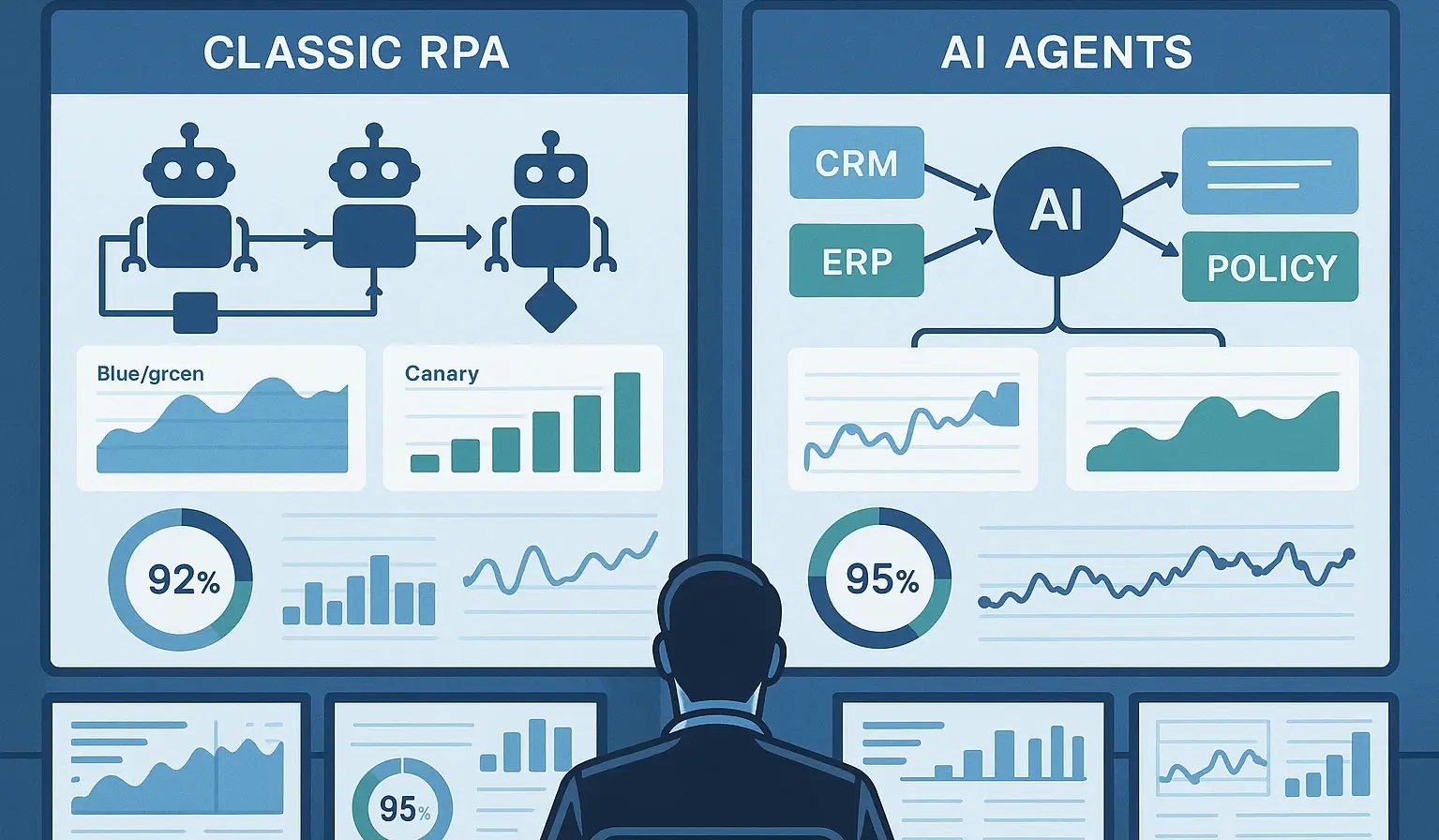
RPA earned its place by automating repetitive, rules-based steps—form fills, reconciliations, and copy‑paste across systems that never exposed proper APIs. You should keep it where inputs are structured, variance is low, and exceptions are rare. But as processes traverse CRM, ERP, policy admin, and custom apps, rules alone hit a ceiling.
Document ambiguity, policy nuance, and multi-step judgment balloon exception rates and maintenance costs. That’s where agentic AI extends the stack. Agents perceive (interpret text, images, or conversations), decide (weigh evidence against policy and goals), and act (take the next step in context), closing the gap between “automation” and “outcome.” The decision of where to place agents is architectural, not ideological. Inventory workflows and segment steps by variance and risk.
Keep deterministic RPA for low-variance steps (e.g., validated data entry) and place agents at decision nodes: eligibility checks with conflicting evidence, exception routing that weighs multiple signals, high-value outreach that must adapt to context, or summarization that turns unstructured notes into structured signals. Treat each potential decision node like a mini-product: define the outcome you want (cycle time, accuracy, cost-to-serve, CSAT/NPS), the smallest helpful action, the allowable data, and the human-in-the-loop threshold.
From a systems perspective, think “microservices for judgment.” An agent should have a clear contract—inputs, outputs, and scope. It perceives by retrieving only the minimal context required; it decides using rules first and selective models where the surface is complex; it acts within an allow-listed set of tools; and it logs everything with an immutable trail. Decoupling is your friend.
Rather than wiring an agent directly into brittle legacy flows, mediate through an orchestration layer that normalizes authentication, enforces retrieval boundaries, handles retries, and publishes events. This makes change safe—you can run agents in shadow mode, compare recommendations to actuals, and graduate them to supervised actions without disrupting steady-state operations. Security and privacy aren’t afterthoughts; they’re performance features. Least‑privilege access and data minimization lower both exposure and latency. Consent-aware retrieval ensures that each action’s lawful basis is evaluated at activation, not just at initial data collection. Governance should accelerate, not slow. Map your controls to the NIST AI RMF and consider operating under an auditable AI management system like ISO/IEC 42001 (practical guidance at ISMS.online).
These references provide a common language for risk that product, security, and legal can use to move faster—within guardrails. Finally, insist on observability from day one. If you can’t see it, you can’t scale it. Trace requests end-to-end, monitor golden signals (latency, error, saturation, throughput), and attach cost and quality metrics (token spend, approval/override rates).
Leader-friendly primers on why observability pays are available from Splunk. With these foundations, you’ll know exactly where RPA remains the right tool and where agents create step‑change value—without betting the uptime you’ve already earned.
Integration patterns that protect uptime and trust
Adding agents to brittle workflows without a plan is how outages happen. The principle for safe evolution is separation of concerns and progressive change.
Treat agents as first-class microservices that expose versioned APIs and accept scoped credentials. Interpose an orchestration layer between agents and legacy systems so you avoid point-to-point wiring that’s hard to monitor or unwind.
That layer should handle authentication, policy checks, retrieval boundaries, idempotency, and retries with exponential backoff. Where the legacy stack can’t emit events, use change-data capture or lightweight adapters to publish domain events into a streaming backbone; reference designs for stream analytics explain the building blocks enterprises reuse at scale (see Google Cloud).
Progressive delivery is your safety net when behavior changes under live traffic. New prompts, tools, policies, or models should ship behind feature flags with blue/green or canary releases so you can validate performance on a sliver of traffic, roll back instantly, and expand only when guardrails hold. Friendly primers on zero-downtime delivery are available from HashiCorp and Harness.
Observability turns fear into feedback: instrument the full path from trigger to action with distributed tracing, structured logs, and golden signals—latency, error rate, saturation, and throughput—paired with business KPIs so ops, product, and finance share a single scoreboard; see Splunk for a leader-friendly overview.
Trust is built into the architecture. Enforce least-privilege access and allow/deny lists for data fields, systems, and actions. Make retrieval boundaries explicit so agents fetch only the minimal context bundle they require. Keep immutable decision logs that capture inputs, retrieved evidence, applied policies, rationale, and outcomes; these logs are your backbone for audits, root-cause analysis, and optimization.
Align your controls to accepted frameworks—the NIST AI RMF gives a practical risk vocabulary, and ISO/IEC 42001 provides an auditable AI management system with implementation guidance at ISMS.online. Privacy-by-design isn’t just legal hygiene; minimization reduces payloads and speeds decisions.
A phased rollout with experiments and CFO-ready KPIs
Roadmap discipline converts promise into proof. Run a staircase rollout: Shadow mode (read-only). Agents perceive and recommend but do not act. Benchmark recommendations against actual outcomes to calibrate precision, latency, and cost.
Publish weekly readouts so stakeholders see directional opportunity before any risk is taken. Supervised execution. Enable a narrow set of low-risk actions behind feature flags for small canary cohorts. Pre-define stop-loss thresholds, escalation paths, and an instant rollback button.
Attribute impact at the journey-node level—e.g., “day‑3 claim status update” or “onboarding blocker removed”—to avoid channel-based misattribution. Narrow autonomy. Expand to repetitive, mid-value actions where policies are clear and humans remain in command for exceptions and high-stakes moves. Continue to rotate prompts and models and monitor drift.
Measure what the CFO cares about. Pair SLOs (latency, availability, quality/error budgets) with business KPIs (cycle time, accuracy, cost-to-serve, CSAT/NPS, retention). Prefer randomized control for changes that touch customers; otherwise use quasi-experiments (matched cohorts, difference-in-differences). Maintain a monthly value realization review that reconciles incremental lift with costs (integration, inference, human-in-the-loop). For
MapleSage’s ICPs, good first targets include: - Insurance: claim-status transparency, fraud triage flags, and complex-case routing. Industry analyses highlight measurable gains when data and decision flows unify (see McKinsey). - SaaS: onboarding milestones, usage-cliff detection, and executive-sponsor engagement. - Retail: inventory-aware service recovery and replenishment cues. Culturally, make “humans in command” explicit. Train teams to interpret decision logs, override recommendations, and escalate appropriately.
Publish transparent policies describing automated decisions and data use. When you combine progressive delivery, deep telemetry, privacy-by-design, and experiment-first operations, you evolve from brittle scripts to resilient, learning systems—compounding ROI without breaking what already works.