

#InsuranceInnovation
#OperationalExcellence
De-risk your managed services transition

How to automate General Average claims with evidence and speed.
General Average (GA) cases compress complexity into a single moment: a deliberate sacrifice or extraordinary expense is incurred to save a maritime venture, and then parties must contribute their fair share. That legal principle is centuries old, but the workflows around it are often painfully modern—email chains, re‑keyed data, and week‑long waits to assemble documents and verify coverage. The result is friction for carriers, brokers, cargo interests, and surveyors—and a cycle‑time drag exactly when trust is on the line. Modernizing GA does not require a risky core replacement. You can speed clean cases and focus expert attention on complex ones by standardizing digital intake, attaching evidence to every automated suggestion, and orchestrating work through events rather than brittle point‑to‑point handoffs. Start by getting the rules and context right. Most GA clauses today reference the York‑Antwerp Rules (YAR), with the 2016 revision widely adopted. A concise overview of the changes helps claims teams align terminology, allowable expenses, and documentation expectations; see Marsh’s summary: Marsh: York–Antwerp Rules 2016, and a practitioner briefing on the update: YAR 2016 Changes (PDF). Start at the edge—intake and document capture. Replace free‑form notices with guided GA intake that adapts to the nature of sacrifice/expense and line of cover. Validate required fields in real time (voyage details, vessel, ports, declared values), and request only the artifacts that accelerate review. Large‑file uploads should be painless; mobile capture should enforce photo quality. Each document is indexed down to page and table so reviewers can jump straight to context. With clean intake, you can turn on explainable assistance: layout‑aware extraction pre‑populates key fields across bills of lading, cargo manifests, invoices, and survey reports; summarization condenses lengthy reports into scannable briefs; and triage surfaces coverage conflicts or missing elements early. Crucially, every suggestion carries an evidence breadcrumb to the exact page/snippet to build trust and shorten review. The payoff is flow. When milestones like notice.received, claim.triaged, and coverage.verified are published as events, downstream services—triage engines, vendor assignment, payments, communications—subscribe and act without overloading legacy cores. Complex cases get routed to senior handlers with evidence attached; clean cases glide through with clear human override paths. That’s how you turn GA complexity into throughput.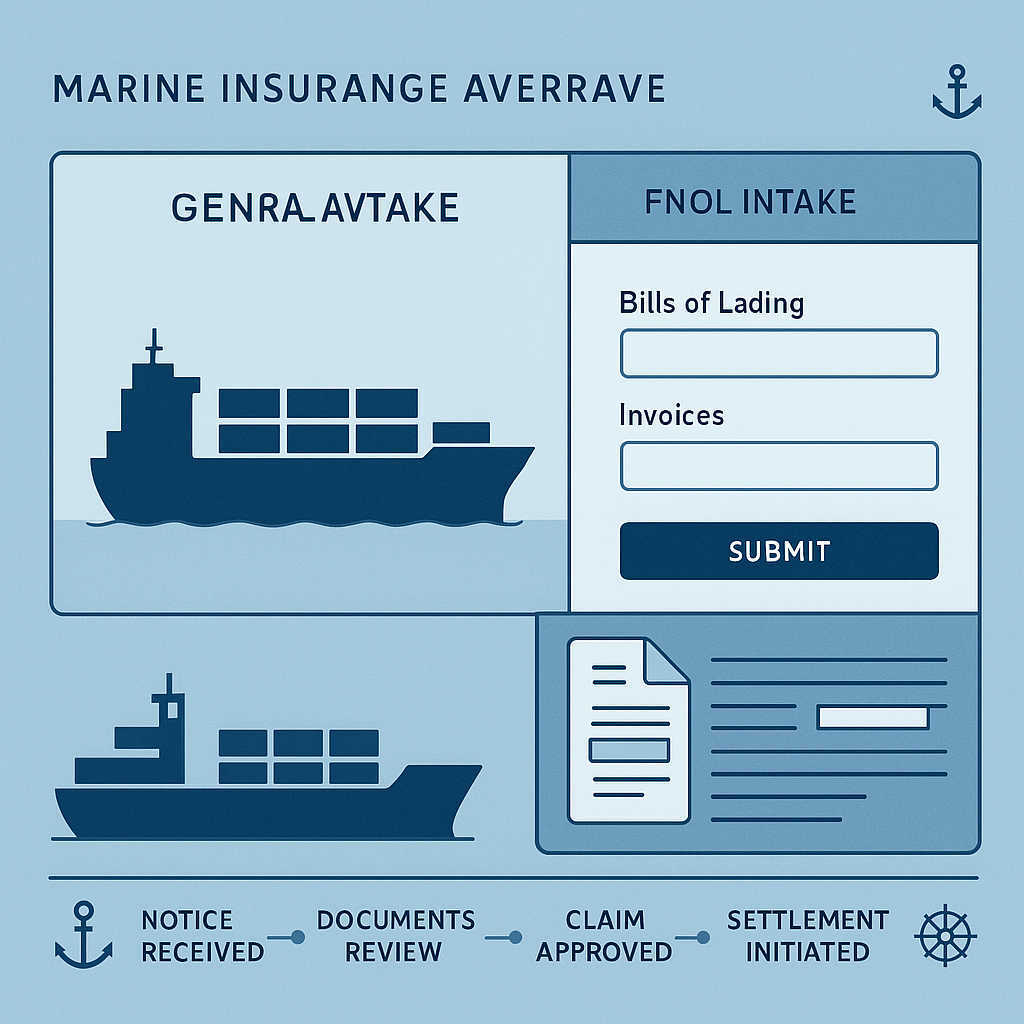
General Average claims strain traditional workflows because they are evidence-heavy, multi‑party, and time sensitive. The backbone that changes outcomes combines evidence-linked document intelligence with event-driven orchestration so that intake fuels the entire journey and every automated assist is explainable. Start at submission. Replace email‑driven intake with guided web and mobile flows that adapt to GA events (jettison, salvage, extraordinary expenditure). Validate basics—policy number format, voyage dates, vessel/port codes—at the edge; pre‑fill details from policy and prior voyages where permitted. Prompt for the documents adjusters actually need: bills of lading, manifests, invoices, general average bond/guarantee, survey reports, and, if applicable, salvage contracts. Align fields to ACORD elements to reduce downstream mapping friction with brokers/TPAs and cores; reference: ACORD Data Standards. Evidence must travel with every suggestion. Use layout‑aware extraction so each pre‑filled field (consignee, declared value, port of loading, contributory value) carries a breadcrumb—document ID, page number, and highlighted snippet. This turns review into “accept/correct” instead of re‑key and builds the audit trail regulators and counterparties expect. Calibrate triage to GA‑specific signals: magnitude of sacrifice/expense, documentation completeness, bond/guarantee status, and coverage conflicts. When a rule or model flags a conflict (e.g., exclusions, warranties), expose the clause reference and supporting text, not a black‑box score. Flow beats handoffs. Publish canonical lifecycle events—notice.received, claim.triaged, GA.adjuster.assigned, coverage.verified, survey.requested, contribution.calculated, settlement.initiated—so specialized services subscribe and act without overloading the claims core. A vendor orchestration service can auto‑assign surveyors based on geography and capacity; a communications service can trigger proactive status updates to brokers/insureds from the same events. This pattern mirrors guidance from market platforms on decoupling outbound integrations with application events; see Guidewire App Events overview.
Turn design into durable outcomes with metrics, governance, and surge readiness. Measure the distribution of cycle times (median, 75th/95th percentile) for GA segments (jettison vs. salvage vs. expenses) and track FNOL‑to‑triage latency, manual touches, and time‑to‑bond/guarantee. Instrument contribution calculation lead time and reconciliation rework. Tie operations to customer/broker outcomes: deflection of “where’s my claim?” calls via proactive events, dispute rates, and renewal deltas for accounts with GA incidents. Anchor governance from day one. Persist decision inputs/outputs with trace IDs next to each event; store the evidence presented to reviewers and capture override reasons as structured data. Publish a transparency statement distinguishing automated assistance from human decisions. Align explainability to regulator expectations; the NAIC’s AI principles emphasize fairness, accountability, and transparency in insurer AI; see NAIC AI Principles. Design for surge. Port congestion, large‑loss incidents, or CAT spillovers can spike GA volume. Use idempotent event handlers, dead‑letter queues, and service‑specific scaling to preserve flow. Define temporary surge policies (e.g., relaxing noncritical validations for low‑exposure cases) with explicit time windows and audit logs. For market alignment that simple claims should move straight through while complex ones get expert attention, see the Lloyd’s market vision in Blueprint One/Two highlighting straight‑through processing for simple claims: Lloyd’s Blueprint Two and an accessible summary: Lloyd’s Blueprint One. With evidence‑linked intake and event‑driven orchestration, GA claims settle faster without sacrificing control. Carriers gain clear audits, fewer handoffs, and broker confidence—speed with accountability.