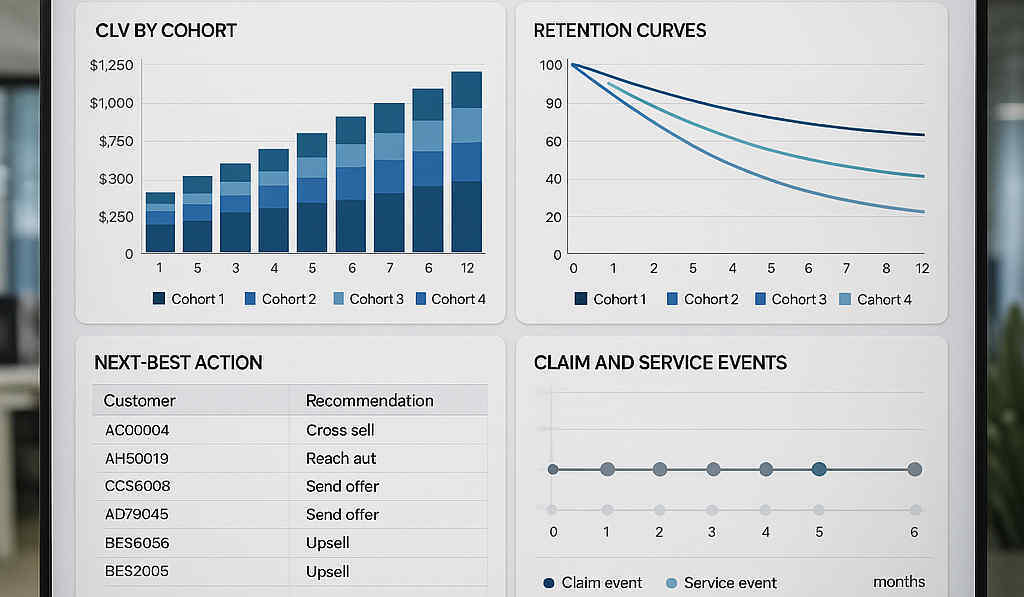
A practical blueprint to raise insurance CLV with real-time, consent-aware decisions.
Start with moments and actions, not models or averages
Customer lifetime value (CLV) is not a single number to admire; it’s the sum of timely decisions that reduce churn, increase loyalty, and expand relationships. In insurance, those decisions happen at recognizable moments: onboarding in the first 30 days, claim transparency in week one, triage and routing at intake, service recovery after a negative interaction, and renewal windows at day 90.
Before touching a model, map these journey nodes for your lines of business (P&C, health, life, specialty) and define the smallest helpful action at each node. If no plausible action exists, don’t measure it—CLV only moves when behavior does. Anchor the program in consent‑aware data. Stitch identities across policy, billing, claims, broker/agent portals, and CRM deterministically first, then probabilistically. Stream domain events—FNOL filed, adjuster note added, medical record received, payment issued, coverage change—into a governed pipeline with schemas, lineage, and freshness SLAs.
Treat consent and preferences as runtime controls evaluated at activation, not just at collection. Tag fields with purpose, residency, and retention to automate policy checks. This reduces payloads and complaint risk while raising response rates. Industry analyses show carriers that unify data and activate decisions at key touchpoints raise satisfaction and compress cycle time; see McKinsey. Finally, translate CLV into operational levers. For each node, specify allowable data, lawful basis, frequency caps, and human‑in‑the‑loop thresholds.
Publish baseline metrics: time‑to‑first‑value for onboarding, call volume and CSAT around status transparency, cycle time for triage, and renewal retention by segment. This makes value hypotheses testable and aligns stakeholders on what “good” looks like.
Design signals, models, and decisions that move CLV
Signals and decisions—not dashboards—move CLV. Build features you can observe before acting: usage trend breaks, claim status recency, unresolved document requests, negative interaction signals, shifts in risk profile, and geo or life‑event triggers. Keep retrieval boundaries tight so each decision fetches only a minimal context bundle. This lowers latency and exposure and makes behavior explainable. Modeling follows economics.
Use rules with guardrails for common moments: day‑3 and day‑7 claim updates, overdue document nudges, coverage reviews after a material change, and renewal benefits reminders at day‑90. Add models where the surface is complex and the cost is real—propensity to act, uplift for costly interventions (e.g., human outreach or offers), eligibility, severity, and anomaly. Uplift (treatment‑effect) modeling outperforms raw propensity when capacity is scarce or actions are expensive because it targets “persuadables”—customers who will change behavior if you intervene.
For accessible primers on next‑best experience and incremental impact, see McKinsey. For broader industry context and planning benchmarks, refer to Deloitte. Make privacy a performance feature. Evaluate consent and lawful basis at activation (contract or legitimate interest often applies for service communications); minimize PII in payloads; enforce region‑aware boundaries; and log every decision with inputs, rationale, and outcome so audits become evidence assembly. This discipline reduces incidents and accelerates approvals as you expand CLV programs across lines and regions.
Operate with experiments, SLOs, and CFO-ready attribution
CLV programs succeed when they are operated like products with finance in the room. Start in shadow mode for low‑risk nodes to quantify opportunity and calibrate latency. Move to supervised actions behind feature flags and canary cohorts with stop‑loss thresholds and instant rollback. Attribute lift at the journey‑node level—“day‑3 claim update cut inbound calls X% and raised CSAT Y,” “onboarding blocker cleared reduced early‑life churn Z%,” “renewal benefit check improved retention W points.” Prefer randomized controlled tests; otherwise use quasi‑experiments (matched cohorts, difference‑in‑differences).
Pair business KPIs with technical SLOs. Track cycle time, cost‑to‑serve, retention/NRR, and loss ratio alongside golden signals (latency, error, saturation, throughput). Deploy changes safely—treat rules, prompts, and models as deployable artifacts with rollback via blue/green and canary releases; leader‑friendly primers on zero‑downtime practices are available from HashiCorp. If you can’t see it, you can’t scale it—instrument end‑to‑end observability so product, operations, risk, and finance share one scoreboard; see Splunk. Governance aligns speed with trust.
Map lifecycle controls to the NIST AI RMF and consider operating under an auditable AI management system (ISO/IEC 42001). As programs mature, standardize reusable services (identity/profile, event streaming, decisioning, observability) so lines of business compose outcomes without reinventing the rails. With consent‑aware data, cost‑sensitive decisioning, and disciplined experiments, insurers can raise CLV visibly and verifiably—customers feel the difference, and the P&L does too.