How AI augments insurance teams to solve the talent crunch.
Why capacity broke: submissions up, experts down
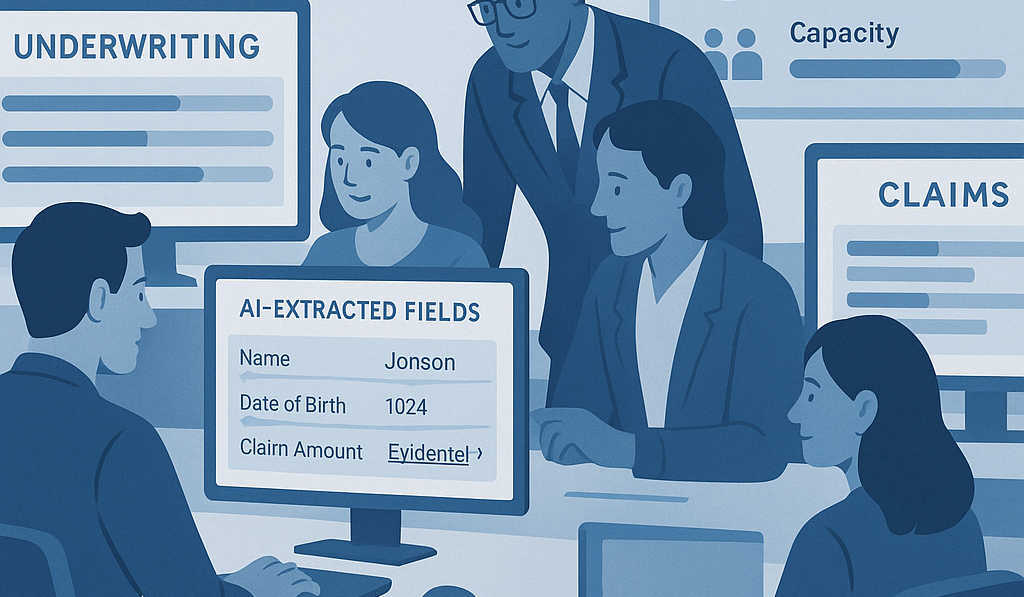
Insurers face a structural capacity problem. Submission volumes and claims complexity are rising while experienced underwriters and adjusters retire or leave the industry. Many carriers respond with overtime or outsourcing, but that doesn’t solve the core issue: too much low‑value work (re‑keying, document chasing, status calls) and not enough support for human judgment where it matters. The durable fix is AI‑augmented workflows—designed for insurance—that reclaim capacity, raise quality, and keep people in control. Start with the business reality. Industry labor studies show persistent demand for underwriting and claims roles and growing pressure on experienced staff. In some markets, back‑to‑back CAT seasons have revealed how thin adjuster capacity can become, with workload and dispute risks spiking; see reporting on adjuster workloads and delays: Insurance Journal. At the same time, underwriting leaders are being asked to handle more submissions, faster, without adding headcount. The path forward is not “full automation.” It’s right‑sized assistance that removes mechanical tasks and amplifies human expertise with evidence and explainability. Fix the front door to cut noise. Replace static PDFs and email ping‑pong with ACORD‑aligned submission in underwriting and guided, mobile‑first FNOL in claims. Validate required fields and pre‑fill from policy data and third‑party sources where allowed. Accept large attachments and index them so reviewers can jump straight from a field to the source page or table. With standardized data, you can introduce assistance that teams will actually use: classification to separate forms from evidence, extraction to pre‑populate fields, and summarization to condense long documents. Crucially, every suggestion must carry evidence and a confidence score so reviewers can accept or correct quickly and move on. This changes minutes into seconds—and minutes into hours across a day.
Design AI-augmented workflows for underwriting and claims
Designing AI-augmented workflows starts at the front door and ends with explainable human decisions. Standardize intake: ACORD-aligned submissions for underwriting and guided digital FNOL for claims reduce rework and missing data. Validate addresses, dates, and required fields at the edge; pre‑fill from prior terms and permissible third‑party sources. Ingest broker emails and large attachments into object storage and index every page and table for one‑click evidence. With standardized intake, turn on explainable assistance that removes low‑value work without replacing judgment. Classification separates forms from evidence; extraction pre‑populates insured, COPE, limits, endorsements, and loss‑run metrics; summarization condenses engineering reports and long adjuster notes into scannable briefs. Every suggestion must carry breadcrumbs—page snippets or table‑cell references—and a confidence score so reviewers can accept or correct quickly. This “evidence‑linked” pattern is essential for trust and speed. Route for expertise and value. Build specialty‑aware queues (Marine, Cyber, D&O, Renewable Energy) and route by complexity signals (sum insured, exclusions, prior losses, documentation completeness). Keep a fast lane for low‑risk renewals and administrative tasks under strict thresholds, with clear override paths. Integrate tightly with PAS, rating, and claims cores through an API gateway and publish lifecycle events—submission.received, claim.triaged, coverage.verified, payment.initiated—so services subscribe and scale independently. This event‑driven design is how you absorb spikes without burning out teams or overloading legacy systems; see a platform view on application events that decouple outbound integrations: Guidewire App Events overview. Calibrate augmentation to talent realities. Underwriters need context, not black boxes; claims adjusters need clarity on what to do next, not another alert. Prefer transparent models (e.g., tree ensembles with SHAP explanations, monotonic GAMs for sensitive features) and capture reviewer overrides with reasons to improve models over time. For background on underwriting talent challenges and the shift toward technology‑enabled roles, see: McKinsey on Underwriting Talent.
Operating model: metrics, change, and governance that pass audits
Run the operating model with outcomes, change, and governance built in. Metrics should reflect reclaimed capacity and quality: time‑to‑decision distribution by line of business, manual edits per field (falling), quote‑to‑bind lift, FNOL‑to‑triage latency, touches per claim, and deflection of “where’s my claim?” calls. Track team health: queue age, after‑hours load, and rework rate. Tie operational gains to retention—broker/policyholder satisfaction and renewal deltas for accounts exposed to the new journey. Change management is as important as models. Train reviewers on fast evidence checks and when to override; publish specialty playbooks; celebrate “time saved” stories; and appoint product owners for the workbench and intake experiences. Equip leaders with dashboards connecting capacity wins to business outcomes. Sustain trust with governance. Persist decision inputs/outputs with model versions and trace IDs; keep a model/rules inventory with intended use and limitations; and publish a transparency statement that distinguishes automated assistance from human decisions. Align to the NAIC’s principles emphasizing fairness, accountability, and transparency for insurer AI; see NAIC AI Principles. For labor‑market context on adjuster workloads and staffing pressure, see examples from industry reporting: Insurance Journal: Adjuster Workloads. With augmentation that is explainable and audit‑ready, carriers do more with fewer heroics—and keep scarce talent engaged.