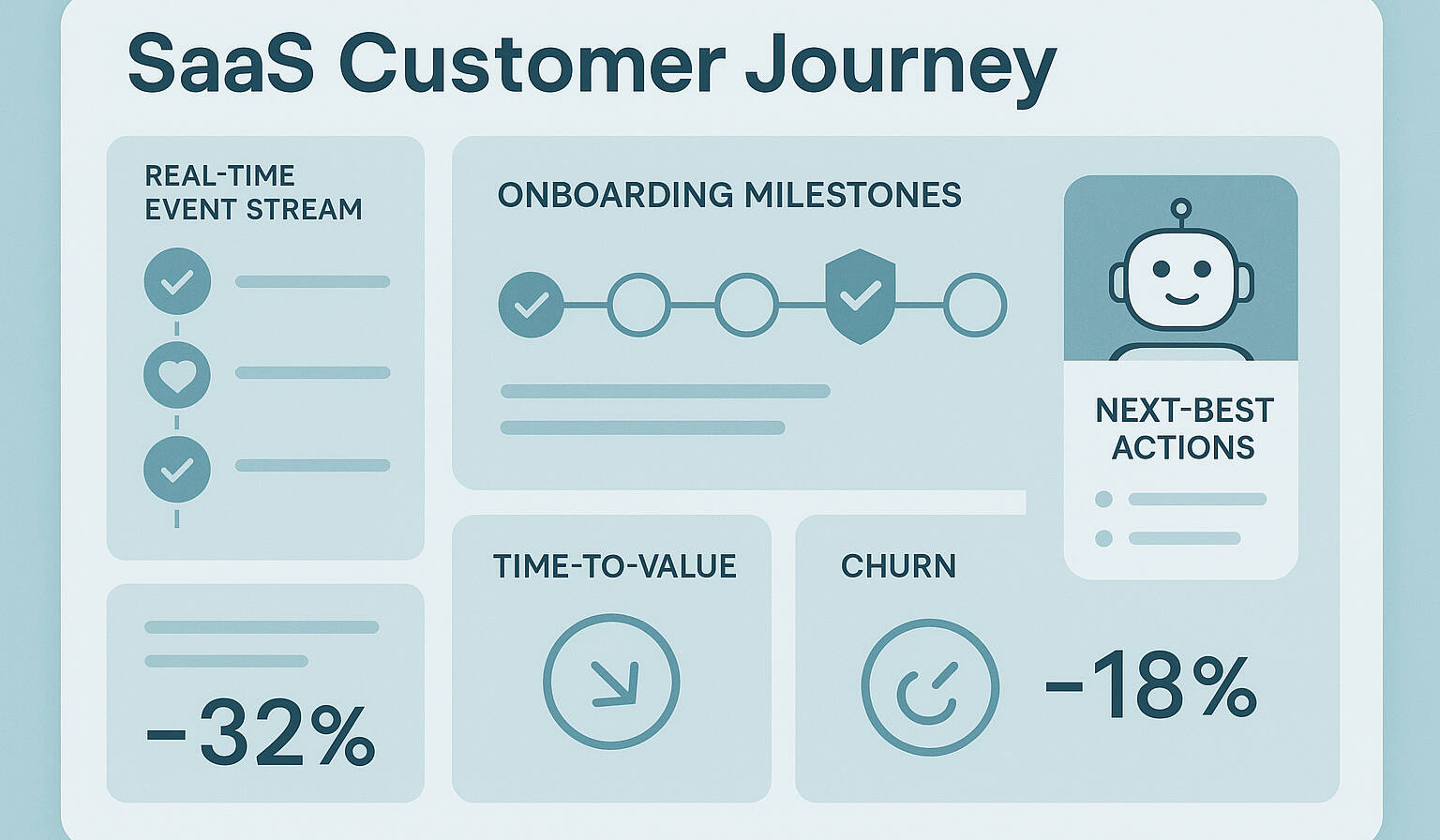
A practical playbook for real-time onboarding that reduces churn.
Why onboarding timing beats volume for preventing churn
Most SaaS churn isn’t a dramatic exit; it’s a slow drift that starts in onboarding. Customers hit friction, time-to-first-value stretches, sponsors go quiet, and renewal risk hardens. The instinctive response—more emails, more webinars—rarely works because activity without timing and context becomes noise.
What moves the needle is a sequence of timely nudges that help users clear specific milestones in the hours and days when it matters. Think activation tasks completed within week one, integration blockers removed promptly, and executive sponsors re-engaged before usage cliffs deepen.
Practitioner write-ups and industry trackers consistently link strong onboarding to lower churn and higher expansion; for example, Gainsight’s guidance highlights onboarding as a primary lever for retention (Gainsight).
Leadership conversations also underscore net retention’s centrality to SaaS value creation (McKinsey). The question isn’t “how many touches,” but “which moment, what action, and why now?” When you design onboarding around decision points—milestones and failure modes—you can test specific interventions, attribute lift credibly, and scale what works.
MapleSage’s stance is simple: helpful, on time, with consent. That lens keeps nudges effective and trust intact.
Architecture: events, decisioning, consent, and observability
Speed comes from architecture as much as copy. Instrument your product and CRM to emit events for login, feature milestones, integration success/failure, support tickets, and executive-sponsor engagement. Stream them into a governed pipeline with schemas, lineage, and freshness SLAs.
Separate systems of record from a consent-aware profile that exposes only the minimal context each decision needs. Above this, run a rules-first decision layer with selective models where the surface is complex (propensity to adopt, uplift for costly outreach).
Each decision should
1) request a minimal context bundle,
2) evaluate consent and lawful basis,
3) choose an action (message, task, escalation),
and 4) write an immutable decision log.
Vendor-neutral primers on real-time analytics patterns are helpful for non-SRE leaders (see Confluent and a cloud reference at Google Cloud). Deploy changes safely. Treat new onboarding logic and models like any production system: ship behind feature flags, validate with blue/green or canary cohorts, and roll back instantly if metrics degrade.
A concise overview of zero-downtime patterns is here: HashiCorp. Make observability a habit: trace decisions end-to-end and monitor golden signals—latency, error, saturation, throughput—beside business KPIs (time-to-first-value, activation rate, early-life churn).
For leadership context on observability’s benefits, see Splunk. Privacy is a performance feature. Evaluate consent and preferences at activation; minimize PII; respect regional residency; and align lifecycle controls with the NIST AI RMF. These controls reduce payloads, speed decisions, and build trust.
Proof: experiments, KPIs, rollout, and operating rhythm
Turn architecture into outcomes with an operating rhythm. Start with a shortlist of high-leverage moments: activation checklist completion in week one, first value event (e.g., data import), integration unblock, and executive sponsor cadence. For each, define the smallest helpful action (contextual guide, office-hours invite, task for CSM, internal escalation), allowable data, and KPIs with counterfactuals. Roll out in stages:
1) shadow mode (read-only recommendations and counterfactual lift estimates),
2) supervised actions for a small cohort behind flags with stop-loss thresholds,
3) expand when lift clears a pre-set hurdle. Attribute at the journey-node level—“onboarding blocker cleared reduced early-life churn by X%.”
Maintain weekly experiment readouts and a monthly value realization review that reconciles incremental lift with cost (integration, inference, human-in-the-loop). Evidence compounds.
Public analyses and operational playbooks show onboarding-led retention programs outperform generic campaigns when they’re timely and measured (Gainsight). Supplement qualitative wins with quantitative signals: time-to-first-value, milestone completion rate, day-30 activation, and 6–12 month NRR. With consent-aware data, rules-first decisioning, progressive delivery, and observability, you’ll move onboarding from “welcome tour” to a reliable engine that cuts churn in real time.