A pragmatic playbook for integrating AI agents with zero downtime and measurable ROI.
Enterprises eager to adopt agentic AI often underestimate the integration work required to make agents invisible to end users—and non-disruptive to core systems.
Architecting zero-downtime AI agent integrations
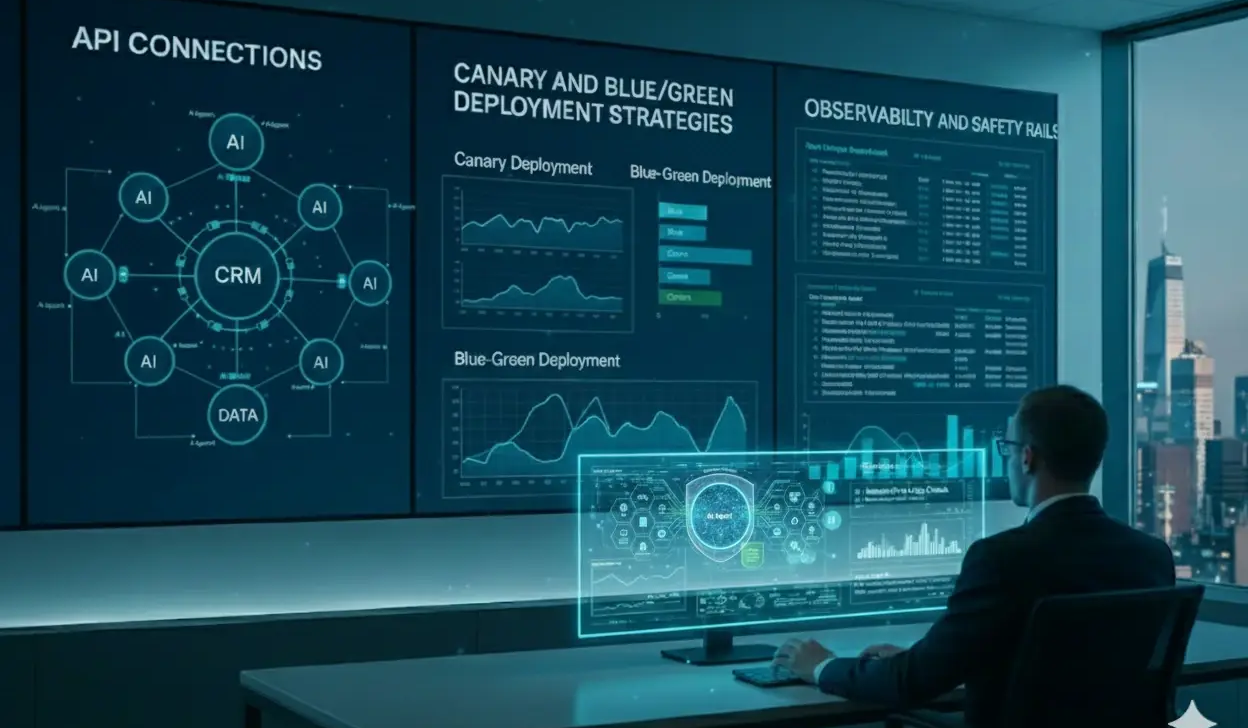
A zero-downtime mindset is the difference between pilot theater and production-grade value. Start by mapping the end-to-end workflow where the agent will operate, clarifying system boundaries, upstream/downstream dependencies, and the “blast radius” if something goes wrong. Integration patterns that minimize disruption include blue/green deployments, rolling updates, and canary releases. These strategies let you ship new agent capabilities to a small audience, monitor key service-level indicators, and roll back instantly if regressions appear. For a concise primer, see HashiCorp and Harness. Because agents interact with live data and transactional systems, strict interface contracts and compatibility tests are essential. Treat your agent like any microservice: define stable APIs, version them, and validate backward compatibility before releasing. Use feature flags to toggle behaviors on and off without redeploying, and isolate risky capabilities behind kill switches. Progressive delivery lets you validate performance, cost, and quality signals under real load before scaling traffic. In addition, build fault-tolerant integration points: timeouts, retries with jitter, circuit breakers, and idempotent operations to prevent duplicate side effects. While many blogs popularize these ideas, the core reliability principles originate from SRE and continuous delivery—see overviews on Splunk and industry case notes from Christian Posta. Finally, plan the agent’s “adjacency” strategy. Instead of wiring an agent deep inside a brittle legacy workflow, create a sidecar or orchestration layer that mediates between the agent and systems of record (CRM, ERP, policy administration). This isolates change, accelerates experimentation, and allows you to phase the agent from read-only observation to supervised actions, then to autonomous execution in narrow scopes. MapleSage typically applies this staircase approach for high-stakes workflows in insurance and SaaS ops—preserving business continuity while unlocking compounding efficiency gains.
Observability, safety rails, and compliance by design
Observability is your safety net. If you can’t see it, you can’t safely scale it. Before agents touch production data, instrument the full request path with distributed tracing and structured logs. Track golden signals—latency, error rate, saturation, and throughput—for each integration hop. Observability platforms should support SLO dashboards, alerting, and automated rollback triggers when error budgets are threatened. Practical benefits and patterns are summarized by Splunk and DevOps best-practice guides such as Firefly. Combine logs with semantic eventing that captures agent decisions, prompts, retrieved evidence, and actions—this is crucial for debugging and post-incident analysis. Safety rails must be built-in, not bolted on. Enforce least-privilege access for the agent’s credentials; scope tokens to the minimum datasets and actions. Add allow/deny lists for systems and fields, and verify data minimization at each call. Where the agent produces content or decisions, implement human-in-the-loop checkpoints for high-risk operations, and run automated policy checks for PII handling and regulatory constraints. Keep an immutable audit trail of prompts, inputs, outputs, and downstream effects to satisfy auditors and security teams. This aligns with emerging best practices across SRE and security engineering, and mirrors patterns used in reliable zero-downtime releases such as blue/green and canary (HashiCorp). Compliance by design means you treat governance as code. Classify data and tag flows; enforce retention, masking, and residency rules at the pipeline level; and continuously validate for fairness, bias, and model drift. For regulated sectors like insurance, agents should start in advisory mode—surfacing recommendations, rationales, and linked evidence—before graduating to automation with clear overrides and rollbacks. MapleSage’s implementations in claims and customer ops adopt tiered controls and explicit SLAs to ensure reliability, explainability, and trust.
Proving value: rollout playbooks, SLAs, and ROI metrics
Zero-downtime integration is only worthwhile if it demonstrably improves outcomes. Define business and technical success upfront: cycle-time reduction, first-contact resolution, claim adjudication speed, AHT, CSAT/NPS, error rates, and operating margin. Pair these with SLOs for availability, latency, and quality to align IT and the business. A typical rollout playbook: (1) shadow mode with read-only insights; (2) supervised actions in narrow slices via feature flags and canaries; (3) phased autonomy for repetitive, low-risk tasks; and (4) continuous optimization with feedback loops. Set your measurement cadence—weekly operational reviews, monthly value realization checkpoints, and quarterly roadmap updates. Each release should carry a revert plan and budget guardrails. As you scale, keep progressive delivery in place; don’t abandon canaries just because the agent “works.” Evolve SLAs to reflect real-world complexity, and keep an eye on long-tail failure modes (rare inputs, new data sources, policy changes). Where possible, quantify the deployment approach itself: track incidents avoided and time-to-rollback, citing established patterns from Harness and reference materials like HashiCorp. For MapleSage clients, integrating agents into CRM, policy, and service workflows with zero downtime has unlocked compounding returns: faster claims triage, higher agent productivity, and consistent customer experiences without service interruptions. With the right architecture, safety rails, and measurement, leaders can scale AI confidently—delivering tangible value while keeping operations stable.