

#InsuranceInnovation
#OperationalExcellence
De-risk your managed services transition
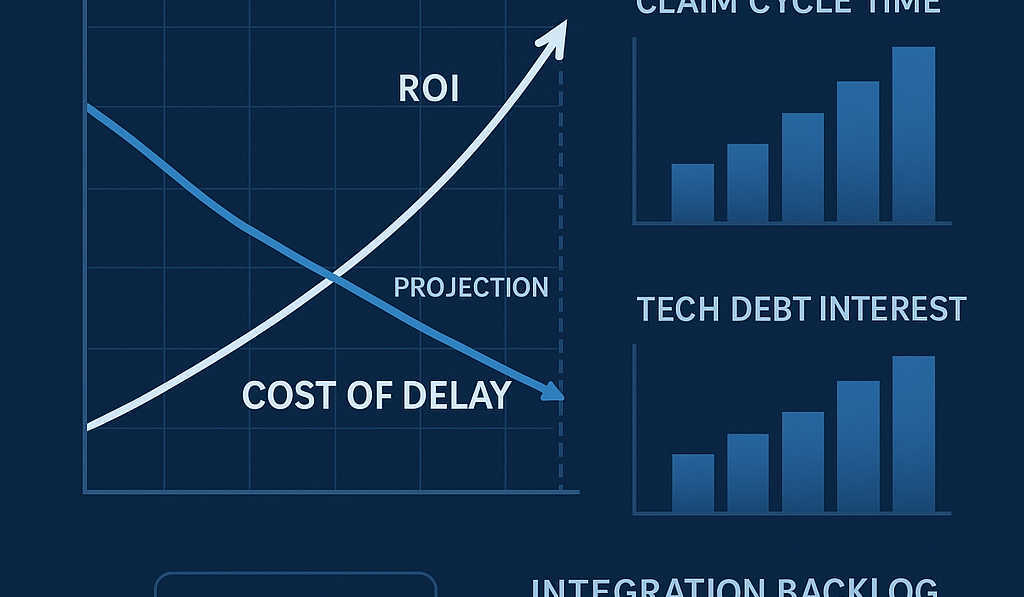

A CFO-ready model for quantifying the cost of modernization delay.
Modernization is often framed as a binary: rebuild the core or do nothing. In reality, most insurers live in the gray—shipping new products and channels while legacy policy and claims systems creak under integration debt. The real risk isn’t only in the code; it’s in the clock. Every quarter of delay compounds hidden costs: partner integrations that take months instead of days; claim cycle times stretched by re‑keying and status chasing; outages tied to brittle point‑to‑point links; and audits that require heroics. This post provides a CFO‑ready model to quantify the cost of delay and a blueprint to reverse it with low‑risk, API‑first moves. Quantify five drivers of “tech‑debt interest” that accrue each month you defer modernization: 1) Integration lag tax. Each new partner or broker integration consumes N engineer weeks because there’s no stable API catalog or sandbox. If your team onboards six partners a year and each takes eight weeks of engineering at a blended $150/hour, you’re spending ~$288,000/year that a contract‑tested API could cut by 50–70%. 2) Manual handoff tax. In claims and underwriting, missing data and unindexed documents add minutes per touch and touches per case. If claims handlers spend an extra five minutes per claim across 200,000 claims annually, that’s >16,000 hours/year—nearly eight FTEs—before considering leakage from delays. 3) Status‑chasing tax. Without lifecycle events and portals, contact centers field “where’s my claim?” calls that deflectable notifications would avoid. If 20% of 500,000 calls/year are status checks at $5 per contact, that’s $500,000 in avoidable cost. 4) Audit and incident tax. When decisions aren’t logged with inputs/outputs and trace IDs, regulators and internal audit burn weeks reconstructing journeys. A modern event/audit spine cuts mean‑time‑to‑reconstruct from days to minutes. 5) Opportunity cost. Delayed launches mean premiums you don’t write and distribution you don’t win. Staged modernization shortens time‑to‑market through reusable contracts and sandboxes—compounding returns. These aren’t hypotheticals; they’re measurable. Industry outlooks repeatedly show that staged, platform‑based modernization yields faster ROI and lower risk than rip‑and‑replace; see a current perspective: Deloitte on Legacy Modernization. The objective is to turn these costs into a business case that funds an API‑first, event‑driven foundation you can deploy in quarters, not years.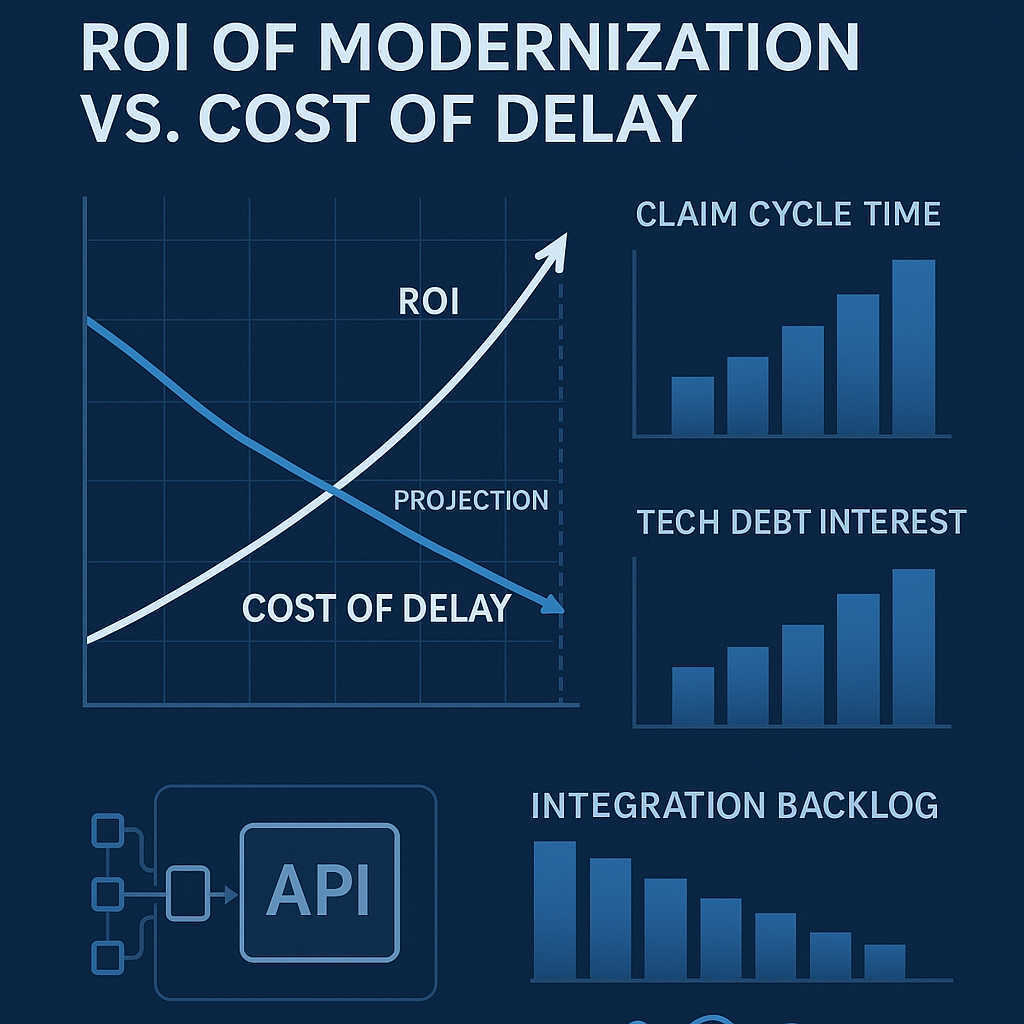
A reference architecture that accelerates payback has three layers: gateway APIs that wrap legacy cores, a lifecycle event backbone that turns state changes into immutable facts, and thin adapters that translate REST/JSON into legacy transactions. This combination reduces handoffs, shrinks integration timelines, and makes it safer to add explainable AI at the edges. In practice: an API gateway enforces identity, consent, schema versioning, and field‑level encryption for PII. Behind it, read APIs (policy, claims, billing) ship first to unlock analytics and partner use cases, followed by a narrow write path like digital FNOL or endorsements. In parallel, publish a minimal event stream—policy.bound, fnol.received, claim.triaged, payment.initiated—to decouple long‑running tasks and power real‑time customer updates. This architecture de‑risks change and creates measurable value fast. Partners integrate faster with predictable contracts and sandboxes; operations move from batch to flow; and compliance gains an audit spine that reconstructs “what happened, when, and why?” in minutes. Major platforms are endorsing event‑driven patterns to simplify outbound integrations and real‑time updates; see an overview of application events from a leading core vendor: Guidewire App Events overview. For a broader strategy lens on legacy modernization and AI’s role, review this summary: Deloitte on Legacy Modernization. Governance must be built in. Persist decision inputs/outputs with model versions and trace IDs next to events; log consent; and align retention by data domain and region. Prefer explainable models at decision boundaries (tree ensembles with SHAP values, monotone GAMs) and capture reviewer overrides as structured data. This is how you deliver speed and remain audit‑ready—a requirement emphasized by regulators; the NAIC’s AI principles stress fairness, accountability, and transparency in insurer AI; see NAIC AI Principles.
Make the numbers visible and actionable. Build a CFO‑ready scorecard that reports monthly: tech‑debt interest avoided (Δ integration hours × blended rate), cycle‑time compression by line (median, P75/95) and its dollar impact (storage/rental days, LAE), deflected status calls (contact‑center cost), and revenue lift from partner speed (time‑to‑integrate weeks → days). Tie modernization metrics to CX (NPS delta for portal users, proactive notifications coverage) and risk (audit reconstruction time, incident MTTD/MTTC). Use these numbers to stage‑gate funding: each quarter unlocks the next capability if KPIs hit targets. CTAs that convert: 1) Download the “Insurance Modernization ROI Calculator” that implements the model above; 2) Book a 45‑minute modernization assessment to baseline your cost of delay; 3) Request a reference architecture kit (API contracts, event catalog, and governance checklist). For market context that staged modernization outperforms rip‑and‑replace, see insurer outlooks emphasizing platform approaches and real‑time operations: Deloitte: Tech ROI 2024–2025. By turning “delay” into a line item and pairing it with a low‑risk architecture, CIOs and CFOs can sequence modernization for fast payback—without betting the company on a multi‑year cutover.