A practical blueprint to lift underwriting output without adding headcount.
Why capacity is constrained—and what to fix first
Underwriting leaders face a structural squeeze: submissions are up, documents are messy, talent is tight, and brokers expect decisions yesterday. Hiring alone won’t fix the gap, and full automation isn’t realistic for complex risks. The answer is a workbench that respects human judgment while eliminating low‑value work—standardized intake, evidence‑linked document intelligence, and orchestration that routes the right case to the right underwriter at the right time.
This playbook shows how to lift output per underwriter without adding headcount. \n\nStart by fixing the front door. Standardize submission intake with ACORD‑aligned forms and edge validation for addresses, dates, and required fields by product. Pre‑fill from prior terms and third‑party data where permitted. Replace email scavenger hunts with portals that accept large attachments and automatically index them so underwriters never lose context.
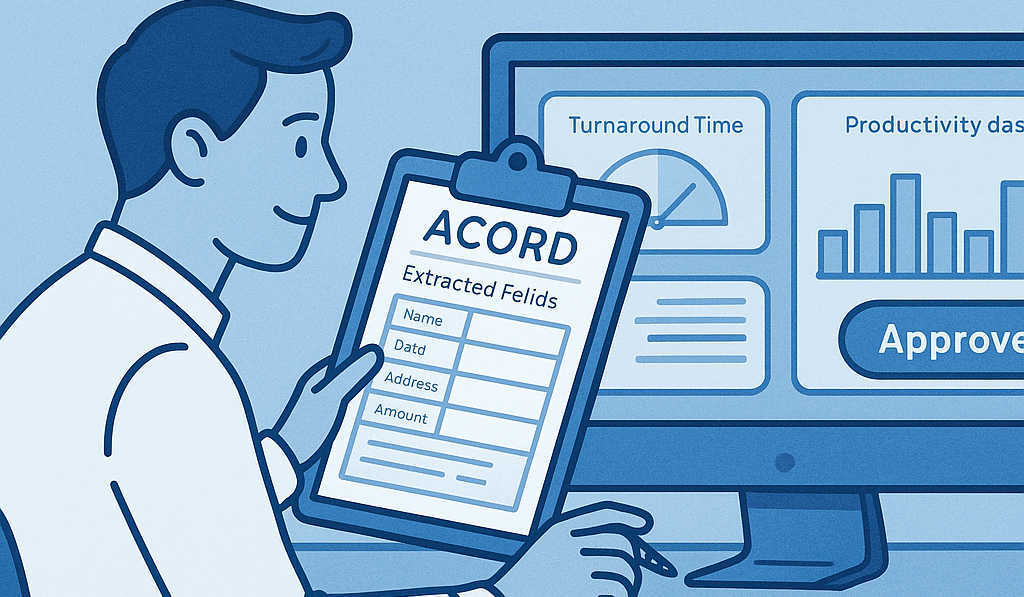
A single pane of glass should tie together submissions, attachments, third‑party signals (property data, cyber posture), and internal history. \n\nElevate document review with explainable AI assists. Use classification to separate forms from evidence, extraction to pre‑populate key fields, and summarization to condense loss runs. The rule: no black boxes.
Every extraction should be linked to the exact page and text that supports it, with a confidence score and a one‑click “accept/correct” action. This turns review into a confirmation task rather than re‑keying, and it creates an evidence trail that speeds audits and appeals. \n\nDesign for speed with control. Keyboard‑first editing, inline redlines, and structured broker requests cut seconds from every step, adding up across thousands of submissions.
Role‑based queues and specialty checklists (Marine cargo manifests, D&O litigation summaries, Renewable Energy engineering reports) keep quality consistent. When the workbench feels like an intelligent teammate that cites sources and learns from feedback, adoption follows—and productivity rises.
Design the workbench: intake, evidence, and human-in-the-loop
Design the workbench around explainable assistance and human‑in‑the‑loop control. Treat ACORD standards as your data backbone to minimize mapping churn and make integrations durable; learn more at ACORD. Ingest broker emails, portal uploads, and third‑party data into object storage with strong indexing so every document, page, and table is addressable by ID.
Use models to classify document types, extract entities (insured, limits, COPE, endorsements), and summarize long artifacts like loss runs and engineering reports. Crucially, attach evidence (page snippets, table cells) and confidence scores to every extraction so reviewers can accept or correct in seconds. \n\nRoute intelligently. Use product rules and complexity signals—sum insured, exclusions present, prior losses—to direct cases to the right expertise.
Reserve fast lanes for low‑risk renewals and simple endorsements under strict thresholds, but keep clear override paths. For new business in specialty lines, surface “what matters most” first: loss trends, coverage conflicts, and missing documents, with one‑click broker requests pre‑filled from context. Build role‑based queues and keyboard‑first workflows to reduce context switching and clicks. \n\nRespect underwriters’ judgment.
Provide transparent rationale for AI suggestions (e.g., which clause triggered a flag), allow inline redlines that propagate back to data stores, and never hide the original document. When AI feels like a junior analyst who cites sources and takes feedback, adoption follows—and so do the cycle‑time gains. For an outside perspective on where insurers are focusing AI in underwriting and the necessity of workflow change, see EY on Generative AI.
Rollout and change: metrics, playbooks, CTAs
Operationalize with a phased rollout and metrics that matter.
Phase 1 (30–45 days): digitize intake for one line (e.g., Marine cargo), turn on ACORD extraction with evidence links, and measure baseline turnaround time and manual data entry minutes per submission.
Phase 2 (45–90 days): add decision support—loss trend summaries, appetite checks, exception routing—and push cleansed data into rating and PAS; enable broker status webhooks to reduce email loops.
Phase 3 (90–150 days): pilot limited auto‑decisions for low‑risk renewals with clear override paths and monthly governance reviews. \n\nMeasure adoption as much as automation. Track manual edits per field (falling over time), time‑to‑decision by product, and quote‑to‑bind lift. Monitor override reasons to refine models and rules; publish transparency statements on where AI assists and where humans decide to satisfy regulators. Tie gains to revenue: faster quotes mean more broker win‑rate and better cycle control. \n\nClose with clear CTAs for the business side: offer an implementation checklist, a 90‑day rollout template, and a calculator that estimates hours reclaimed per underwriter based on submission mix.
These convert curiosity into action—and pipeline. Finally, invest in change management: train reviewers on fast evidence checks, create specialty playbooks (Marine manifests, D&O litigation summaries, Renewable Energy engineering docs), and celebrate “time saved” stories. Productivity compounds when people trust the system and the system learns from people.