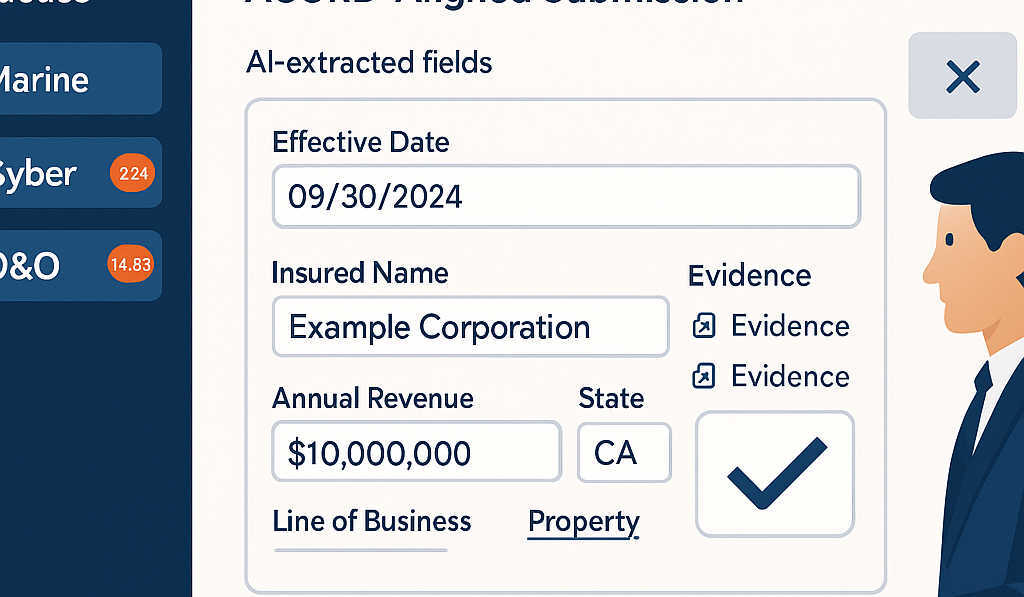
Design triage that speeds underwriting while preserving control.
Why triage, not autopilot, unlocks underwriting speed
Underwriting teams don’t need more alerts—they need clean submissions, clear priorities, and evidence at their fingertips. The fastest way to lift output without risking control is to fix triage: standardize intake, pre‑populate what’s obvious with evidence, and route the right risk to the right reviewer at the right moment. This isn’t “full automation.” It’s right‑sized assistance that respects human judgment and gives compliance the audit trail it expects. Start at the front door. Replace static PDFs and email ping‑pong with ACORD‑aligned e‑submission that adapts to product and appetite. Validate required fields at the edge (addresses, dates, limits) and pre‑fill from prior terms where permitted. Accept large attachments without friction and index every page and table so context is always one click away. With standardized data in place, you can add services that actually help: classification separates forms from evidence; extraction pre‑populates insured, COPE, limits, and endorsements; and summarization condenses loss runs and engineering reports into a human‑scannable brief. Standards matter because they reduce mapping sprawl across brokers, MGAs, TPAs, and the PAS; see the canonical reference: ACORD Data Standards. Design triage for speed with control. Build specialty‑aware queues (Marine, Cyber, D&O, Renewable Energy) and route by complexity signals (sum insured, prior losses, exclusions, ambiguity of extractions). Keep a fast lane for low‑risk renewals and simple endorsements under strict thresholds, with clear override paths. Every AI suggestion must carry evidence—page snippets or table cells—and a confidence score. Review becomes “accept/correct,” not re‑key. Treat explainability as an interaction model: show reviewers why a risk signal fired using transparent techniques (e.g., SHAP for tree ensembles) and let them override with reasons that feed model improvement. For perspective on the workflow and change elements that drive ROI, see: EY on Generative AI. Close the loop with integration and transparency. Push cleansed data back into PAS and rating engines; expose APIs and webhooks so brokers can check status and supply missing docs without email. Instrument the flow: time‑to‑first‑review, manual edits per field, quote‑to‑bind lift, and reviewer adoption. Publish a transparency statement that separates AI assistance from human decisions. With triage redesigned around ACORD, evidence, and human oversight, underwriters spend time on judgment—not transcription—and leaders get speed they can defend to auditors and brokers alike.
Design ACORD‑first triage: queues, evidence, and human oversight
Design triage around ACORD‑first intake, explainable evidence, and specialty‑aware routing. Standardize the front door with ACORD‑aligned submissions so key fields are consistent and validations run at the edge. Ingest broker emails and large attachments into object storage; index every document by page and table so reviewers can jump to evidence in one click. Classification separates forms from evidence; extraction pre‑populates insured, COPE, limits, and endorsements; summarization condenses loss runs and engineering reports. Crucially, each suggestion must carry breadcrumbs—page snippets or table cell coordinates—and a confidence score so underwriters can accept or correct quickly. Build queues that reflect expertise and value. Route by product and complexity (Marine cargo vs. hull; Cyber incident history; D&O litigation exposure). Keep a fast lane for low‑risk renewals and simple endorsements under strict thresholds, with clear override paths. Present “what matters most” first—missing documents, coverage conflicts, and risk signals—so reviewers act without hunting. Standards reduce friction across the ecosystem; ACORD’s data models minimize bespoke mapping and speed integration with PAS and rating engines. References: ACORD Data Standards, and a recent standards update underscoring digital efficiency: ACORD Life App 2024. Human‑in‑the‑loop isn’t a concession—it’s the design. Use explainable models at decision boundaries (tree ensembles with SHAP values or monotonic GAMs) and persist inputs/outputs with model version next to a trace ID so compliance can reconstruct decisions. EY’s perspective on AI in insurance highlights that workflow and change management drive ROI as much as model choice; see analysis here: EY on Generative AI.
Operate with metrics, playbooks, and governance guardrails
Make triage durable with operating metrics and governance. Track median and 75th/95th percentile time‑to‑decision by line of business, manual edits per field (falling as the system learns), accept/correct rates on extractions, and quote‑to‑bind lift. Monitor override reasons to refine rules and models; publish a transparency statement on where AI assists and where humans decide—regulators increasingly expect explainability and auditability in underwriting. For EU‑bound business, align to supervisory guidance emphasizing documentation and human oversight; reference: EIOPA AI Governance. Implementation can be phased in a single quarter. Days 1–30: digitize intake for one product with ACORD‑aligned fields; wire identity, storage for large files, and indexing. Days 31–60: turn on classification/extraction with evidence links; present a review pane with accept/correct and confidence scores; route by specialty. Days 61–90: add broker status webhooks, proactive requests for missing documents, and write‑backs to PAS and rating. Throughout, measure adoption (time‑to‑first‑review, manual edits per field) and business impact (turnaround, quote‑to‑bind). Standards power sustainability: ACORD reduces mapping churn today and tomorrow, while evidence‑linked suggestions and human oversight protect decisions and trust.