A pragmatic guide to AI-assisted underwriting at scale.
Why a workbench—now
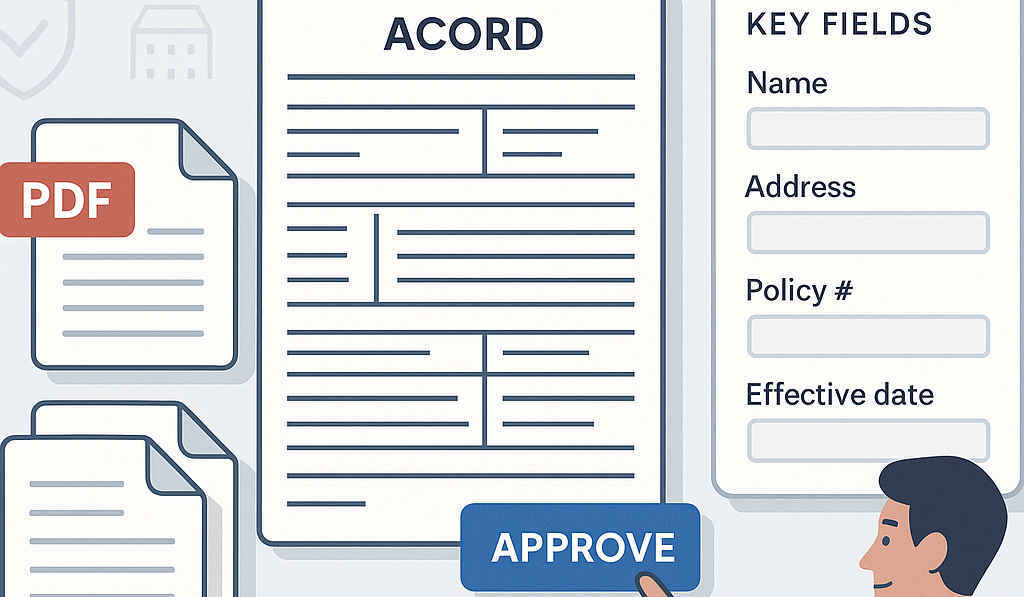
Underwriting leaders face a bind: submissions are surging, documents are messy, and talent is stretched thin. An underwriting workbench solves the operational bottleneck by digitizing intake, extracting key fields from ACORD forms and attachments, and presenting a consolidated view for faster, more accurate decisions—without replacing human judgment.
The intent is augmentation, not autopilot: AI handles classification, extraction, and summarization; underwriters validate and decide, with a complete audit trail for each action. Why now? Specialty lines like Marine, Cyber, and D&O demand deeper document review and third‑party data correlation, while brokers expect rapid responses. Firms that systematize intake and document intelligence are already seeing materially faster cycle times and higher quote‑to‑bind ratios. The workbench approach also reduces downstream rework: clean data feeds rating engines reliably and improves renewal quality next term.
For a view of industry innovation priorities, see EY’s outlook on how AI and digital platforms are reshaping underwriting and risk: EY on generative AI in insurance. Standards are your ally. ACORD data models and forms standardize how submissions are captured and exchanged, minimizing one‑off mappings and easing integration with policy admin systems. Learn more here: ACORD. With standardized data at the core, you can layer analytics that surface anomalies, pre‑fill missing values, and highlight conflicts across attachments—giving underwriters a head start instead of a blank page.
Designing the workbench: data, models, and human review
A scalable workbench blends data, models, and human expertise while preserving auditability. Start with a canonical submission schema (anchor it to ACORD where possible) to normalize broker feeds, email attachments, and portal uploads. Ingest documents to object storage, extract entities and key fields (insured name, limits, COPE, loss runs) with AI models, and reconcile against third‑party data (property, cyber posture) and internal policy history.
Present results in a review pane that highlights confidence scores and discrepancies, allowing underwriters to accept, correct, or request clarifications. Decision support should be explainable. For every model output, expose the evidence: which pages, tables, or metadata drove the extraction or risk signal. Maintain trace IDs from ingestion through decision so compliance can reconstruct the journey.
Embed playbooks for specialty lines—Marine cargo manifests, D&O litigation histories, and Renewable Energy engineering docs require domain‑specific templates and checks. Use role‑based queues to route complex risks to senior reviewers, while auto‑approving low‑risk renewals under strict thresholds. Integrations make or break the workbench. Pre‑populate submissions with ACORD data elements and push cleansed data back into policy admin and rating engines. Provide APIs and webhooks for brokers to see status and provide missing documents without back‑and‑forth email.
Instrument every step—submission completeness, manual edits per field, time‑to‑decision by line of business—to drive continuous model and process improvement. Finally, invest in the human experience: quick keyboard actions, inline redlines on documents, and one‑click requests to brokers. A workbench that respects underwriters’ time will be adopted, which is the real determinant of ROI.
Governance, workflow change, and value realization
Operationalizing an underwriting workbench is as much about governance and change as it is about technology. Define model risk management expectations upfront: inventory models, set approval gates, capture training data provenance, and monitor drift. Establish data retention and deletion schedules aligned with regulatory requirements. Build audit logs that record who changed what, when, and why—down to field‑level corrections on extracted data.
Publish transparency statements that describe how AI assists and where human judgment prevails. Set a phased rollout. Phase 1 digitizes intake and ACORD extraction for one line, improving data quality without altering pricing decisions. Phase 2 adds decision support (loss trend summaries, appetite checks), cutting time‑to‑quote. Phase 3 introduces limited auto‑decisions for low‑risk renewals with clear override paths. Along the way, measure outcomes: turnaround time, quote-to-bind ratio, and underwriter capacity reclaimed.
EY’s global insurance outlook details how AI‑driven underwriting can unlock productivity while maintaining control—see: EY 2024 Global Insurance Outlook. Standards strengthen sustainability; ACORD provides the data scaffolding and industry alignment necessary for interoperability and straight‑through processing: ACORD Data Standards and news on underwriting-focused standards: ACORD underwriting standards news. Finally, celebrate outcomes with the team.
Publish “before and after” stories that show time saved on complex accounts and errors avoided in transcription. Provide coaching on reviewing AI suggestions efficiently and when to escalate. A thoughtfully governed workbench not only accelerates underwriting; it raises confidence across compliance, brokers, and insureds by making decisions faster, clearer, and more consistent.