

#InsuranceInnovation
#OperationalExcellence
De-risk your managed services transition
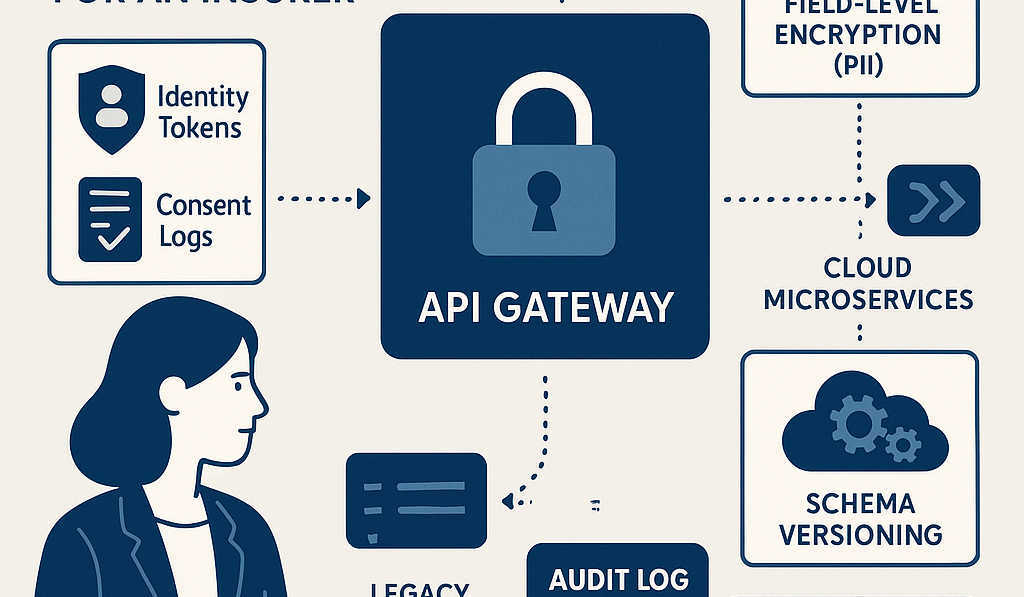

A practical blueprint to secure APIs, protect PII, and pass audits.
Insurers are modernizing fast—but trust is the constraint. Brokers and customers will not adopt new digital journeys unless access is safe, privacy is respected, and audits are painless. A zero‑trust API strategy meets that bar without slowing delivery. Instead of assuming anything inside your network is safe, every call is authenticated, authorized, encrypted, and logged—with data flows designed for least privilege and regional privacy. Start with a clear security contract at the boundary. Put an API gateway in front of legacy cores and modern services to enforce identity, consent, rate limits, schema versioning, and field‑level encryption. Treat PII as toxic: encrypt at rest and in transit, tokenize where possible, and segregate PII domains to reduce blast radius. Use short‑lived tokens with narrow scopes; rotate keys automatically; and prefer mutual TLS for service‑to‑service calls. Document which endpoints accept what scopes and publish a change log so partners never guess. Next, build privacy into the payloads. Share only what’s necessary, map fields to ACORD elements to avoid bespoke sprawl, and annotate data with purpose and expiry. For customer‑facing flows, capture consent that is specific, informed, and revocable—and log both the request and any downstream uses tied to a trace ID. When AI assists decisions (triage scores, fraud hints, document extraction), store inputs/outputs, model versions, and explanations next to the event that triggered the action. This turns explainability from an aspiration into an artifact auditors can verify. Regulators are moving rapidly: NAIC’s principles emphasize fairness and transparency; the EU’s supervisory authority for insurance has published governance expectations on documentation and human oversight. See references here: NAIC AI Principles and EIOPA AI Governance. Finally, design for auditability as a user experience. Persist significant state changes as immutable events—policy.bound, fnol.received, claim.triaged, payment.initiated—and keep event payloads minimal but reference sources of truth by ID. Build dashboards that let compliance reconstruct a journey—who accessed what, when, and why—in minutes. For teams seeking speed and safety, this pattern complements modernization guidance from industry leaders; a current view on platform modernization and API‑first benefits appears here: McKinsey on IT Modernization, and vendor guidance on event‑driven claims is here: Guidewire App Events overview. With these guardrails, you can ship faster, prove compliance, and earn the trust that keeps customers and regulators on your side.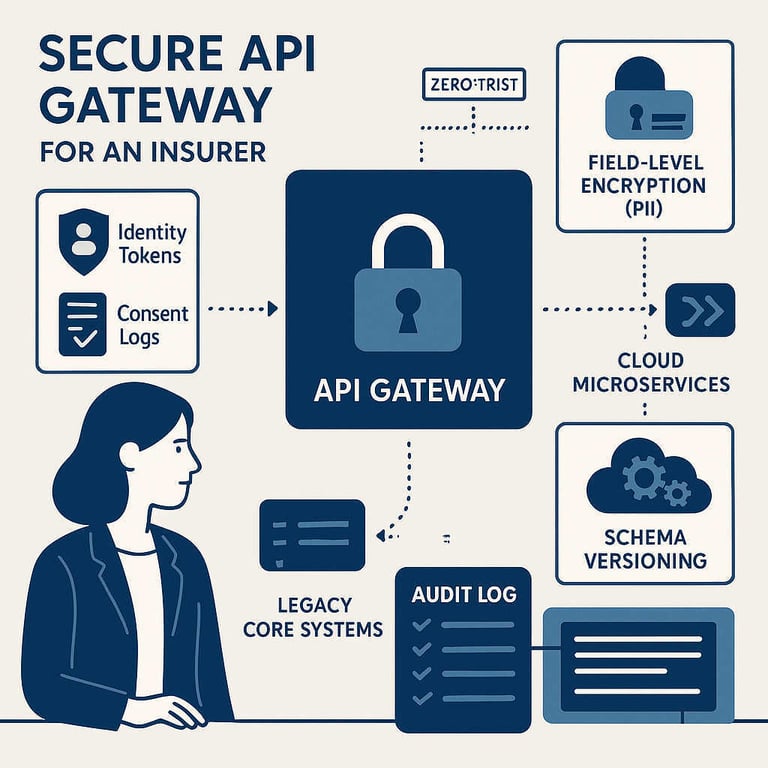
Zero‑trust begins with identity and consent. Every API call—human or machine—should carry a short‑lived token with scopes that map to least privilege. Enforce step‑up authentication for sensitive operations, and propagate a subject identifier (sub) and trace ID end‑to‑end so actions are attributable. For customer data, capture granular consent (purpose, fields, expiration) and propagate it to downstream processors; log consent reads and writes just like data access. Field‑level encryption for PII (names, addresses, bank details, SSNs) protects against inappropriate exposure inside your network; tokenize sensitive fields so downstream services see only what they need. Pair this with schema versioning and consumer‑driven contracts so changes don’t break partners—publish deprecation schedules and test stubs in a sandbox. Design the audit spine into the integration layer. Persist immutable event logs for significant state changes—policy.bound, fnol.received, claim.triaged, payment.initiated—alongside decision inputs/outputs (model version, features used, explanation artifacts) when AI assists. This turns “why did this change?” into a query, not a war room. The pattern aligns with modern insurance platforms leaning on application events to decouple outbound flows; see one vendor’s guidance here: Guidewire App Events overview. For a modernization lens that complements security with speed, review a current viewpoint on platform overhauls in financial services: McKinsey on IT Modernization. Make data minimization the default. Align payloads to ACORD elements so you share consistent, minimal data with brokers and TPAs; standardization reduces mapping sprawl and lowers the likelihood of over‑collection. Document your retention schedules by data domain and region, and implement policy‑as‑code to automate deletion and legal hold. For EU‑bound business, expect heightened documentation and transparency obligations under the evolving AI governance regime; a practical reference from the insurance supervisor is here: EIOPA AI Governance. In the U.S., regulators coordinate via NAIC and emphasize fairness, accountability, and transparency for insurer AI—principles that dovetail with zero‑trust design; see NAIC AI Principles.
Operationalize security as a product with clear ownership, SLAs, and metrics that map to business outcomes. Create an API product council with security, privacy, compliance, and engineering accountable for: • Access and consent posture: % of endpoints covered by least‑privilege scopes; % of PII fields encrypted and tokenized; time to revoke consent and reflect downstream. • Change safety: contract test coverage; partner‑breaking change rate; deprecation policy adherence. • Audit readiness: % of significant events logged with trace IDs; mean time to reconstruct a decision; number of unresolved audit inquiries. • Incident resilience: mean time to detect (MTTD) anomalous access; mean time to contain (MTTC) token abuse; breach tabletop frequency and outcomes. Publish a transparency statement that distinguishes automated assistance from human decisions, links to your retention and appeal policies, and describes the safeguards behind your APIs in plain language. This builds trust with brokers and insureds and pre‑answers auditor questions. Finally, align security with modernization. An API gateway centralizes identity, rate limits, schema versioning, and encryption keys; a schema registry and consumer‑driven contracts let teams ship independently without breaking the ecosystem. Events make oversight easier by turning state changes into immutable facts; when combined with field‑level encryption and consent logs, they create a forensic trail that satisfies regulators and shortens investigations. With zero‑trust APIs, you protect customers, enable faster integrations, and give compliance proof—not promises.