

#Insurance
#RenewableEnergy
#SolarPower
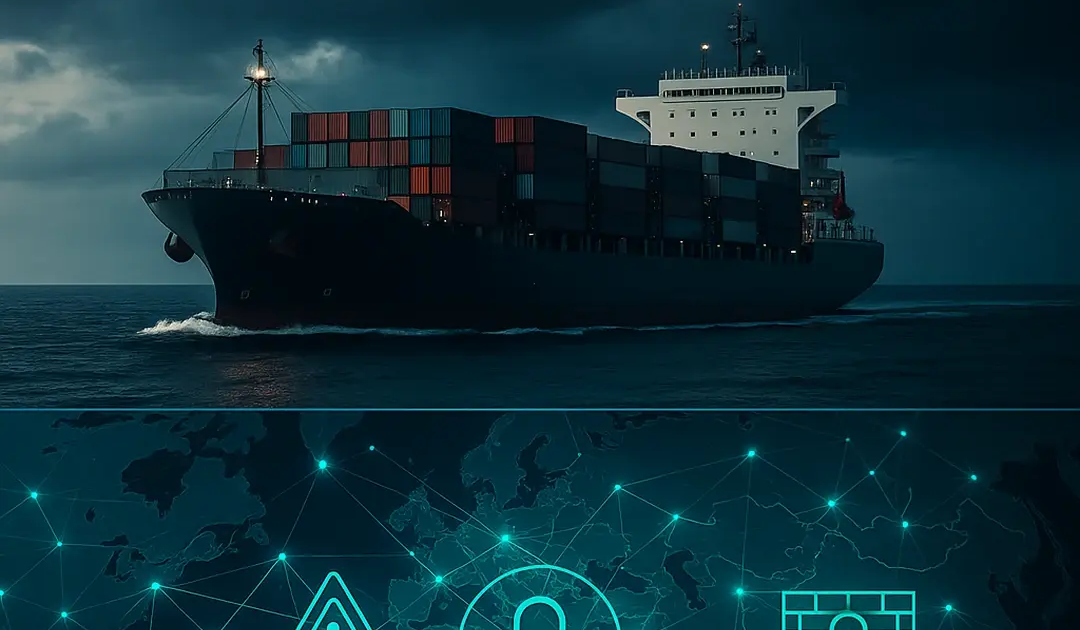

The U.S. Coast Guard's expanded cyber authority signals a fundamental shift in maritime risk management. For the first time, cybersecurity isn't just an IT concern—it's a regulatory imperative for maritime operators. Yet most marine insurance policies remain silent on cyber risks, creating a dangerous coverage gap.
Here's the problem: modern container ships, tankers, and bulk carriers are no longer purely mechanical systems. They're complex networks where Information Technology (IT) systems and Operational Technology (OT) systems are increasingly integrated. This convergence—often called IT/OT convergence—creates a new category of risk that traditional marine underwriting was never designed to address.
To understand the risk, you need to understand how modern vessels operate.
Operational Technology (OT) refers to systems that control physical processes and equipment:
Historically, these were isolated, proprietary systems. A vessel's engine was controlled by a dedicated engine management computer that had no connection to anything else. Navigation was handled by a separate GPS/radar system. Propulsion was its own independent system.
Information Technology (IT) refers to systems that process and transmit data:
Historically, these IT systems were separate from operational systems. You might have one computer for email, another for cargo tracking, another for crew scheduling.
Today, modern vessels integrate these two previously-separate worlds. Modern ship management systems connect operational and informational systems to create an integrated platform. A vessel's fleet management system might pull real-time data from engine management computers. Route optimization software might interface with navigation systems. Crew management integrates with safety systems.
The efficiency gains are real: crew can monitor engine health remotely, fleet managers can optimize routes based on fuel consumption, maintenance can be scheduled based on actual equipment performance rather than scheduled intervals.
But the security risks are equally real.
A cyber attack on the fleet management system (an IT system) could potentially propagate to operational systems. Malware in the email system could spread to computers controlling propulsion. A compromised navigation system could send false positioning data. A sabotaged ballast system could create stability problems.
The maritime industry has begun experiencing cyber incidents that validate these concerns:
2023-2024 Shipping Industry Incidents: Multiple shipping companies experienced cyber attacks that disrupted operations, including:
Geopolitical Context: In regions with elevated geopolitical tension, cyber attacks on maritime infrastructure have become a potential weapon. Shipping companies operating in contested waters face both criminal cyber threats and state-sponsored threats.
Supply Chain Risk: Third-party software vulnerabilities affecting multiple vessels simultaneously. When a vulnerability is discovered in widely-used maritime software, thousands of vessels may be affected.
Nation-State Interest: Maritime infrastructure is increasingly viewed as critical national infrastructure. This elevates the threat from casual cyber criminals to more sophisticated nation-state actors with greater capabilities.
Most marine insurance policies were written before IT/OT convergence became a significant concern. Review your existing marine policy and search for the word "cyber." You likely won't find it.
This creates ambiguity in coverage:
Coverage Question #1: Is a cyber attack an "accident"? Marine policies typically cover "accidents" and specifically exclude intentional acts. But how does this apply to cyber attacks? Is a cyber attack an accident if the attacker intended it but the ship operator didn't foresee it? Different underwriters have rendered different interpretations.
Coverage Question #2: What about business interruption? If a cyber attack disables propulsion systems and the vessel is stranded for three days, is this a covered loss? Some policies might cover mechanical failure but not cyber-caused mechanical failure.
Coverage Question #3: What about regulatory fines? If the Coast Guard imposes fines for cyber security failures, are those covered losses?
Coverage Question #4: What about recovery costs? If your IT systems are compromised, the cost of forensic investigation, system rebuilding, and operational restoration can be substantial. Are these covered?
The honest answer in most cases: "It depends on the specific policy language and the specific incident."
In November 2024 and ongoing into 2025, the U.S. Coast Guard has expanded its regulatory authority over maritime cybersecurity. This includes:
These new requirements create regulatory risk for vessel operators and their insurers. Non-compliance can result in:
Yet if your marine insurance doesn't explicitly address cyber risks, your coverage for these regulatory penalties may be unclear.
To address maritime cybersecurity, a new category of tools has emerged: Human Risk Management (HRM) platforms specifically designed for maritime operations. These platforms:
Organizations implementing HRM platforms are demonstrating their commitment to cyber risk management. Underwriters are beginning to view these investments favorably in underwriting decisions.
However, HRM platform implementation creates a new question for insurers: If an insured has invested in an HRM platform but still experiences a cyber incident, does this affect coverage? The platform was supposed to prevent the incident—if it failed, is the loss covered?
These questions highlight why traditional marine policies are inadequate for modern maritime risk.
For marine underwriters, IT/OT convergence creates several challenges:
Challenge #1: Expanded Risk Assessment Underwriters now need to assess both traditional maritime risk AND cyber risk. This requires expertise in both domains—expertise that few underwriters currently possess.
Challenge #2: Regulatory Uncertainty With Coast Guard cyber authority expanding, underwriters don't yet know what the full regulatory framework will look like. Policies written today may need to be modified as regulations evolve.
Challenge #3: Pricing Uncertainty Without historical claims data for maritime cyber incidents, it's difficult to price cyber risk accurately. Underwriters face the classic problem of pricing new categories of risk.
Challenge #4: Technology Risk As maritime cybersecurity technology evolves rapidly (HRM platforms, security monitoring systems, etc.), underwriters struggle to keep pace with what constitutes adequate cyber risk management.
The first step for marine underwriters is recognizing that traditional marine policies are inadequate for modern vessels. This creates an opportunity to develop enhanced coverage that specifically addresses:
Explicit Cyber Coverage: Rather than assuming cyber incidents are or aren't covered, explicitly state what cyber-related losses are covered and under what conditions.
Regulatory Compliance Coverage: Explicitly cover regulatory fines and penalties resulting from cyber security failures or breaches.
Recovery Cost Coverage: Explicitly cover the costs of incident response, forensic investigation, system restoration, and operational recovery.
Cyber Risk Management Requirements: Establish underwriting requirements for cyber security practices, including HRM platform implementation, crew training, and incident response procedures.
Emerging Technology Consideration: Build in periodic policy review mechanisms to ensure coverage keeps pace with evolving maritime cyber threats and regulatory requirements.
The convergence of IT and OT systems in maritime operations is creating a new category of risk that traditional insurance instruments struggle to address. Underwriters who wait for regulatory clarity or comprehensive claims data will find themselves behind the curve.
The leading path forward is to work with specialists who understand both maritime operations and cybersecurity—who can help design coverage that addresses the real risks modern vessels face.
Is your organization ready for the maritime cybersecurity era? Visit https://sagesure.io to explore how AI-powered intelligence can help underwriters assess and price maritime cyber risks with unprecedented accuracy and speed.