#AIinInsurance
#ClaimsAutomation
ClaimsROI
AI You Can Be Sure

How to deploy AI fraud detection in claims that cuts loss and false positives without eroding trust.
Fraud is one of the few places where AI can deliver hard, near-term ROI for insurers—but brute-force detection comes with a cost. If your models throw too many false positives, you slow down honest customers, overload SIU, and damage broker relationships. If they are too conservative, organized rings and opportunistic fraudsters slip through, quietly eroding the combined ratio. The strategic question for claims leaders is not "Can AI find more fraud?"—it is "Can AI help us find materially more fraud while improving the experience for the 90–95% of claimants who are doing the right thing?" Market data suggests the opportunity is real. Industry estimates from anti-fraud coalitions put the cost of insurance fraud in the tens of billions of dollars each year in North America alone, spanning everything from staged auto accidents to exaggerated property losses and soft fraud in injury claims. At the same time, large carriers and analytics vendors are publishing case studies in which AI-driven fraud detection has improved hit rates substantially compared with traditional rules. For example, a recent study of AI-powered claims management found that an integrated platform combining NLP on claim narratives, computer vision on damage photos, and ensemble fraud models reached more than 90% accuracy for auto claim fraud and reduced false positives by nearly a third versus a legacy rules engine; see the performance summary in AI-Powered Claims Management. Academic research on fraud detection in insurance claim datasets similarly documents accuracy lifts when ensembles and feature engineering are applied thoughtfully, as summarized in Optimizing Insurance Fraud Claim Detection. For specialty and P&C carriers focused on SageSure-style claims automation, the imperative is to harness these capabilities without turning the customer journey into a gauntlet. That means baking fraud analytics into the same event-driven, evidence-linked architecture you use for triage and straight-through processing. Every fraud signal should be traceable—"why we flagged this" should be a click away, not a mystery. And high-risk decisions must remain explicitly human-in-the-loop: models propose, experienced claims professionals decide. Done well, this approach can reduce loss costs, protect honest policyholders, and demonstrate to regulators that your fraud program is both technologically sophisticated and procedurally fair.
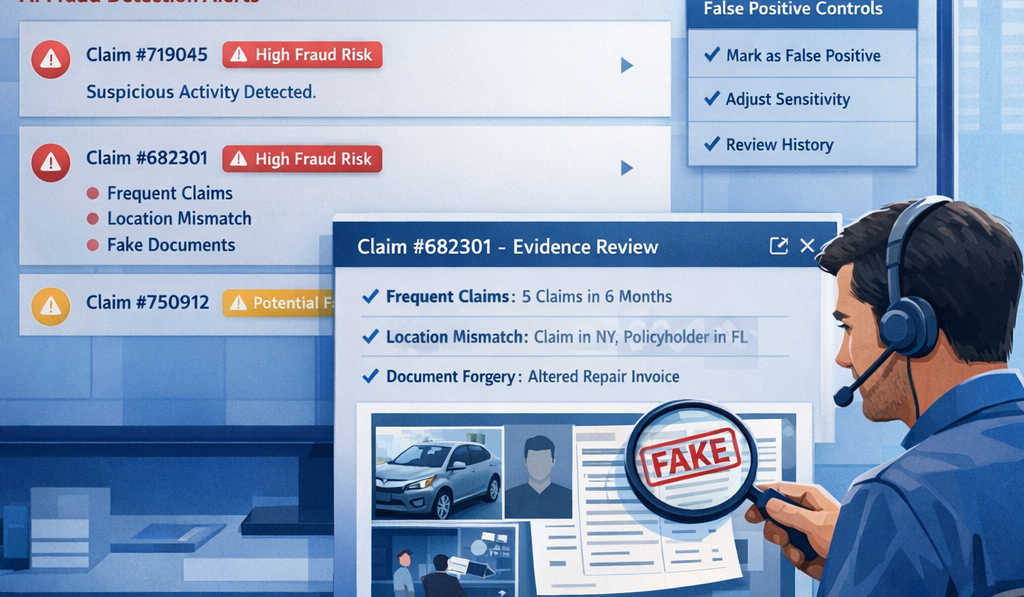
Designing AI fraud detection that claims teams actually trust starts with three principles: evidence first, humans at the decision boundary, and tight integration with existing claims workflows rather than a parallel "fraud platform" no one logs into. In practice, that means treating fraud detection as an assistive, explainable layer on top of intake, triage, and settlement—not a black box that quietly vetoes claims in the background. Start by anchoring on the difference between high-intent fraud and normal claims noise. Industry studies show that while total fraud-related losses are material—often estimated in the tens of billions annually—the majority of claims are legitimate. Machine-learning-led approaches deliver the most value when they elevate the small fraction of genuinely suspicious cases to Special Investigation Units (SIUs) with clear reasoning. Recent research on insurance fraud detection using machine learning, such as a 2024 ensemble study that achieved more than 80% accuracy and precision above 90% on auto insurance fraud datasets, underscores that feature-rich models can separate signal from noise when trained and governed correctly; see, for example, the methodology and performance discussion in Optimizing Insurance Fraud Claim Detection. Those gains only translate into business value, however, if front-line teams can understand and act on the outputs. The design pattern that works in regulated insurance environments uses a layered architecture. At intake, AI classifies the claim, extracts structured data from documents, and applies basic anomaly checks (inconsistent dates, mismatched locations, duplicate VINs or policy references). At triage, machine-learning models assign a fraud propensity score based on a wide range of features: claimant history, past losses, incident characteristics, repair patterns, network relationships, and text signals in narratives and adjuster notes. But instead of sending just a score, the system surfaces human-readable reasons: unusual claim frequency in the past 12 months, outlier patterns relative to peers, or documented links to known suspicious entities. Graph-based approaches and sequence embeddings are increasingly effective at spotting ring behavior and unusual claim sequences; recent work on graph and embedding-based fraud detection in insurance claim datasets highlights how relational patterns can lift accuracy beyond traditional rules alone. Critically, every flagged indicator must carry a breadcrumb to underlying evidence: the specific policy, prior claim, document page, or external data source that triggered the alert. That is what allows an SIU investigator or senior adjuster to click from the fraud panel directly to the source and decide whether the concern is warranted. As AI adoption accelerates across P&C, thought leadership from analytics vendors and consulting firms consistently emphasizes that pairing multi-model ensembles with transparent explanations is far more sustainable than opaque scores—particularly when regulators, internal audit, and customer advocates can all ask, "Why was this claim treated differently?"
Once an AI fraud program is live, the hard work begins: operating it as an audited, evolving capability that improves loss ratios without eroding trust among adjusters, brokers, and policyholders. That starts with clear metrics. At minimum you should track: incremental fraud detected and prevented (in dollars), false-positive rate (percentage of legitimate claims flagged), lift over legacy rules (how many additional high-quality cases SIU receives), exoneration time for clean-but-flagged claims, and impact on cycle time for non-fraudulent claims. Benchmarks from leading carriers and research firms suggest that well-run AI fraud programs can lift detection by double digits while cutting false positives materially; recent reports from consulting and analytics providers highlight examples where machine learning models improved fraud detection rates several-fold compared to rules, while reducing unnecessary investigations. Governance must be embedded rather than bolted on. Treat each fraud model as part of a formal inventory with a named owner, documented training data, and clear intended use. High-impact models—those that influence coverage or payment decisions—should be subject to validation and stress testing, mirroring model risk management practices in banking. Explainability techniques (for example, feature importance and local explanations) should be used not only to generate investigator-friendly reasons but also to monitor fairness: if certain segments of customers, geographies, or brokers are disproportionately flagged, you need to understand whether that reflects genuine risk or spurious correlations. Research on graph analytics for fraud and advanced ensemble methods in insurance consistently emphasizes the importance of monitoring for drift and recalibrating as behavior changes. Integration with claims operations is where AI fraud projects often succeed or fail. Fraud scores should slot into existing work queues and dashboards, not force adjusters into a completely separate tool. An effective pattern is to combine severity, complexity, and fraud risk into a single triage view: clean, low-risk claims flow down a fast path; ambiguous or high-exposure cases are routed to specialists; and high-fraud-risk claims are directed to SIU with clear SLAs. Case studies on AI-powered claims management illustrate that when fraud analytics are wired into a unified claims platform—alongside automated document analysis and straight-through processing—carriers can reduce average handling time dramatically while cutting leakage; one large North American auto insurer, for example, reported double-digit improvements in fraud detection and a reduction in average processing time from weeks to days using an integrated AI stack, as outlined in AI-Powered Claims Management. Finally, embed a human narrative around the system. Train adjusters and SIU staff not just on how to click through alerts, but on the model’s strengths and limitations: where it tends to shine, where it struggles, and when to override it. Publish a transparency statement that explains, in plain language, how AI is used in fraud detection and how customers are protected from unfair treatment. Pair that with incident playbooks—what happens if a model is found to be misclassifying a particular cohort, or if a drift indicator lights up. External guidance from supervisors such as NAIC and EIOPA stresses fairness, accountability, and human oversight in insurance AI; aligning your fraud program with those expectations from day one reduces regulatory friction and reinforces SageSure’s promise of "AI you can be sure of."