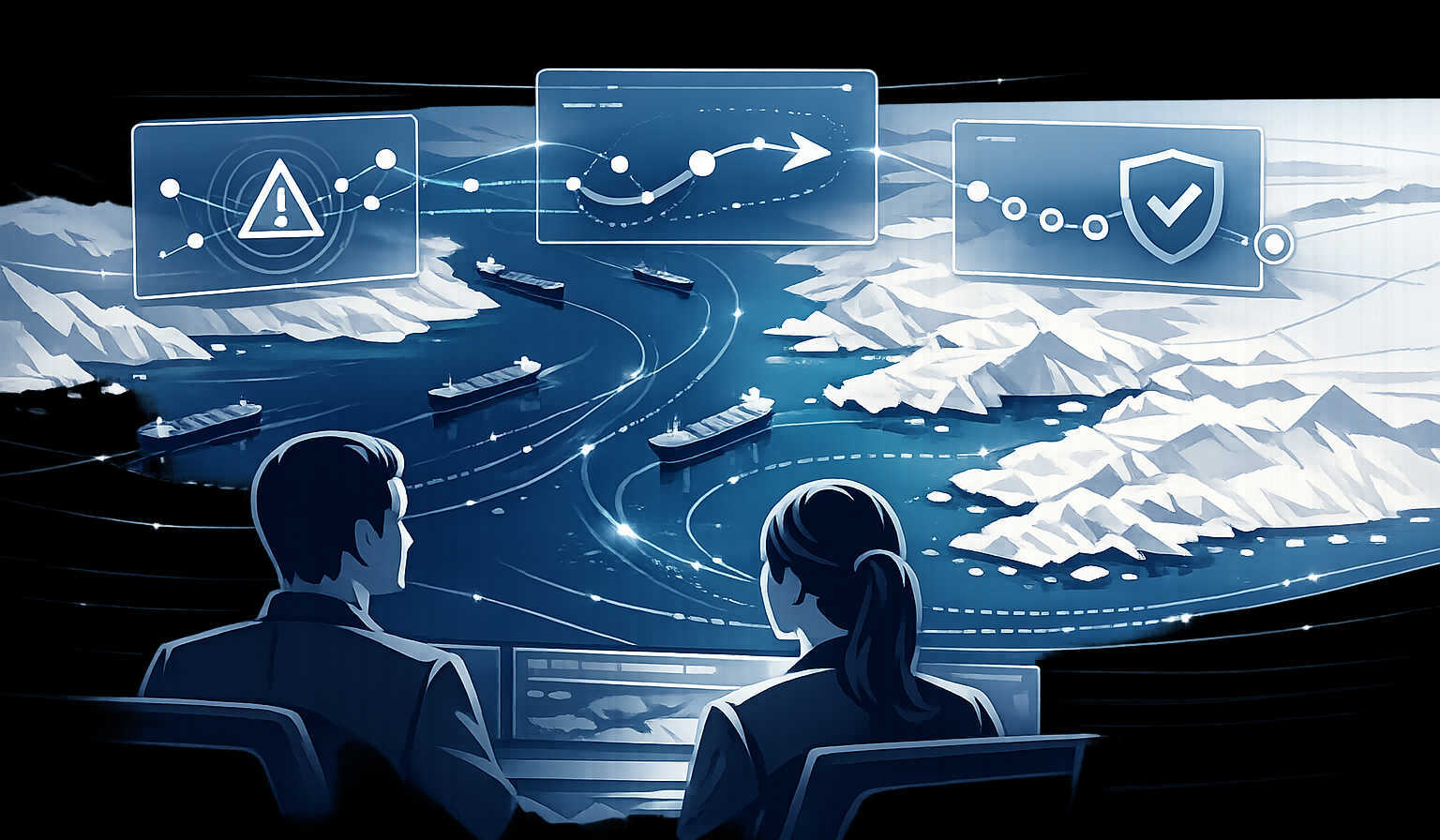
What continuous intelligence means for Hormuz-scale geopolitical risk
Continuous intelligence is the practice of using live data, AI models, and cloud infrastructure to monitor events, simulate scenarios, and recommend business actions in real time. Instead of treating geopolitical shocks as isolated crises, enterprises run a standing decision system that watches chokepoints like the Strait of Hormuz continuously.
Recent events around Hormuz, including renewed blockades, proposed transit fees of about $30 million per fully loaded supertanker at current oil prices, and escalating strikes, are not just diplomatic headlines. They are operational variables that affect route viability, commodity pricing, and the economics of maritime insurance in hours, not quarters. Analysis from Kpler shows that the right question is no longer whether vessels can technically pass, but whether their movements can be trusted, verified, and defended under changing legal, insurance, and sanctions conditions. Kpler argues that organizations still using a simple "open or closed" view of Hormuz risk are already behind.
For executives in energy, logistics, and insurance, the pain point is clear: traditional risk functions cannot read, interpret, and reprice this level of volatility in real time. Continuous intelligence addresses this by fusing maritime movement data, satellite signals, sanctions lists, and market prices into one decision surface. Instead of periodic memos, leadership receives live scenario scores: which voyages are now uneconomical, which contracts are mispriced, and which counterparties introduce sanctions or security exposure.
Designing an AI decision stack for real-time chokepoint disruption
A continuous intelligence system is not one model. It is a layered stack. At the base, cloud platforms ingest streams such as AIS vessel positions, port congestion metrics, futures prices, and news alerts. On top of that, AI models classify events (for example, possible dark vessel behavior), detect anomalies in route patterns, and generate forward-looking risk scores for individual voyages and shipping corridors.
Specialist platforms are already moving in this direction. Dryad Global’s Verihelm, for example, combines AI-assisted maritime intelligence with analyst expertise to show where trade flows are exposed to disruption, including sanctions exposure and regional threats. Dryad Global emphasizes that maritime risk has shifted from an issue for shipping teams to a board-level concern affecting finance, retail, energy, and manufacturing.
For an enterprise, the decision stack needs three layers. The perception layer turns raw signals into structured entities such as routes, fleets, policies, and contracts. The reasoning layer runs simulations: if transit fees rise by a further 10%, which contracts fall below hurdle rates? Finally, the action layer connects to operational systems—TMS, trading platforms, underwriting workbenches—so decisions can be executed as changes in routes, prices, limits, or hedges.
Using continuous intelligence to protect supply chains and portfolios
In a Hormuz-style disruption, supply-chain leaders must answer very specific questions. Can cargo be rerouted around the chokepoint without breaking delivery windows? How do changes in freight rates, insurance premiums, and dwell time reshape landed cost per unit? A continuous intelligence system can run these calculations automatically for every lane, not just a handful of strategic routes.
Consider a manufacturer that relies on petrochemical inputs shipped through Hormuz. When visible crossings decline and a 20% reimbursement fee is announced, the system can immediately re-score all open purchase orders. It compares alternative routings, estimates additional bunker fuel costs, and calculates the breakeven price where rerouting via alternative ports becomes cheaper than absorbing higher tolls and risk premiums.
Portfolio managers face a similar challenge. They must translate maritime disruption into sector, issuer, and asset-class exposures. A continuous intelligence platform can link tanker traffic patterns and sanctions actions to revenue sensitivities for listed refiners, shipowners, and insurers. If crossings fall below a defined threshold or if a specific flag state is targeted with new restrictions, the system can surface holdings with outsized dependence on that corridor and propose hedge adjustments in near real time.
Translating maritime risk into underwriting and capital decisions
For insurers and reinsurers, Hormuz-scale volatility is not just a supply-chain story. It is a capital problem. Every new fee, blockade, or attack reshapes total exposure across hull, cargo, trade credit, and political risk lines. Traditional approaches rely on periodic exposure snapshots and manual portfolio reviews. Continuous intelligence replaces this with live, event-driven views of risk.
An AI system can observe that Iran previously charged up to about $2 million per voyage on an ad hoc basis, compared with the proposed US 20% toll, and infer that premium adequacy assumptions tied to prior fee levels no longer hold. It can also overlay real-time vessel traces to identify which insured voyages are taking higher-risk routes closer to contested territorial waters.
Capital allocation benefits as well. Rather than waiting for quarterly results, insurers can simulate loss distributions under new fee or blockade scenarios and adjust reinsurance purchases, line sizes, or pricing corridors the same week. A specialty carrier might, for example, reduce line size on voyages transiting at peak times, while maintaining capacity for routes that use escorted convoys with better protection and more transparent fee structures.
Building trusted data, governance, and explainability into AI systems
Enterprises cannot rely on opaque models for decisions that move vessels, capital, or coverage. Trust requires clear data lineage, governance, and explainability. Continuous intelligence platforms must log which data streams were used, how signals were transformed, and why a given scenario produced a specific recommendation.
In maritime intelligence, that can mean storing the sequence of AIS pings, satellite images, and news alerts that led to a high-risk score for a given voyage. When a decision team questions why a vessel was flagged, the system can show that the ship switched off its transponder near a sanctioned port, deviated from declared routes, and entered a higher-risk corridor during a period of elevated strikes.
Explainability is also essential for regulators and auditors. When an insurer adjusts pricing or capacity based on continuous intelligence, it needs audit-ready rationales: which indicators changed, what stress scenarios were used, and how those inputs flowed through models. Systems like the Strait of Hormuz Risk Tracker described by Approved America on LinkedIn highlight this by transforming vessel activity and chokepoint behavior into transparent risk scores and disruption alerts.
Getting started: A practical roadmap for continuous intelligence
Most organizations do not need to build a global maritime intelligence platform from day one. They do need a roadmap that ties investment to concrete decisions. The first step is to identify a narrow set of Hormuz-related questions that cause recurring stress: for example, repricing political risk endorsements, re-routing specific high-value cargoes, or rebalancing exposure to a set of energy-linked credits.
Next, teams should map the minimum viable data and models required to answer those questions automatically. That might include AIS data for the relevant lanes, sanctions and tariff feeds for affected jurisdictions, and live commodity prices. From there, they can pilot a decision dashboard that watches those signals, runs basic scenarios, and recommends actions that are reviewed—but not yet executed automatically—by human experts.
Over time, as confidence, governance, and explainability mature, organizations can automate more of the pipeline: from signal detection to underwriting changes, hedges, or routing decisions. The endpoint is not a fully autonomous system but a continuously informed enterprise, where AI, digital infrastructure, and cloud platforms turn Hormuz-scale geopolitical volatility into structured, auditable, and faster decisions.