
P&C Insurance
API-First
Legacy-Modernization
AI You Can Be Sure

How claims automation changes broker loyalty decisions in specialty insurance—and how to design it so brokers see you as their fastest, most transparent partner.
In specialty insurance, brokers ultimately decide where much of the business goes. When two markets offer comparable coverage and price, the tie-breakers are almost always ease of doing business and claims experience. Yet most claims automation strategies still talk inwardly—about cycle times, loss adjustment expense, and AI models—without connecting explicitly to what matters to brokers on the ground. That is a missed opportunity. Brokers feel the friction of manual claims long before carriers see it in quarterly metrics. They are the ones fielding calls from clients who want an update, explaining why documentation has to be resubmitted, or apologizing when a carrier’s backlog turns a routine loss into a reputational risk. At the same time, brokers are increasingly open to technology that removes this friction. A wave of research in 2024 and 2025 highlights how automation is changing both claims and broker operations. Five Sigma, for example, outlines how automation in claims management—spanning data entry, document processing, and routing—can dramatically reduce adjuster workload while improving consistency (How Automation Is Transforming Claims Processing). Pathway’s guide for agencies and brokerages argues that automated insurance claims are becoming essential in a market where speed, accuracy, and customer-centricity are no longer optional (Automated Insurance Claims: Why Now Is the Time for Brokerages). For SageSure’s ICPs—claims leaders, COOs, and specialty line executives—the implication is clear: claims automation is not just an internal efficiency play; it is a lever for broker loyalty and growth. If you can make your claims process more predictable, transparent, and explainable than competitors’, brokers will remember that the next time they place a complex cyber, marine, or D&O risk. Conversely, if automation feels like a black box that slows down unusual claims or generates unexplained denials, brokers will quietly shift business elsewhere. This article reframes claims automation through that broker lens. First, it explores how automation is changing the economics of claims and why brokers care about more than speed alone. Second, it lays out how to design automation journeys—FNOL, document intelligence, triage, and payments—that brokers can see and trust, using real-time events and portals instead of opaque queues. Third, it explains how to operate and measure claims automation as a broker-first strategy, with governance and KPIs that tie directly to placement decisions, retention, and specialty growth.
To turn automation into a broker loyalty driver, insurers need to design journeys that brokers can see, explain, and trust. That starts with shared visibility. Brokers repeatedly say their biggest frustration is not being able to answer simple client questions—“Where is my claim?”, “What happens next?”, “Why is this taking so long?”—without picking up the phone or chasing multiple carrier contacts. A 2024 survey of more than 500 independent P&C agents found that over half still need frequent live carrier support for claim status and underwriting questions, and that ease of doing business and response time are as important as price in placement decisions (2024 State of the Insurance Agent Experience Report). Claims automation should directly address that pain. Event-driven architectures, where lifecycle events such as fnol.received, claim.triaged, inspection.scheduled, coverage.verified, and payment.initiated are published to an event bus, make it possible to surface a real-time timeline in broker and client portals. Guidewire, for example, describes how lifecycle events integrated with AWS EventBridge allow carriers and partners to consume near-real-time updates without brittle point-to-point connections (Streamline Data Consumption with Lifecycle Events). When those same events drive automated communications—texts, emails, in-portal messages—the broker’s workload shifts from chasing status to advising clients. Design also needs to respect the boundary between automation and judgment. For straightforward, low-severity claims, automation can drive straight-through processing, with brokers delighted to see “claim opened, validated, and paid” in hours instead of days. For complex specialty claims—large marine losses, cyber incidents, D&O matters—automation should focus on intake, evidence organization, and orchestration, not on final coverage decisions. That means using intelligent document processing to normalize cargo manifests, forensic reports, or legal correspondence; AI triage models to suggest severity and next steps; and workflow engines to coordinate surveyors, breach coaches, and counsel. Five Sigma’s overview of how automation is transforming claims processing highlights how intelligent document processing and routing can relieve adjuster workload and speed up resolution, while still keeping humans in control of decisions (How Automation Is Transforming Claims Processing). Critically, every automated step must be explainable. If a claim is routed to a particular queue or flagged for additional review, brokers should be able to see why at a high level—“missing documentation,” “coverage ambiguity,” “high exposure and jurisdiction risk”—without exposing internal scoring models. That transparency reinforces your brand promise of AI that brokers can be sure of, rather than a black box that might derail a client relationship at the worst moment.
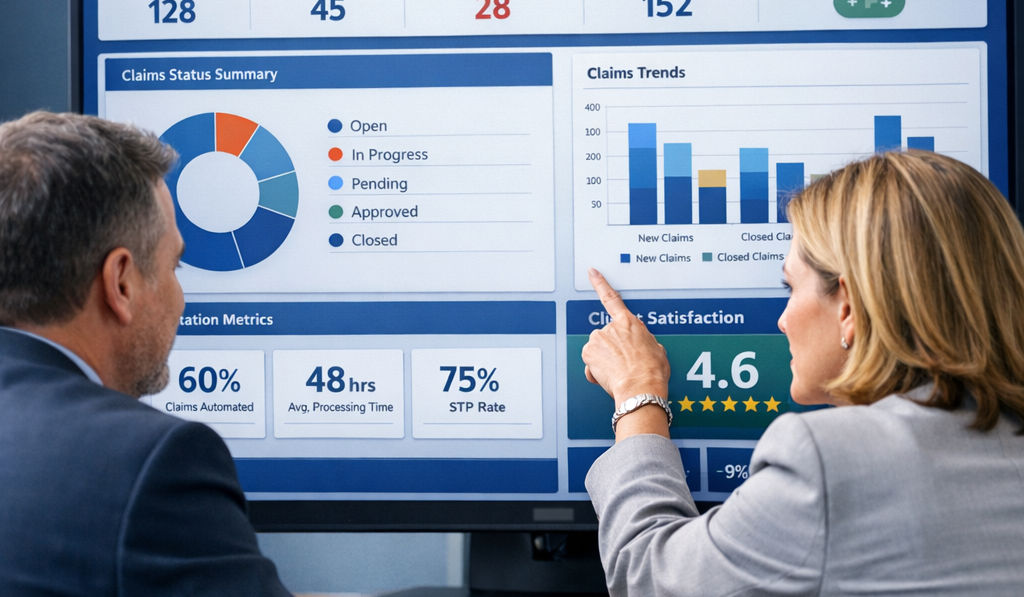
The final step is to run claims automation as a broker-first program, with clear KPIs and governance that link technology changes to placement and retention outcomes. Start with metrics that matter to brokers and their clients. For each key segment—marine, cyber, D&O, and complex property—track FNOL-to-first-contact time, FNOL-to-coverage-position, and FNOL-to-first-payment, alongside the distribution of these metrics across automated vs. non-automated cohorts. Overlay broker-facing indicators: share of status inquiries handled via portal and digital notifications; average response time to broker questions; and broker satisfaction or NPS specific to claims support. External data can help set ambition. A 2024 study of claims handlers in the US and UK by Sprout.ai found that 95% expect technology to significantly impact claims processing in the next five years, and that the biggest internal pain points are reviewing documents and complying with reporting requirements—tasks automation directly targets (Report: Claims Handlers Embracing Technology). Another 2024 feature from Insurance Business summarises the same survey, noting that 28% of handlers cite customer complaints about delays or communication gaps, and 20% cite demands for greater transparency—exactly the friction points automation and real-time portals can relieve (Claims Handlers Reveal Pain Points). Studies focused on automation for agents and brokers highlight similar themes: operational gains, fewer manual follow-ups, and better client experience when claims and policy workflows are automated (Automation for Commercial Insurance Agents & Brokers). On top of metrics, governance must reassure brokers that their clients will not be harmed by automation mishaps. That means defining where straight-through processing is allowed; where human review is mandatory; and how exceptions, complaints, and disputes are handled. Every automated decision—routing, validation, payment initiation—should generate an auditable event with inputs, rules or model versions, and human overrides logged. That event spine feeds dashboards for claims, operations, and compliance teams, and gives you the ability to investigate any broker-raised concern quickly. Finally, bring brokers into the roadmap. Share automation metrics in quarterly reviews, invite feedback on portal features and communication templates, and co-design playbooks for high-stakes events such as cyber incidents or large marine losses. Content aimed at brokers and agencies, like Pathway’s guide on why now is the time to embrace automated insurance claims, stresses that intermediaries see tangible benefits when automation delivers faster processing, fewer errors, and clearer communication (Automated Insurance Claims: Why Now Is the Time for Brokerages). Position your program in those terms—and back it up with data—and you turn claims automation from a cost-cutting story into a shared growth strategy with your distribution partners.