#ClaimsAutomation
ClaimsROI
ClaimsTransformation
AI You Can Be Sure
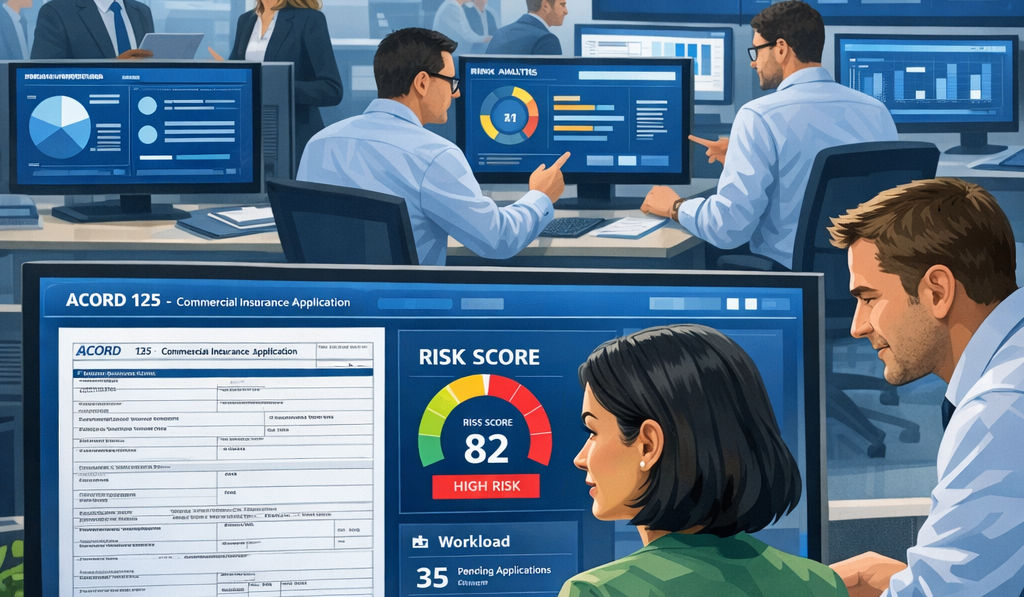

How AI-ready underwriting workbenches help insurers solve the underwriter shortage while protecting judgment and compliance.
Across commercial and specialty insurance, underwriting leaders are grappling with a talent equation that no longer adds up. Veteran underwriters are retiring, new entrants are scarce, and the complexity of risks—from climate-exposed property to cyber and renewable energy—continues to rise. A 2026 analysis of AI and the insurance talent crisis notes that the industry has struggled for years to attract younger professionals, and that looming retirements among underwriters, adjusters, and actuaries are forcing carriers to rethink how work is done (Can AI Save the Insurance Industry from Its Talent Crisis?). The risk is not just operational: if you cannot staff underwriting desks with capable people, your ability to grow profitably in complex lines erodes. At the same time, AI and underwriting workbenches are maturing quickly. Instead of promising to replace underwriters, the most credible offerings focus on augmenting judgment: pre-reading ACORD submissions, extracting key facts from documents, highlighting anomalies, and orchestrating workflows so specialists can focus on complex decisions. Capgemini describes the underwriting workbench as a holistic ecosystem where data, analytics, and collaboration tools come together to increase throughput and accuracy, while also making roles more attractive to scarce talent (Elevate Underwriting Accuracy and Efficiency). Unqork’s AI underwriting workbench materials echo this, emphasizing reductions in manual tasks and the ability to scale without burning out teams (AI Underwriting Workbench). For SageSure’s ICPs—underwriting leaders, COOs, and CTOs in P&C and specialty segments—the convergence of these trends creates a specific opportunity: use AI-ready workbenches as a lever to solve the underwriting talent crisis. That means designing workbenches that underwriters actually trust, proving that they meaningfully reduce administrative load, and governing them in a way that satisfies regulators and internal risk committees. It also means reframing workbench investment as part of a broader talent strategy, not just a technology refresh. Bain’s recent work on “AI Talent Labs” in underwriting underscores that generative AI can reshape the job into a more attractive blend of analysis, judgment, and client engagement when deployed thoughtfully (AI Talent Lab: Underwriters). This article takes that lens. First, it examines how the underwriting talent crisis is unfolding and why current tools are often part of the problem. Second, it outlines how to design AI-ready workbenches that genuinely help underwriters by automating low-value tasks while preserving judgment and explainability. Third, it describes how to run, measure, and govern those workbenches as a core component of your talent and modernization strategy, aligning with emerging expectations on AI governance and reinforcing a trust-first narrative for regulators, brokers, and employees alike.
Building an underwriting workbench that underwriters actually welcome—and that helps solve the talent crunch—means treating it as a change in how work happens, not just another system. The starting point is to remove the tasks that underwriters consistently describe as soul-sapping: reconciling ACORD forms, hunting through email threads, rekeying the same data into multiple screens, and reconstructing prior decisions. Studies of modern workbenches and AI in underwriting make clear that this is where the biggest gains lie. Capgemini, for example, highlights that underwriters today spend a large share of their time on non-core activities and that firms investing in workbenches see measurable lifts in accuracy and throughput (Elevate Underwriting Accuracy and Efficiency). Unqork’s guide to AI underwriting workbenches reports similar findings, noting that carriers using a unified, AI-enabled desktop can cut administrative time dramatically and get quotes out faster (The Underwriting Workbench: A Guide). For SageSure’s ICPs, the design principles are straightforward. First, make the workbench the front door for intake. ACORD and bespoke broker submissions should land in a single queue where intelligent document processing classifies documents, extracts structured data, and flags missing items. Every extracted field should carry a breadcrumb—document ID, page, and highlighted snippet—so an underwriter can click from “Limit: $25M” straight to the original ACORD. That pattern respects regulatory expectations and dramatically reduces rekeying. Bain’s recent analysis of “AI Talent Lab: Underwriters” stresses that generative AI delivers the most value when it summarizes documents, surfaces key risks, and automates routine steps around pricing and policy generation, freeing underwriters to focus on complex, relationship-driven risks (AI Talent Lab: Underwriters). Second, design the canvas around decisions, not databases. Underwriters should see a structured view of the risk—core facts, evidence, appetite fit, portfolio impact—rather than a maze of tabs. AI can pre-compute risk indicators (for example, industry risk bands, cyber hygiene signals, cargo route risk scores) and suggest “next best questions” when information is missing. But every suggestion must show its work: which document or data source it relied on, and where confidence is low. That is critical for trust and for regulatory alignment around explainability. Third, bake in collaboration. Workbenches should make it easy to loop in technical specialists, actuaries, and distribution partners without resorting to email. Comments and decisions need to be part of the record, so that future underwriters—and auditors—can understand why a risk was accepted, declined, or priced as it was. When workbenches behave this way, they do more than speed up individual cases; they make underwriting feel like a supported, modern profession rather than a lonely, manual grind.
To turn AI-ready workbenches into a credible response to the underwriting talent crisis, insurers need to manage them as strategic products with clear metrics and governance—not just IT projects. That starts with defining KPIs that link the workbench to both business outcomes and people outcomes. On the business side, track submission-to-quote turnaround time, quote-to-bind ratios, underwriter capacity (submissions per FTE), and loss ratio trends for portfolios using the workbench. On the people side, monitor underwriter time allocation (how much time is spent in core analysis vs. administration), overtime hours, internal engagement scores, and retention by team. External research points to the magnitude of the opportunity. A 2025 Accenture study cited in Unqork’s AI underwriting workbench overview found that underwriters devoted only 26% of their time to core underwriting tasks in 2024, down from 31% in 2021 (AI Underwriting Workbench: How Unqork Is Modernizing Commercial Insurance Underwriting). Bain’s perspective on AI and underwriting similarly frames generative AI as a way to return time to judgment-intensive work and to make underwriting roles more attractive to scarce talent (AI Talent Lab: Underwriters). For SageSure’s audience, those findings support a narrative where workbenches are a talent strategy as much as a technology upgrade. Governance is equally important. Workbenches that embed AI must align with emerging AI governance expectations from supervisors in the US and Europe, which emphasize explainability, data quality, and human oversight. That means cataloging each AI capability (for example, document extraction, triage scoring, appetite suggestions) with a named owner, documented training data, and defined use cases. High-impact models that influence pricing or declination decisions should be human-in-the-loop by design, with logs that record recommendations, overrides, and rationales. An event-driven architecture, where every significant action (submission.received, risk.scored, quote.issued, referral.approved) emits an auditable event with metadata, makes it far easier to reconstruct decisions when questions arise. Cloud and integration patterns for insurance—such as event-driven policy and underwriting workflows documented by major platforms—provide reference implementations for this kind of audit-ready design (Modernizing Insurance with digiRunner). Finally, change management must treat underwriters as partners, not subjects. Pilot the workbench with respected underwriters in targeted segments (for example, mid-market cyber or marine cargo), track their before-and-after metrics, and invite them to shape the backlog. Communicate clearly that the goal is to augment expertise, not deskill it. Industry commentary—including a 2026 Insurance Business feature asking whether AI can save the industry from its talent crisis—highlights that carriers who frame AI as a way to enrich professional roles, rather than replace them, are more likely to attract and retain scarce talent (Can AI Save the Insurance Industry from Its Talent Crisis?). By positioning workbenches as part of a broader plan to make underwriting careers more sustainable and high-impact, insurers can turn a looming talent shortfall into a catalyst for building modern, AI-enabled underwriting franchises. For insurers using SageSure-style messaging, the through-line is clear: show how your underwriting workbench returns time to judgment, embeds explainability into every assist, and supports underwriters as strategic risk managers. That is the kind of story that resonates with both boardrooms and the next generation of underwriting talent.