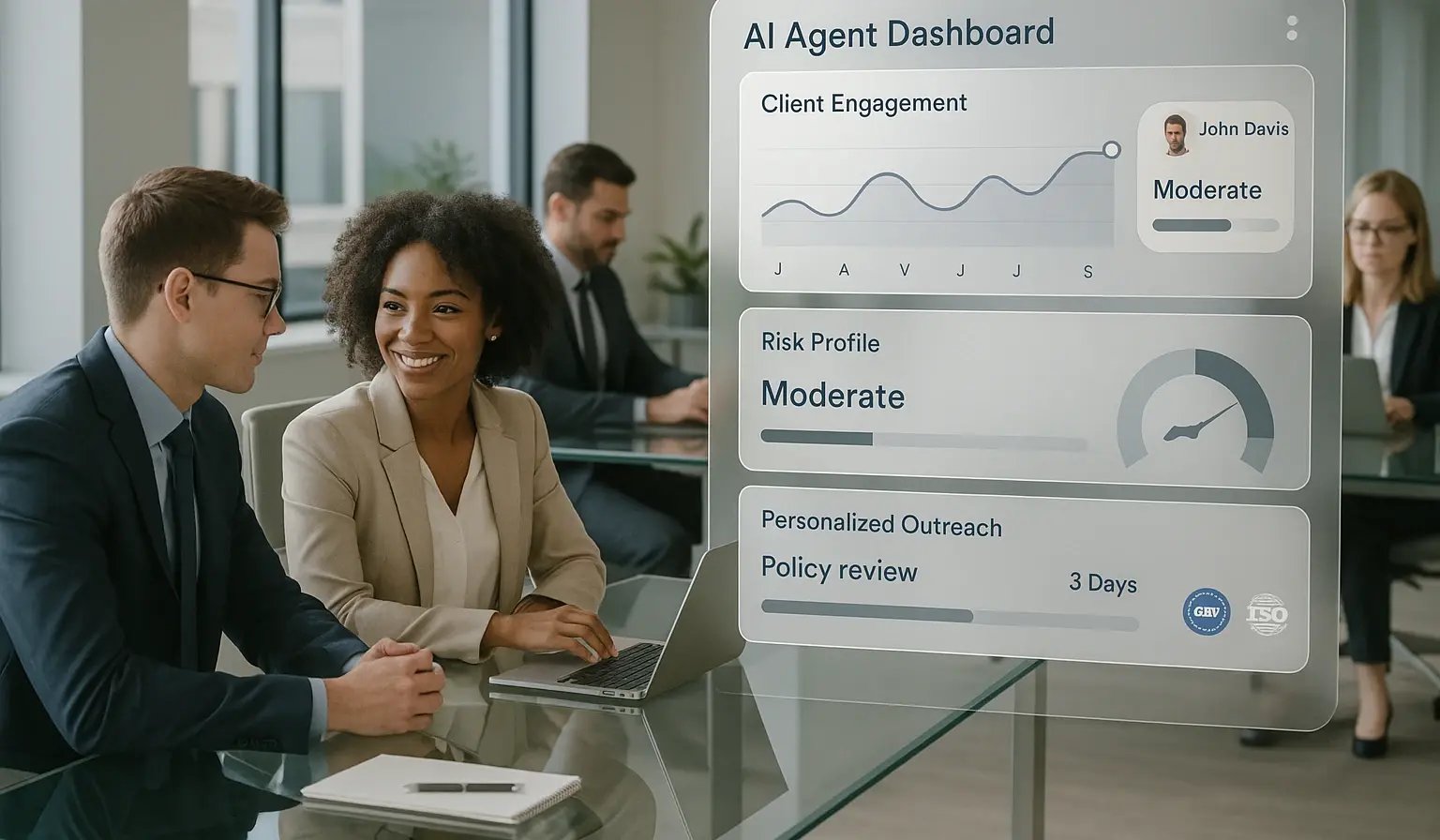
How brokers can use AI to personalize outreach, protect trust, and grow share.
Why brokers need AI-driven engagement now
Aggregators and direct-to-consumer carriers have reset customer expectations. Clients want fast answers, proactive recommendations, and transparency on coverage and claims—all delivered on their preferred channel. For brokerages, this creates a paradox: more interactions to manage with the same or fewer people. AI resolves the paradox when it transforms raw data into timely, permissioned decisions that improve the experience without adding noise. Industry research underscores the shift. Carriers leading on AI are deploying dozens of models across the value chain, compressing cycle times and improving satisfaction when data and decision flows are unified; see McKinsey.
Brokerages face similar pressures in distribution: clients expect coverage guidance in context (renewals, new risks, life events), not generic campaigns. Trade coverage highlights brokerages investing in AI to bring cross-border knowledge and real-time insights to every client meeting; see Risk & Insurance. What changes with AI is not just speed—it’s relevance and auditability. An AI engagement layer retrieves a minimal, consented context (industry, policy stack, location risks, claims history signals) and proposes the next best action: a coverage gap reminder, a renewal checklist, or a risk advisory triggered by events (e.g., wildfire, flood, cyber exposure). Done right, each decision is logged with inputs, rationale, and outcome so teams can learn what works and prove compliance.
The National Association of Insurance Commissioners tracks how AI is reshaping underwriting, service, and marketing—and reminds firms to embed governance from the start; see NAIC. In practical terms, brokers that adopt AI improve retention, focus producers on high-impact conversations, and compete with aggregators on experience rather than price alone. Common objections—“Will this feel creepy?” “Will it create compliance risk?”—are solvable by design. First, capture consent and preferences explicitly and evaluate them at activation, not just collection. Second, minimize data: most outreach needs a small context bundle, not the entire client file. Third, keep humans in command for high-stakes moves (coverage changes, complex claims). With these guardrails, AI augments the broker’s advisory role instead of replacing it.
Data, decisioning, and compliant activation
Effective AI engagement rests on three layers that map neatly to a brokerage’s reality: data, decisioning, and activation—with governance threaded through each. Data and identity: Unify core entities (client, policy, carrier, producer, risk location) and key events (renewal window opened, claim filed, certificate requested, loss control inspection scheduled). Standardize identity so the system knows “who is who” across AMS/CRM, policy admin, and email. Attach lineage and freshness so advisors trust insights. Where personal data is involved, enforce privacy-by-design: purpose limitation, data minimization, and regional residency.
Regulators and standards bodies provide usable references—NIST’s AI Risk Management Framework offers lifecycle controls that align well with marketing/service activation; see NIST AI RMF. Decisioning: Use “rules first, models where needed.” Many valuable moments are rule-friendly: send a renewal prep checklist 90 days out; escalate if claims notes indicate severity; notify when a new regulation impacts a client’s industry. Where the surface is complex, add selective models (propensity to renew, likelihood to respond to risk advisory, anomaly detection for certificates). Each decision should:
1) request a minimal context bundle;
2) evaluate consent;
3) choose an action;
4) write an immutable decision log.
Separating decisioning from channels avoids brittle one-off automations and keeps explainability intact. Activation: Deliver through email/SMS/portal with frequency caps and clear value. Provide advisors with “context packs” for calls: recent claims, open service tickets, coverage gaps, and suggested talking points. Industry roundups illustrate how AI-driven engagement improves sales throughput and client experience in distribution; for perspective, see Insurance Thought Leadership. Keep the experience transparent: explain why a message was sent and how to update preferences. This transparency raises response rates and trust.
Rollout, metrics, and ROI for brokerages
Rollout is where brokerages win or stall. Treat AI engagement like a product with hypotheses, guardrails, and evidence.
1) Start where timeliness changes outcomes. Good first nodes: 90-day renewal windows, claim-status transparency, and event-driven advisories (e.g., wildfire smoke near insured locations). Define allowed data, lawful basis, and risk tier per node.
2) Ship in stages. Begin in shadow mode (read-only recommendations), move to supervised actions for small cohorts with feature flags, then scale when metrics clear thresholds. Zero-downtime patterns—blue/green and canary—reduce risk; see HashiCorp.
3) Instrument observability across the path from event to action: trace decisions, monitor golden signals (latency, error, saturation, throughput), and pair them with business KPIs (retention, response rate, cost-to-serve). A concise primer on observability benefits for leaders is available from Splunk. Measurement must be CFO-ready. Attribute lift at the journey-node level, not by channel.
For renewals: “checklist email + advisor follow-up improved 12‑month retention by X points.” For claims transparency: “day‑3 status update reduced inbound calls Y% and raised CSAT Z.” Favor randomized control where feasible; otherwise, use quasi-experiments (matched cohorts, difference‑in‑differences) with stop-loss thresholds. Keep an audit trail that ties every recommendation to consent and rationale; this is essential for regulators and carrier partners.
Finally, upskill your team. Train producers and CSRs to interpret decision logs, use context packs, and escalate appropriately. Publish a monthly value realization review that reconciles incremental lift with cost (integration, inference, human-in-the-loop). With consent-aware data, policy-driven decisioning, and measured rollout, brokerages can offer the proactive, personalized service clients now expect—and grow share without racing to the bottom on price.