Insurance
AI
#AIinInsurance
AI You Can Be Sure

How insurers can turn AI explainability into dashboards, audit trails, and trust-building conversations with regulators and customers.
The tipping point for AI in insurance is no longer about accuracy; it’s about accountability. Underwriting engines, fraud models, and claims triage systems can already hit impressive performance metrics—but regulators, auditors, and customers now want to know how those systems work, whether they are fair, and what happens when something goes wrong. That shift is showing up clearly in the regulatory stack. In the US, the NAIC’s Model AI Bulletin on insurers’ use of AI systems, adopted in December 2023 and now being implemented state by state, sets expectations for documented governance, data practices, validation, bias testing, and record-keeping for any AI that influences regulated decisions; the full text is available at NAIC AI Model Bulletin. In Europe, the AI Act is now in force, and in August 2025 EIOPA followed up with an Opinion clarifying how existing insurance legislation (Solvency II, IDD, DORA) applies to AI, emphasising risk-based governance, data quality, explainability, and human oversight; see the summary at EIOPA AI Governance Opinion. For carriers pursuing SageSure-style AI in claims and underwriting—evidence-linked copilots, fraud analytics, automated FNOL, underwriting workbenches—the implication is that explainability can’t be a side project. It has to be baked into architecture and operations: from how models are logged and versioned, to how events and decisions are recorded, to how teams and customers see what happened in a specific case. Legal commentators are blunt about this: a 2025 analysis of state-level adoption of the NAIC bulletin notes that departments of insurance will increasingly ask carriers to demonstrate explainability on demand, especially for adverse decisions, and recommends building “explainability infrastructure” that can serve regulators, courts, and consumers; see When Algorithms Underwrite: Regulators Demanding Explainable AI. This article argues that the most effective way to respond is to treat explainability as a first-class product in its own right: dashboards and audit trails designed for different stakeholders, all powered by a common event spine. Done well, that product does double duty: it satisfies supervisors and auditors, and it reinforces your brand promise of “AI you can be sure of” by giving brokers and policyholders clearer, more consistent answers about how AI is used in their journeys.
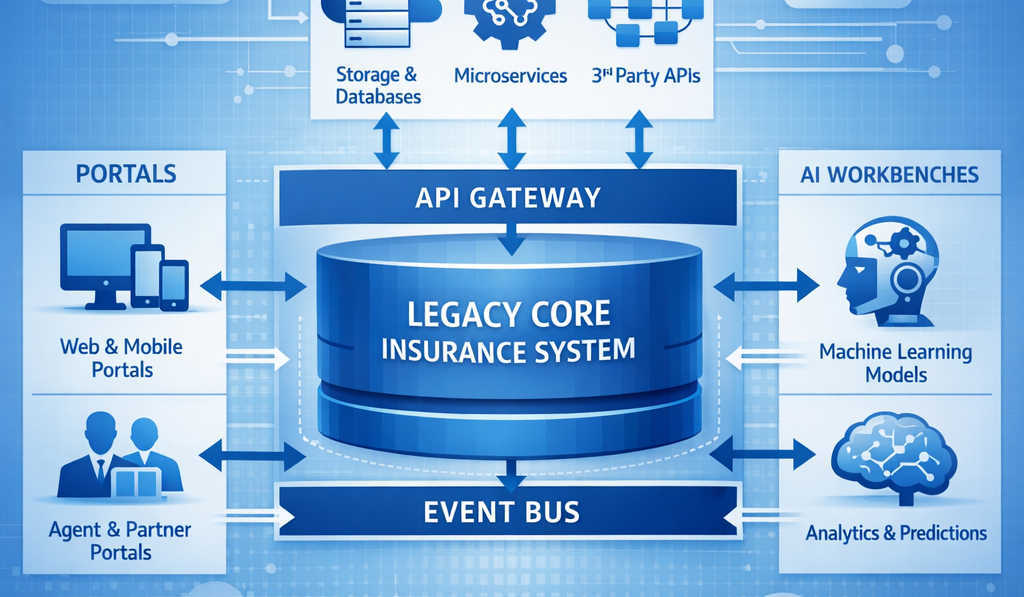
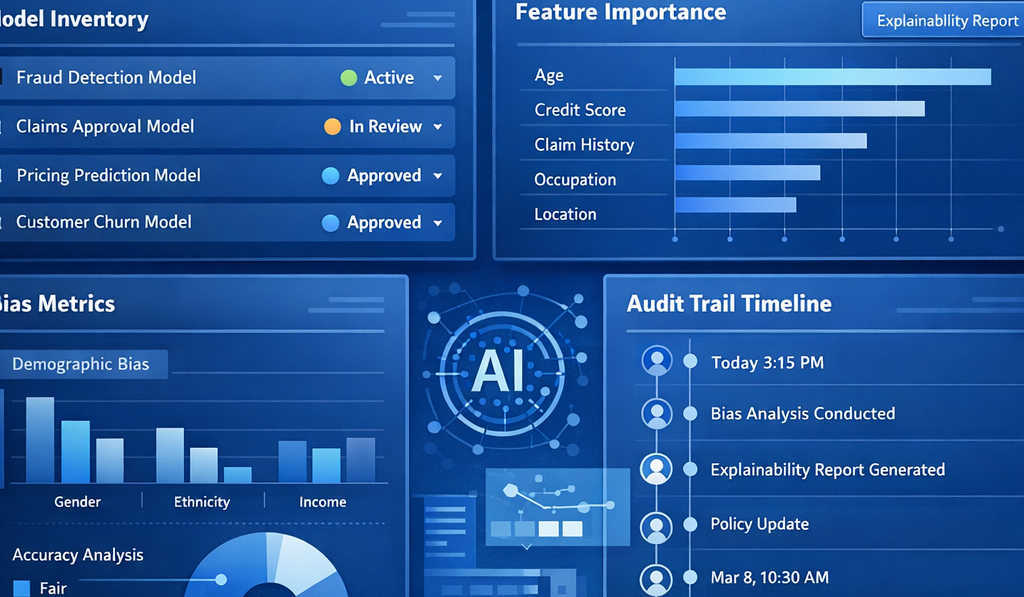
For most insurers, “AI explainability” still lives in scattered slide decks and model validation PDFs—hard for executives to consume, and almost impossible to use in real time when a regulator, broker, or policyholder asks, “Why was this decision made?” Treating explainability as a dashboard and audit-trail problem, not just a data-science concern, changes that dynamic. It turns abstract principles into concrete artefacts: model inventories that can be filtered by line and use case, per-decision traces that reconstruct inputs and human overrides, and bias monitors that flag drift before it becomes a headline. Regulators are pointing in this direction. The NAIC’s 2023 Model Bulletin on insurers’ use of AI systems—now being adopted across many US states—expects carriers to maintain documented governance, data practices, bias testing, and auditability for any AI that influences regulated decisions. It explicitly calls out the need to store model versions, inputs, outputs, and explanation artefacts alongside lifecycle events for claims and policies; see the full text at NAIC AI Model Bulletin. In Europe, EIOPA’s 2025 Opinion on AI governance and risk management makes the same move for Solvency II and distribution rules, stressing proportional, risk-based oversight, record-keeping, fairness, data governance, explainability, and human oversight across AI systems in pricing, underwriting, claims, and fraud; see the overview at EIOPA Opinion on AI Governance. Practically, that means designing a data and event spine where every significant AI-assisted action—claim.triaged, fraud.score.updated, quote.proposed, coverage.verified—emits an event with enough metadata to explain itself later: which model or ruleset ran (with version), which key features drove the output (for example, line of business, claim severity indicators, document completeness), whether the recommendation was accepted, edited, or rejected, and by whom. Architectures from cloud providers show how an event-driven approach makes this tractable. For instance, AWS’s guide to event-driven insurance processing uses Amazon EventBridge and Step Functions as a central event broker and workflow orchestrator, allowing each microservice (including AI services) to publish and consume events with consistent schemas and trace IDs; the pattern is described in detail at Event-driven Insurance Policy Processing. Once those events land in a central store, you can build explainability dashboards that matter to different audiences. For model-risk and compliance teams, views focus on model inventory, validation status, drift indicators, override rates, and fairness metrics by segment. For claims or underwriting leaders, the emphasis is on how often AI recommendations are used, where they are overruled, and how assistive tools are affecting cycle time and leakage. For executives and boards, a higher-level dashboard connects AI usage to outcomes—loss ratio improvements, LAE reductions, fraud recoveries, retention lifts—while highlighting governance KPIs (number of AI incidents, time-to-reconstruct a contested decision, regulator queries answered from logs vs. manual exercises).
Dashboards and logs are only as valuable as the conversations they enable: with regulators, with internal auditors, and with customers. To make explainability a trust asset rather than a defensive chore, insurers need an operating model that uses these artefacts proactively—and language that makes complex systems intelligible to non-technical stakeholders. Start with regulators and supervisors. A number of US states have begun to implement the NAIC Model AI Bulletin via their own circular letters and guidelines, and they are increasingly asking carriers to demonstrate how they govern AI systems, especially in underwriting, pricing, and claims. Legal analyses of these moves note that departments expect “defensible by documentation” programmes: inventories, validation reports, bias tests, and trace logs that can show, for a given AI system, what data it uses, how it was tested, and how decisions are overseen; see, for example, a 2025 briefing on how state insurance regulators are demanding explainable AI systems at When Algorithms Underwrite: Regulators Demanding Explainable AI. EIOPA’s 2025 Opinion takes a similar stance in the EU, framing explainability and documentation as an extension of existing Solvency II and IDD governance obligations rather than something entirely new; the summary is available at EIOPA Opinion on AI Governance. An explainability dashboard tailored for supervisors doesn’t need animations; it needs clarity. Think in terms of a “model passport” view for each high-impact system—claims triage, fraud scoring, underwriting workbench—not just a technical spec. Each passport page should summarise: purpose and use cases; data sources and key features (with rationale); training and validation approach; monitoring metrics; known limitations; human oversight points; and recent incidents or remediation actions. Under the hood, this view links to detailed logs and validation artefacts so you can move from overview to evidence in a few clicks. On the customer side, explainability is as much about tone as it is about machinery. When a claim is flagged for additional review, a quote is adjusted, or coverage is declined, your communications should explain the decision in plain language without exposing proprietary models. Research and early enforcement actions suggest that regulators will look favourably on insurers who can demonstrate consistent, understandable explanations and accessible appeal paths. The NAIC Model AI Bulletin explicitly emphasises consumer notice and meaningful information about AI use; EIOPA’s framework stresses that explanations must be comprehensible to laypersons, not just experts. Aligning your letter templates, portal messages, and call-centre scripts with these expectations turns your technical groundwork into visible proof of “AI you can be sure of.” For internal teams, dashboards should become part of the cadence: model committees using them to approve changes; claims and underwriting leaders reviewing override patterns; risk and compliance using them to monitor drift and fairness; and executives using them to see how AI adoption is affecting operational KPIs. Over time, this normalises a culture where AI is neither a black box to be feared nor a toy to be deployed without guardrails, but a governed capability. When everyone—from data scientists to adjusters to board members—can see and interrogate how AI works in your environment, explainability moves from checkbox to competitive differentiator. Bringing these elements together—event-level audit trails, role-specific dashboards, regulator-ready documentation, and customer-friendly narratives—positions carriers to scale AI safely. In a world where supervisors in the US and EU are converging on similar expectations, insurers that invest early in explainable, evidence-linked AI will be better placed to expand automation in claims and underwriting without triggering regulatory backlash—and will have a clearer story to tell policyholders about how technology is being used on their behalf.