How to design AI-ready underwriting workbenches that underwriters trust and actually use.
Why underwriting workbenches now decide who grows in specialty and P&C
Across commercial and specialty insurers, “underwriting workbench” has become a boardroom buzzword. But for many underwriting leaders, the experience on the ground hasn’t caught up with the promise: underwriters still live in email and spreadsheets, ACORD PDFs pile up in shared drives, and every new AI feature seems to add a dashboard without removing any work. For SageSure’s ICPs—underwriting heads, COOs, and CTOs in P&C and specialty lines—the question is no longer whether to invest in a workbench; it’s how to design one that underwriters actually use, that respects regulatory expectations, and that unlocks measurable productivity and growth. Market data reinforces why this matters now. Capgemini’s 2025 P&C insurance trends report flags underwriting workbenches as a top enterprise-management priority, noting that trailblazer carriers already enjoy higher underwriting efficiency and better quote-to-bind than peers by giving underwriters unified, AI-assisted desktops; see their discussion of “underwriting workbenches” as a 2025 trend at Capgemini Top Trends 2025. A 2025 guide from Unqork, which analysed the shift from PAS-centric flows to workbench-centric underwriting, underscores that disconnected systems and rigid policy admin screens are now a structural brake on growth, especially in commercial and specialty lines; the guide describes how next-generation workbenches orchestrate intake, enrichment, triage, and quote within a single hub, see The Underwriting Workbench: A Guide. For SageSure’s target carriers—mid-to-large P&C and specialty insurers under pressure to grow in Marine, Cyber, Renewable Energy, and D&O—the implication is clear: the workbench has to become the primary operating surface for underwriting, not a cosmetic layer on top of legacy cores. That means designing around underwriter workflows and trust, not around system boundaries; instrumenting every assist with evidence and audit trails; and wiring the workbench into claims, broker portals, and data platforms so it becomes the pivot for AI-assisted decisioning across the value chain. This article lays out a pragmatic blueprint: start by fixing ACORD-driven intake, then design a workbench that surfaces the right evidence and signals at the right time, and finally operate it as a governed product with KPIs that connect directly to speed, hit ratios, and portfolio quality.
Designing an AI-ready underwriting workbench underwriters trust
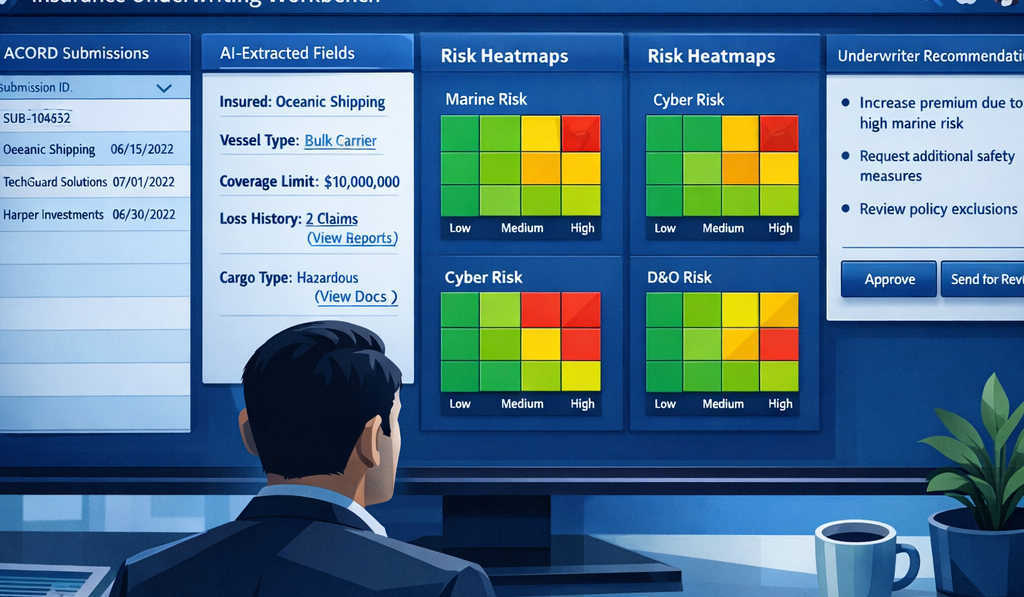
If you ask ten underwriters what they want from a workbench, you’ll hear the same themes: stop making me re-key ACORDs, show me what matters first, and don’t make me fight a black box. Yet a surprising number of “modern” workbenches still behave like prettier policy admin screens—multiple tabs, little context, no sense of priority. To build a workbench that underwriters actually adopt, insurers need to combine three design principles: ACORD-first intake, evidence-linked assistance, and queues that reflect how specialty portfolios really run. The data case for getting this right is getting stronger. Capgemini’s 2025 P&C Top Trends report highlights underwriting workbenches as a top priority trend for commercial lines, noting that underwriters today spend roughly 41% of their time on administrative and operational tasks instead of risk judgment, and that trailblazer carriers with mature workbenches are already seeing higher underwriting efficiency and better growth than peers; see the summary of this trend at Capgemini Top Trends 2025: P&C Insurance. Vendors building AI-enabled workbenches report similar gains: a 2025 guide from Unqork describes how its AI underwriting workbench helps carriers cut time-consuming intake and triage work and get to quote faster, with underwriters spending more time on decisions and less on hunting through email and spreadsheets; see their overview at The Underwriting Workbench: A Guide. Translate those lessons into SageSure’s world and the first move is to treat the workbench as the front door for every submission and referral, not as an afterthought UI bolted onto the PAS. Start by normalizing intake around ACORD and a small set of product-specific extensions for Marine, Cyber, Renewable Energy, and D&O. Use intelligent document processing—whether from a specialist vendor or an in-house model—to classify packets, split out ACORDs and loss runs, and pre-fill key data fields with confidence scores. Crucially, every pre-fill must carry a breadcrumb: document ID, page number, and a highlighted snippet so an underwriter can click straight from “Limit: $25M” in the workbench to the exact box on the ACORD or schedule. On top of that, design the canvas for underwriter judgment, not for database tables. That means side-by-side views of core facts and evidence, clear flags for what’s missing or unusual, and compact visualizations of risk drivers—location heatmaps for property, attack surface indicators for cyber, board composition and litigation history for D&O. External examples show why this matters: Unqork’s and other platforms’ case studies stress that consolidating 10+ tools into a single underwriting cockpit drastically reduces swivel-chair time and errors; see how a no-code AI workbench aims to do this at Unqork AI Underwriting Workbench. The goal is similar for SageSure’s ICPs: one governed, AI-assisted desk where underwriters can see submissions, evidence, analytics, and appetite in one place.
Run, measure, and evolve underwriting workbenches
Once a workbench is live, the difference between a shiny pilot and a real productivity engine is how you run it. Underwriting leaders and CTOs need a shared operating model: product owners for the workbench, clear SLAs for triage and decisions, and metrics that tie usage and speed back to premium and loss ratio, not just click counts. Start with queues and benchmarks. Segment work by specialty (Marine cargo vs. hull, Cyber SME vs. large enterprise, Renewable Energy solar vs. wind, D&O private vs. public) and by complexity and value. For each segment, define target medians and P75/P95 decision times, then use the workbench to expose where cases are stuck—awaiting broker data, internal referral, external engineering reports. Capgemini’s 2025 trends research stresses that carriers leading on workbenches are using them not only for individual case handling, but as platforms for data-driven book management and productivity—freeing underwriters to focus on high-ROI opportunities and improving quote response times by hours, not days; see the underwriting workbench case examples in the same report at Capgemini P&C Top Trends 2025. Then wire AI assistance into the cadence in a way that regulators and underwriters both accept. Use models to score submission completeness, suggest appetite fit, highlight anomalies in loss runs, and draft broker responses—but always surface the rationale and preserve human decision rights. Legal and supervisory guidance on insurance AI governance, from NAIC principles in the US to EIOPA in Europe, consistently emphasises explainability and human oversight; workbenches that log model versions, input features, outputs, and override reasons next to each decision will be far easier to defend under those regimes. Finally, invest in feedback loops. Track which AI suggestions underwriters accept, edit, or ignore; where evidence links are missing; and where brokers still send email instead of using structured e-submission. Use that data to improve models, refine intake, and adjust playbooks by line. External benchmarks on workbench impact suggest that commercial carriers are already trimming risk assessment time by up to 60% and lifting submission-to-bind conversion when they close this loop; see a recent example of an AI workbench marketed on cutting risk assessment time dramatically at AI Underwriting Workbench: Cut Risk Assessment Time. For SageSure’s ICPs, the message is simple: an underwriting workbench underwriters actually use is one they helped design, that proves its value in their KPIs, and that treats AI as a transparent assistant—not as a replacement for their judgment.