How to design digital insurance experiences that raise NPS and retention by linking claims, self-service, and AI to measurable outcomes.
Why digital CX, not price alone, now decides who stays with their carrier
Insurance executives talk a lot about "digital transformation," but policyholders and brokers experience it in much simpler terms: did the app help me when I needed it, or did I end up back on the phone? In an environment where acquisition costs are rising and pricing flexibility is constrained by regulation and capital, improving digital customer experience is one of the few levers carriers control directly to protect retention and lifetime value.
Recent data illustrates both the progress and the remaining gap. J.D. Power’s 2024 U.S. Claims Digital Experience Study finds that satisfaction with digital claims channels has surged: overall satisfaction with digital claims journeys reached 871 on a 1,000-point scale, 17 points higher than the prior year, with mobile apps now the most satisfying way to report and track a claim thanks to better image capture, status updates, and guidance; see the release at 2024 U.S. Claims Digital Experience Study. At the same time, other research on policyholder expectations points out that many customers still experience friction when journeys cross channels—starting in an app, then having to switch to email or call center when they have a question.
For carriers building SageSure-style AI claims, underwriting workbenches, and modern portals, the strategic opportunity is to make digital CX more than a set of screens. It should be the visible layer of an event-driven, AI-assisted operating model that keeps customers informed, reduces effort, and makes your promise of "fast, fair, explainable" service feel real at every touch. That means tying journey design tightly to back-end architecture and governance: digital touchpoints should reflect true state in near real time, AI assistance should be evidence-linked and transparent, and human teams should be able to see and intervene in any journey quickly when needed. When these elements come together, digital channels stop being cost-saving experiments and become retention engines.
Designing digital journeys that balance automation with human assurance
Designing digital journeys that genuinely improve satisfaction—and not just push work onto policyholders—means balancing automation with human assurance. Insurance customers increasingly expect app-quality interactions, but they also want to feel that a real person is accountable when something goes wrong. Successful carriers recognize that the goal is not to deflect every interaction into self-service; it is to make routine tasks effortless while making complex moments feel guided and transparent.
Recent research on digital claims experience shows just how far the industry has come. J.D. Power’s 2024 U.S. Claims Digital Experience Study reports that satisfaction with digital claims has risen by 17 points year-over-year, and that mobile apps are now the most satisfying way to report a claim, thanks to streamlined reporting tools, proactive updates, and better-designed interfaces; see the study summary at 2024 U.S. Claims Digital Experience Study. Yet the same analysis flags a persistent gap: while 84% of claimants say digital communication is easy, only 39% say carriers respond to emails and texts in a timely fashion, and many customers end up using multiple channels for the same question—eroding satisfaction.
For operations and CX leaders, this highlights two design imperatives. First, orchestrate channels rather than just adding them. Digital-first FNOL, self-service status, and policy self-management should be backed by event-driven systems that keep web, app, call center, and broker views in sync. When a claim moves from "reported" to "triaged" to "inspection" to "payment," that state change should be an event that updates every relevant channel, not a manual update in one queue. Architecture briefs from core and cloud vendors describe this pattern as the backbone of modern, omnichannel insurance; using lifecycle events and cloud-native integration, carriers can keep experiences consistent and reduce the need for customers to chase answers across phone, email, and apps.
Second, build human checkpoints into high-stakes or ambiguous moments. For example, digital journeys can let customers choose their preferred communication blend—self-service with periodic human check-ins, or high-touch for large losses or complex specialty claims. AI can assist by pre-reading documents, summarizing conversations, and drafting explanations, but final coverage decisions and complex settlements should always come with a named contact and evidence-linked rationale. Studies on AI-powered claims management emphasize that the most effective programs pair machine learning for fraud detection and triage with proactive communication and human oversight, improving both loss ratios and Net Promoter Scores; one 2025 study of an integrated AI claims platform reported a 28-point NPS increase alongside significant reductions in processing time and fraud false positives, as detailed in AI-Powered Claims Management.
Run, measure, and govern digital CX as a retention engine
To turn digital CX from a collection of projects into a retention engine, insurers need to manage it like a product portfolio—anchored in metrics, governance, and continuous improvement.
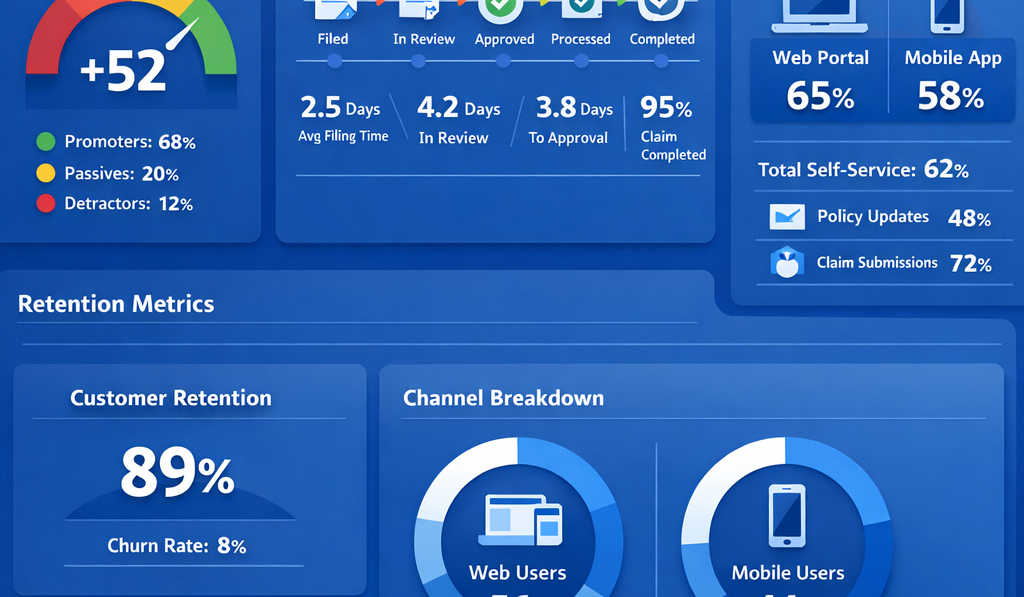
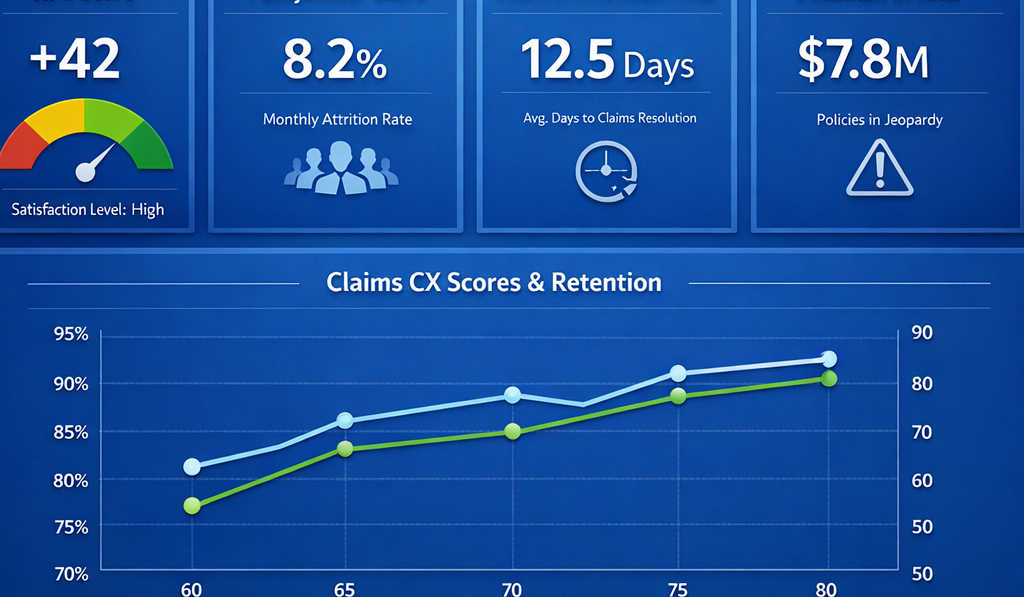
Start with a clear measurement framework that links digital touchpoints to loyalty. At minimum, track: NPS or CSAT by journey (claims, billing, self-service policy changes), digital adoption rates (percentage of claims initiated and serviced through digital channels), time-to-complete for key tasks, and containment rates (how often customers resolve an issue digitally without channel-hopping). Overlay these with retention and cross-sell outcomes for customers who use your digital journeys versus those who do not. Industry reports on digital insurance platforms suggest that carriers deploying modern customer experience platforms see measurable lifts in new business and retention—one analysis of digital CX platforms for insurance cites double-digit improvements in engagement and churn reduction when web, mobile, and portal experiences are unified and deeply integrated into policy and claims systems; see an overview of digital CX platforms for insurance at Insurance Client Portal Software: A Complete Guide for Brokers and Insurers, which highlights how workflow-driven portals can reduce email and accelerate service.
Next, treat each major journey as a product with an owner, roadmap, and cross-functional squad. Claims FNOL, digital endorsements, policy onboarding, and broker portals should all have explicit target metrics (for example, reduce FNOL-to-triage latency by 30%, increase digital claims NPS by 15 points, double self-service adoption) and regular reviews with stakeholders from operations, IT, compliance, and marketing. Use customer feedback, call transcripts, and behavioral analytics to identify friction: where do customers abandon flows, call for help, or switch channels? Fix those points first.
Governance is where digital CX intersects with SageSure’s trust and compliance narrative. As you introduce AI into digital experiences—chatbots answering coverage questions, virtual assistants guiding FNOL, recommendation engines suggesting add-ons—you must ensure explainability, data minimization, and human oversight. This means documenting where AI is used, logging inputs and outputs with trace IDs, and providing clear paths to human escalation when customers are confused or stakes are high. Supervisory guidance on AI in insurance, including principles from NAIC and European supervisors, consistently emphasizes fairness, transparency, and accountability; aligning your digital CX governance with these principles from the outset reduces regulatory risk and reinforces your “AI you can be sure of” positioning.
Finally, align incentives. Make digital NPS and containment part of leadership scorecards, and share wins broadly when digital journeys reduce call volume, accelerate claims, or lift renewal rates. When teams see that digital CX improvements translate directly into happier customers and better financial performance, "the app" stops being a side project and becomes core to how the business competes.