
Insurance
#AIinInsurance
ClaimsTransformation
AI You Can Be Sure

How insurers can use API-first integration to modernize legacy cores and unlock AI-ready claims and underwriting.
For many insurers, the phrase “insurance API integration” has been on strategy slides for years—but the stack still looks like green screens, flat-file feeds, and brittle nightly batch jobs. At the same time, claims, underwriting, and distribution teams are under pressure to deliver SageSure-style capabilities: AI-assisted claims, event-driven FNOL, broker portals, and underwriting workbenches that actually reflect real-time data. The missing link is a practical API integration pattern that bridges legacy cores and modern channels without demanding a risky rip-and-replace. Market data and case studies make it clear that this bridge is both feasible and high-ROI. A real-world example from AIG shows how wrapping IBM i (AS/400) policy and claims applications with APIs allowed call-centre staff to provide instant car insurance quotes and cut claim payment times from days to minutes. Using an API and microservices approach, AIG’s team exposed core functions through an integration layer that plugged into their existing DevOps toolchain, reduced manual re-keying, and automated payment processing—ultimately saving eight staff-days per month and materially improving customer experience; see the case study at Insurance API Integration Case Study. A longer-form summary of the same project emphasises that this was achieved without a core replacement, relying instead on pre-built connectors to expose legacy business logic as microservices; details are available at AIG Enhances Customer Experience with OpenLegacy. At a strategic level, global outlooks argue that this kind of API-first, event-driven integration is now a prerequisite for scaling AI and digital experiences. Deloitte’s 2026 global insurance outlook highlights that carriers looking to industrialise AI need stronger data foundations and modern architectures that can feed AI models with real-time, high-quality data from policy and claims systems; see the architectural and spending trends at Deloitte 2026 Global Insurance Outlook. AWS’s industry blog on event-driven insurance processing reinforces this, showing how an event broker and microservices can orchestrate policy lifecycle steps (submission, underwriting, pricing, issuance, renewal) around legacy cores with clear audit trails and surge-ready scalability; the reference design is available at Event-driven Insurance Policy Processing. For CTOs and heads of transformation, the implication is straightforward: the fastest way to unlock SageSure-style AI and claims automation is not to wait for a new core, but to stand up an API and event layer that makes legacy systems look and behave like modern platforms. The rest of this article outlines how to design that integration pattern, sequence delivery, and run it with the governance that regulators and boards now expect.
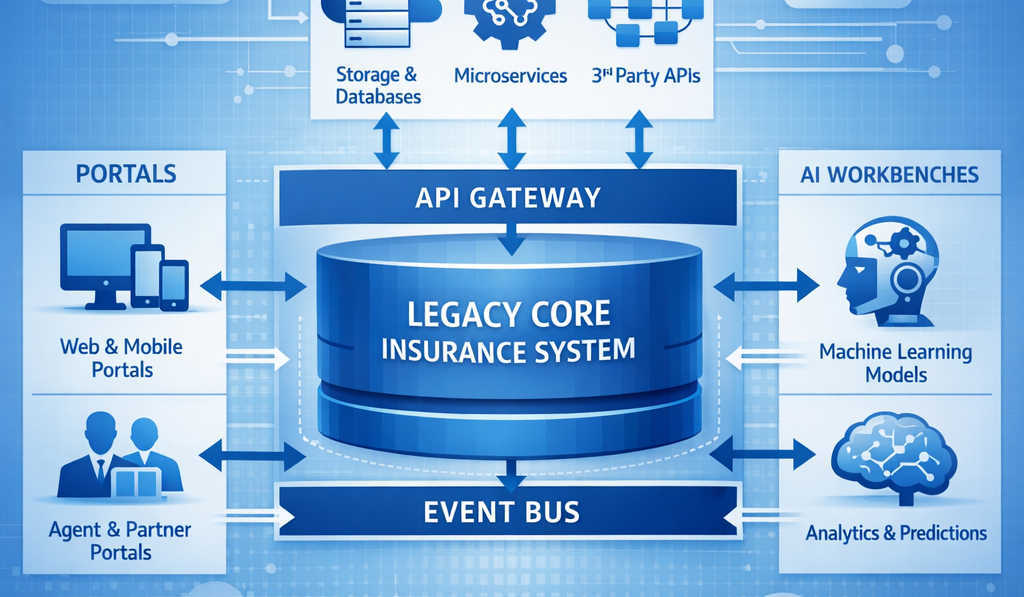
A credible API integration blueprint for insurers has to start with the reality of the stack you already run: mainframe or AS/400 cores, tightly coupled on-prem policy and claims platforms, decades of batch integrations, and line-of-business teams who cannot afford downtime. Architecture decks that assume a greenfield microservices platform miss the point; what you need is a pattern that lets you stand up SageSure-style AI workbenches, event-driven claims, and broker APIs on top of what you have, then progressively decouple over time. The wrap-don’t-rip pattern is well documented, but often poorly operationalised. In practice, it means three things. First, an API gateway that becomes the only front door to your core domains—policy, claims, billing, party, product—enforcing identity, consent, schema versioning, and rate limiting. Second, an event backbone that publishes canonical lifecycle events—policy.bound, fnol.received, claim.triaged, coverage.verified, payment.initiated—so downstream systems can subscribe without point-to-point calls. Third, thin adapters that translate modern REST/JSON calls into whatever your core speaks (SOAP, MQ, copybook-based transactions) without leaking legacy concepts into your contracts. Industry patterns from cloud and integration vendors back this approach; for example, AWS outlines how event-driven policy processing on Amazon EventBridge and Step Functions decouples services and supports spikes in volume while preserving auditability in its reference architecture at Event-driven Insurance Policy Processing. Case studies reinforce that this is not theory. A widely cited example from OpenLegacy describes how AIG used APIs to wrap IBM i (AS/400) applications, enabling call-centre staff to deliver real-time quotes and automating claim payments; the integration reduced staff effort by 40% and cut payment times from days to minutes, without replacing the core, as detailed in AIG Insurance API Integration Case Study. Another insurance-focused blog from AWS walks through how microservices, a central event broker, and serverless components can orchestrate policy underwriting, pricing, and issuance in a way that isolates legacy systems, giving underwriters and developers a more flexible environment while cores remain stable; see the design overview at Event-driven Insurance Architecture. Designing your own blueprint means being explicit about scope and sequencing. Start by cataloguing the top 20–30 operations that matter most to front-line teams and partners: retrieve policy, create FNOL, update claim status, generate quote, issue endorsement, initiate payment. Map which systems currently own those capabilities and where the biggest friction lies. From there, design coarse-grained APIs that align to business capabilities ("CreateClaim," "SubmitUnderwritingCase") rather than mirroring internal tables. Use ACORD data elements where practical to reduce mapping churn with brokers, MGAs, and downstream platforms. Then, define a minimal set of canonical events and the services that will produce or consume them. This is the backbone that your SageSure-style AI copilots, portals, and analytics will ride on.
Once APIs and events are in place, the question shifts from “can we integrate?” to “how do we run and evolve this safely?” An API integration program that actually ships has three characteristics: it is governed like a product, measured like an operations function, and aligned to regulatory expectations around resilience and data protection. Product thinking starts with ownership. Each domain—policy, claims, billing, customer—should have an API product owner responsible for the catalog, consumer onboarding, backward-compatibility strategy, and roadmap. That roadmap ties directly to campaign and line-of-business goals: enabling broker quote-and-bind for a new specialty product, exposing event streams so SageSure-style adjuster workbenches and underwriting copilots can operate in real time, or providing customer portals with accurate claim status. The AWS event-driven policy example underscores that treating events and APIs as reusable products makes it easier to add capabilities over time without destabilising cores; see the discussion of microservices and central event brokers in AWS Event-driven Insurance Architecture. Operationally, you need metrics that reflect both IT and business value: API uptime and latency; error and timeout rates by consumer; time-to-onboard new partners; share of key journeys (FNOL, endorsements, quote/bind) executed via APIs vs. legacy channels; and the impact of new API-enabled experiences on claims cycle time or underwriting turnaround. External case studies offer benchmarks: in the AIG/OpenLegacy story, automating calls from the call-centre app to the core systems via APIs led to instant quote calculations and shaved eight staff-days a month off manual claims payment work; see the quantitative benefits at AIG Real-time Quotes and Faster Payments Case Study. These kinds of numbers make it easier to win budget for the next integration tranche. Regulatory and risk alignment can’t be bolt-ons. As you expose more of your core via APIs and events—to portals, partners, and AI services—you expand your attack surface and your obligations under frameworks like NAIC’s Model AI Bulletin and, for EU-facing business, EIOPA’s 2025 Opinion on AI governance and risk management. That means designing zero-trust principles into your gateway (short-lived tokens, least-privilege scopes, mutual TLS) and ensuring that any AI systems consuming claim or policy events leave behind an audit trail of inputs, model versions, outputs, and human overrides. Regulators are explicit that insurers remain accountable for third-party models and APIs; EIOPA’s 2025 Opinion highlights the need for clear roles, data governance, and traceability for AI systems across pricing, underwriting, claims, and fraud, see EIOPA AI Governance Opinion. When your integration program bakes in these controls from day one, “API-first” becomes a trust asset with supervisors as well as with brokers and customers.