How to automate marine cargo claims documents to speed settlements and cut risk. Marine cargo claims are documentation‑heavy and delay‑prone: bills of lading, packing lists, invoices, certificates of origin, surveyor reports, and correspondence stack up quickly across shippers, ports, and logistics partners.
Why marine cargo claims need automation with human oversight
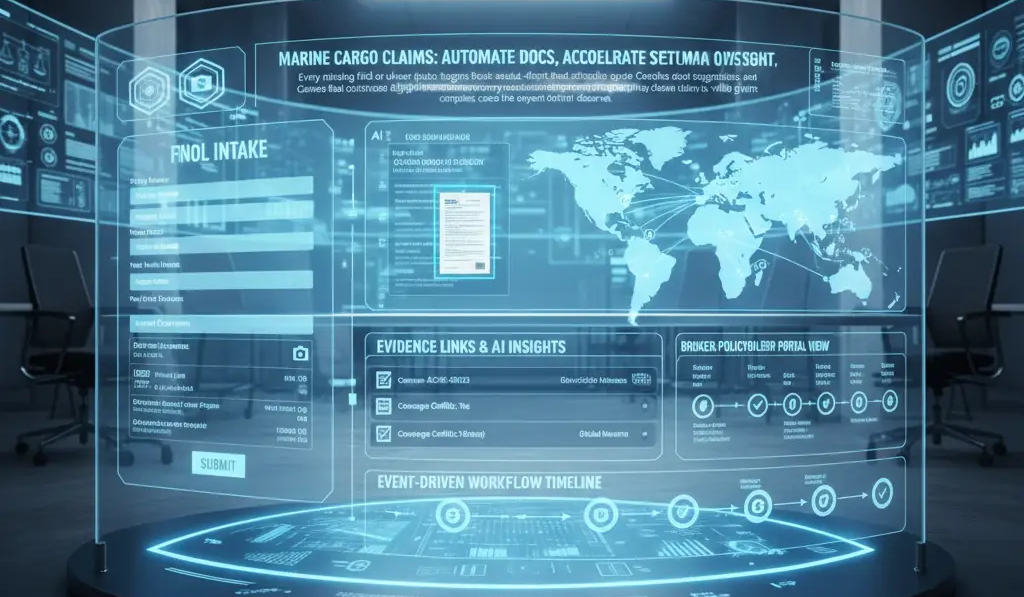
Every missing field or unclear photo triggers a back‑and‑forth that stretches cycle time and frustrates brokers and insureds. Yet the path to faster, fairer outcomes does not require a risky core replacement. Carriers that standardize digital intake, attach evidence to every automated suggestion, and orchestrate work through events are settling clean claims in days, not weeks—while giving complex cases the expert attention they deserve. Start at the edge where delays begin: first notice and submission. Replace email‑driven intake with guided web and mobile flows that adapt to loss type and policy context. Validate basics (policy number formats, voyage dates, vessel/port codes) as the user types; pre‑fill where possible from policy and prior shipments. For reefer cargo, prompt for temperature logs; for break‑bulk, capture stowage details and photographs with on‑device quality checks. The goal is to collect once, use everywhere—feeding claims, fraud checks, surveyor assignment, and customer communications from the same high‑quality inputs. Trust rests on evidence. If AI extracts “consignee: ACME Imports” or flags a potential coverage conflict, reviewers need to see exactly where that conclusion came from. Layout‑aware document intelligence should retain page coordinates and text snippets so an adjuster can click from a data field straight to the source on the bill of lading or survey report. This transforms re‑keying into rapid “accept/correct” actions, reduces errors, and builds an audit trail that satisfies internal and external scrutiny. Marine operations demand orchestration more than monoliths. Instead of pushing every step through the core claims system, publish a small set of canonical events that describe the claim’s journey—fnol.received, claim.triaged, coverage.verified, survey.requested, settlement.initiated. Independent services subscribe and react: a triage engine scores complexity and routes to the right handler; a vendor service assigns surveyors based on location and capacity; a communications service sends status updates to brokers and insureds. This decoupling increases resilience during surges (port congestion, CAT spillover) and makes it easier to add capabilities—like document AI—without risky rewrites. Finally, design for transparency. A broker/policyholder portal that renders the same events as a timeline (“coverage verified,” “survey scheduled,” “payment initiated”) cuts the volume of “where’s my claim?” calls and raises satisfaction. As you scale automation, maintain human‑in‑the‑loop controls at decision boundaries and persist decisions with trace IDs. That’s how you move faster without losing control—and how you prove it to auditors and customers alike.
Design the backbone: intake, evidence links, and event-driven flow
Modernizing the backbone starts at intake. Replace email chains and unstructured PDFs with a guided digital FNOL that adapts to marine loss types (cargo damage vs. delay, general average, theft), validates required fields at the edge, and requests only the evidence that accelerates review: bills of lading, invoices, packing lists, surveyor reports, temperature logs for reefers. Align fields to industry standards to avoid mapping churn downstream; ACORD data elements provide durable scaffolding for interoperability across brokers, TPAs, and core systems. See the reference here: ACORD Data Standards. Evidence must travel with every suggestion. Layout‑aware extraction should retain page, paragraph, or table‑cell coordinates so reviewers can jump straight to the source. When a model extracts “Port of loading: Shanghai” or “Declared value: $750,000,” the reviewer should be able to click an evidence link to the exact location in the bill of lading. This turns re‑keying into rapid confirmation and builds trust with auditors and brokers. Move from handoffs to flow with events. Each milestone—fnol.received, claim.triaged, coverage.verified, survey.requested, settlement.initiated—should publish an immutable event that downstream services subscribe to. This decoupling lets you scale the specific services under pressure (e.g., triage during CAT seasons or port congestion) without overloading the claims core, and it creates an audit spine that survives personnel changes and vendor swaps. Major platforms validate the pattern; for example, guidance shows how application events simplify outbound integrations and lifecycle updates for claims systems: Guidewire App Events. Design “right‑sized automation.” Automate the mechanical tasks—document classification, entity extraction, duplicate detection, appointment of surveyors from a vetted panel—while keeping humans firmly in the loop for ambiguous or high‑exposure cases. Require human sign‑off at decision boundaries (coverage confirmation, settlement offers) and capture override reasons as structured data. Persist inputs/outputs with trace IDs next to events so every decision can be reconstructed in minutes. Finally, expose a status portal for brokers and insureds that renders the same events as a clear timeline; transparency reduces the “where’s my claim?” calls that bog down handlers.
Build a 90‑day rollout: metrics, governance, surge readiness
Turn design into outcomes with a 90‑day plan that respects marine nuance: Days 1–30: Baseline cycle time and touch counts by cargo type and cause of loss. Stand up digital intake for one product (e.g., marine cargo) with ACORD‑aligned fields and large‑file upload. Publish a minimal event stream—fnol.received, claim.triaged, settlement.initiated—to create an immutable audit trail. Define a vetted surveyor panel and initial routing rules by geography and loss type. Days 31–60: Introduce classification and extraction with evidence links for bills of lading, invoices, and surveyor reports. Implement triage scoring that considers declared value, perils, and documentation completeness; route high‑exposure or ambiguous cases to senior handlers. Enable proactive notifications to brokers and insureds tied to events (“survey requested,” “coverage verified”). Instrument deflection of status‑check calls and time‑to‑document completion. Days 61–90: Add straight‑through criteria for low‑severity, clean claims (e.g., minor packaging damage below threshold with complete documentation) with clear human overrides. Pilot surge protocols for port congestion or CAT‑adjacent events—scale extraction and triage services, relax noncritical validations temporarily, and maintain full auditability. Tie operational gains to customer outcomes (broker satisfaction, renewal deltas) and financials (storage/rental days avoided). Anchor governance from day one. Maintain a model and rules inventory with owners and limitations; log every inference with trace IDs and the evidence shown to reviewers. Align with market expectations for straight‑through processing on simple claims while preserving fairness and transparency requirements. Lloyd’s modernization blueprints expressly emphasize automating simpler claims and straight‑through processing to raise service quality—see the vision outlined here: Lloyd’s Blueprint One. Pair this with sanctions and due‑diligence controls appropriate to marine trade lanes to prevent inadvertent violations as you scale digital payouts; Lloyd’s guidance highlights the importance of robust due diligence: Lloyd’s Sanctions Guidance. With evidence‑linked extraction, event‑driven flow, and human‑in‑the‑loop guardrails, marine carriers can settle faster without sacrificing control. The result is fewer handoffs, clearer audits, and happier customers—and a broker community that notices when you move with speed and confidence.