How insurers can modernize PAS for AI-ready underwriting without a risky rip-and-replace.
Why PAS modernization can’t wait for AI
Policy administration systems sit at the heart of every insurer, but many cores were never designed for AI‑assisted underwriting, ACORD‑first submissions, or real‑time distribution partners. At the same time, specialty underwriters and brokers are pushing hard for faster decisions, richer appetite guidance, and clearer status.
Waiting for a multi‑year core replacement project isn’t realistic; the market and your talent won’t stand still. Instead, carriers need a modernization plan that makes their PAS “AI‑ready” in months, not years, by wrapping it with APIs and events and putting a modern underwriting workbench on top.
The first step is brutally honest assessment. Map how underwriting actually flows today—from broker intake and ACORD forms through rating, referrals, and bind. Identify where PAS slows things down: batch integrations, brittle screens that require re‑keying the same data, or hard‑coded product rules that force every change through IT. Then flip the question: what do underwriters, brokers, and actuaries need that the PAS can’t easily provide today?
Typical answers include ACORD‑aligned, validated submissions; evidence‑linked document views; near‑real‑time performance metrics; and predictable integration points for external data. That gap analysis defines which PAS capabilities must be exposed via APIs, which can be augmented at the edges, and which genuinely require core refactoring. Next, decide your modernization posture. For many carriers, the right answer is progressive decoupling, not a risky big‑bang. Industry outlooks from firms like Deloitte keep reinforcing this shift: staged platform modernization—API gateways, event backbones, thin adapters—delivers value faster and de‑risks change (Deloitte Insurance Outlook). For underwriting, that means creating a workbench that becomes the front door for submissions and decisions while PAS remains the book of record. Over time, more logic migrates out of the core into configurable services, but you don’t have to bet the company on a single cutover weekend.
Wrap the core: APIs, events, and data contracts
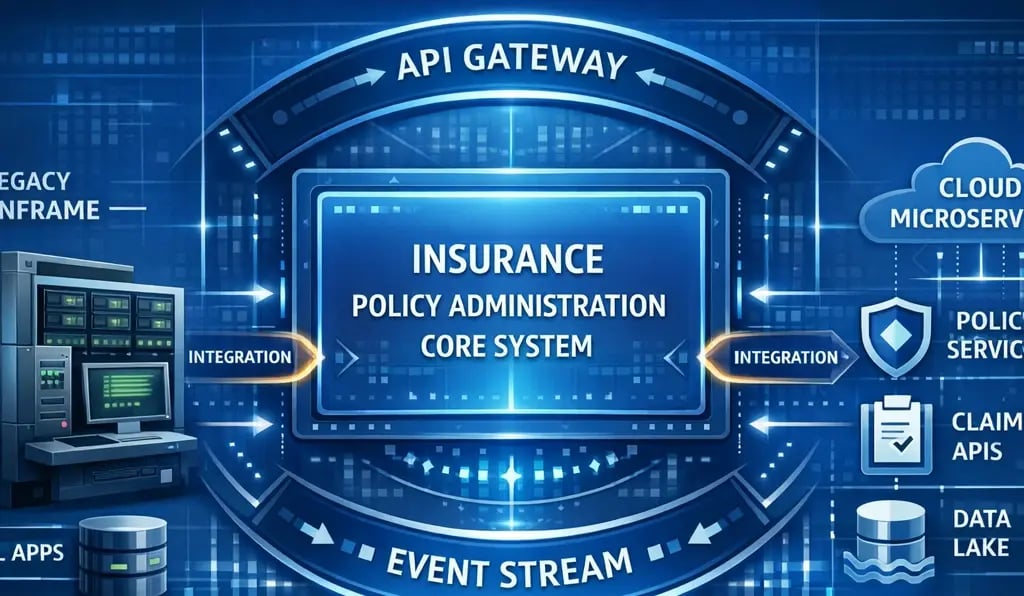
Once you know what you need from the PAS, make it possible without tearing it out. The safest pattern is “wrap, don’t rip”: put an API gateway and event backbone in front of the core so you can add new capabilities at the edges while the system of record stays stable. The gateway handles identity, consent, schema versioning, rate limiting, and field‑level encryption for PII.
Start with a small catalog of high‑value APIs: read‑only policy and product exposure, a submission intake endpoint for the underwriting workbench, and endorsement APIs for common mid‑term changes. In parallel, publish a minimal set of lifecycle events—submission.received, risk.scored, quote.issued, policy.bound, endorsement.issued—so downstream systems can subscribe without hard‑wiring into the core.
This decoupling is what lets you add document intelligence, external data sources, and pricing microservices without rewiring PAS flows for every change. Major core vendors are adopting similar event‑driven patterns; for an accessible reference, see how one platform uses application events to simplify outbound integrations: Guidewire App Events. Data contracts are the quiet hero of this approach. Anchor payloads to ACORD data elements wherever practical to avoid one‑off mappings between PAS, broker portals, and downstream analytics.
A clear, versioned schema and consumer‑driven contracts mean you can evolve APIs and events without breaking channels. Over time, this contract layer becomes the real integration surface for your underwriting and distribution ecosystem; the PAS becomes one of several systems behind it, not the center of every change. With APIs, events, and contracts in place, you can plug in AI where it adds obvious value: classification and extraction of ACORD forms, evidence‑linked pre‑fills for key fields, summarization of long engineering reports, and triage signals that route submissions by complexity. Because each assist hangs off an event with a trace ID and an explanation payload, model risk is easier to govern and auditors can reconstruct any decision quickly.
A 24‑month roadmap with measurable ROI
Modernization only sticks if it is sequenced and measurable. Instead of a five‑year masterplan, think in 24 months and four or five releases, each with clear KPI targets. Industry research consistently finds that staged modernization and platform patterns (APIs + events) beat big‑bang replacements on risk and ROI; see, for example, Deloitte’s view of how insurers are approaching legacy core modernization and AI adoption: Deloitte Insurance Outlook. In the first 6–9 months, focus on the thin API and event layer plus a limited underwriting workbench pilot in one specialty line (for example, Marine or Cyber).
Measure time‑to‑decision, manual data entry minutes per submission, and broker back‑and‑forths. In the second phase, expand APIs to cover common endorsements and renewals, turn on evidence‑linked document intelligence at scale, and add more lines of business. By months 18–24, your PAS should be supplying and receiving clean, structured data for most new business and renewal flows—even if major parts of the core are unchanged. Define a simple, CFO‑ready ROI model that balances cost and opportunity. On the cost side, track integration hours avoided, manual re‑keying eliminated, and reduced change failure rates.
On the revenue side, measure quote‑to‑bind lift, time‑to‑market for new products, and broker win‑rate where the workbench is available. For guidance on quantifying the “cost of delay” and tech‑debt interest that modernization repays, it’s helpful to borrow from broader digital‑transformation ROI approaches like Deloitte’s analysis of technology investment returns: Deloitte Tech ROI. Throughout, keep compliance and security first‑class: zero‑trust APIs, regional data residency handling, explainable AI at underwriting decision boundaries, and a living model inventory.
Done this way, PAS modernization stops being a scary project and becomes a sequence of visible wins—each making the next one easier to fund.