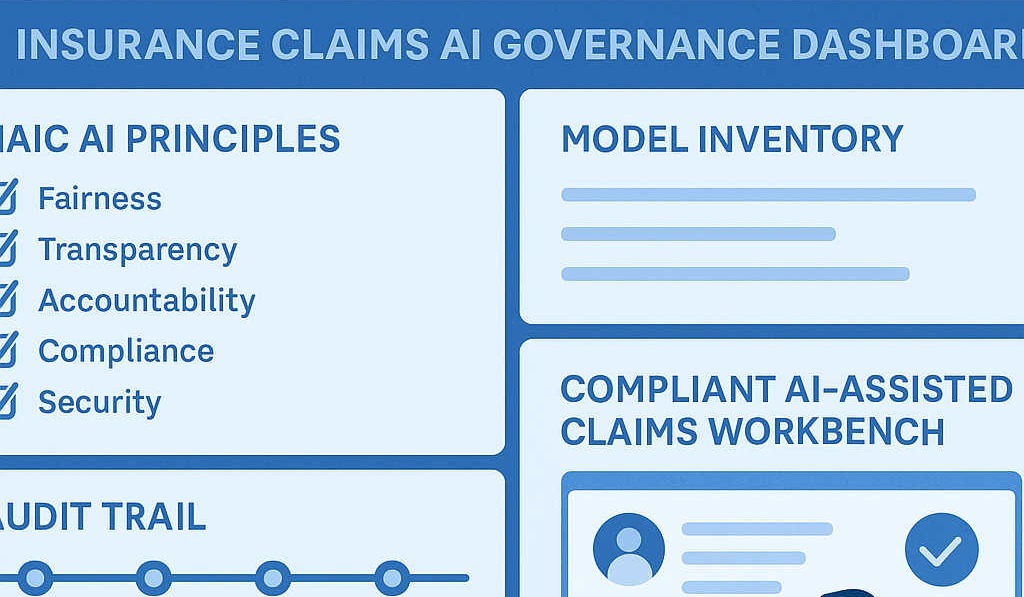
How U.S. carriers can design AI-assisted claims automation that aligns with NAIC AI guidance and passes audits.
Claims automation gets risky fast when speed outruns governance. The design goal is not simply faster intake or lower handling cost. The design goal is a claims workflow that can move quickly, keep humans firmly in charge at the right decision points, and produce evidence that stands up under internal audit, market conduct review, and board-level scrutiny.
That starts with scope. Carriers should separate low-risk operational tasks from regulated or judgment-heavy decisions before introducing AI into production. Summarizing adjuster notes, extracting loss details from FNOL documents, classifying incoming evidence, and drafting status updates are different from setting reserves, determining coverage, or denying a claim. When those boundaries are explicit, AI can operate as a copilot, not a black box, and the control framework becomes much easier to defend.
The next design choice is evidence. Every AI-assisted action in claims should be evidence-linked. If a model extracts a date of loss, flags a missing document, recommends a triage path, or drafts a claimant communication, the adjuster should be able to see exactly which source material supports that output. That means page-level references, structured confidence signals, validation against policy and claim data, and a record of what the human accepted, corrected, or rejected. Explanations should be clear and actionable, but they also need to be reconstructable later.
Carriers also need to treat governance as part of system design, not as a post-launch review step. NAIC guidance pushes insurers toward accountable governance, documented controls, and risk-based oversight for AI systems. In practice, that means documenting where AI is used in the claims lifecycle, who owns each decision boundary, what data sources are allowed, what model behaviors are tested before release, and what escalation path applies when outputs are uncertain or conflict with policy logic. If those controls live only in slide decks or committee notes, they will not hold up when the workflow is under stress.
Data lineage matters just as much as model quality. Claims teams work across policy systems, document repositories, email threads, photos, adjuster notes, vendor inputs, and external data sources. AI can help unify those signals, but only if the carrier can prove what data entered the workflow, what transformations were applied, and whether sensitive fields were masked, restricted, or excluded where required. That is especially important when claims operations rely on third-party administrators, outside counsel, catastrophe vendors, or cross-system handoffs that can introduce inconsistency.
A practical rollout usually starts with one narrow, auditable workflow. First notice of loss is often the best candidate because it is document-heavy, repetitive, and measurable. A carrier can instrument intake time, manual touch count, document completeness, routing accuracy, downstream rework, and adjuster override behavior before and after deployment. That creates a baseline for value and a baseline for control. Optionality is not free, but a staged rollout is usually cheaper than cleaning up a broad deployment that was never designed for auditability.
The operating model matters too. Claims leaders, legal, compliance, model risk, data teams, and frontline operations should all have defined roles before launch. Someone needs to own policy rules. Someone needs to own monitoring thresholds. Someone needs to decide when drift, error rates, or override patterns justify retraining, rollback, or tighter controls. Without that structure, AI issues get discovered too late, after bad outputs have already been operationalized.
The strongest claims automation programs do not frame success as “more automation.” They frame success as faster, more consistent, more evidence-linked execution with humans firmly in charge and trusted execution around every sensitive step. That is the difference between a demo that looks impressive and a production claims workflow that can survive scrutiny.
For U.S. carriers, the near-term opportunity is clear: start with bounded use cases, define decision rights early, require evidence-linked outputs, and instrument the workflow so compliance, operations, and audit can all see the same control story. When claims automation is designed that way, speed should not break compliance, and AI can improve throughput without weakening trust.